Clinical Scorecard: PsA may be linked to jaw limitations
At a Glance
| Category | Detail |
|---|---|
| Condition | Jaw functional limitation and sleep quality in psoriasis, with comparisons by psoriatic arthritis (PsA) status and systemic treatment. |
| Key Mechanisms | The study assessed associations; PsA status was independently associated with greater jaw functional limitation, while higher psoriasis severity was independently associated with poorer sleep quality. |
| Target Population | Adults with psoriasis, including patients with and without PsA, and age- and sex-matched healthy controls. |
| Care Setting | Single-center prospective, controlled cross-sectional study; findings are based on patient-reported questionnaires and do not establish treatment effects. |
Key Highlights
- Patients with PsA had higher mean JFLS-20 scores than patients without PsA (0.80 vs. 0.45); PsA remained independently associated with greater jaw limitation in adjusted analyses.
- Jaw limitation was not significantly greater in the overall psoriasis group than in healthy controls, and was concentrated among patients with PsA.
- Higher PASI scores were independently associated with poorer sleep quality; biologic treatment status was associated with better sleep quality in adjusted analyses.
- Poor sleep quality was reported by 60% of patients receiving no systemic therapy, 60% receiving nonbiologic systemic therapy, 7% receiving biologics, and 10% of controls.
- The cross-sectional design and differences in disease activity between treatment groups prevent conclusions that biologic treatment caused the observed differences.
Guideline-Based Recommendations
Diagnosis
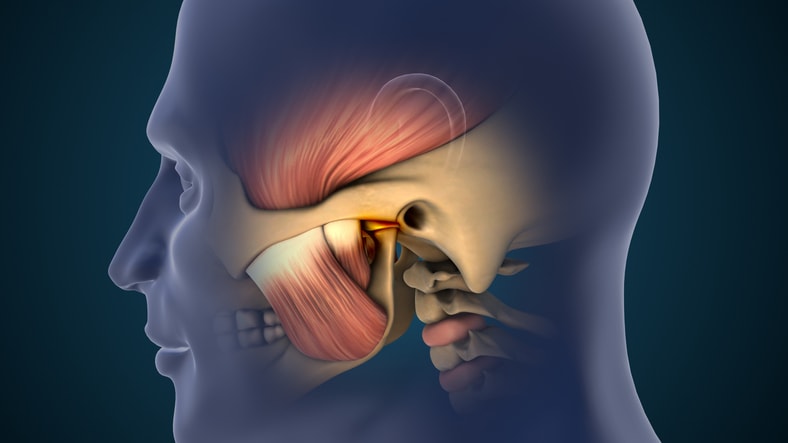
- Jaw function was assessed with the 20-item Jaw Functional Limitation Scale (JFLS-20), covering chewing, jaw mobility, speech, and facial expression.
- Sleep quality was assessed with the Pittsburgh Sleep Quality Index (PSQI); scores greater than 5 indicated poor sleep quality.
- Cutaneous disease severity was measured using the Psoriasis Area and Severity Index (PASI).
Management
- The study did not evaluate or recommend a treatment strategy for jaw limitation or poor sleep.
Monitoring & Follow-up
- The study used patient-reported questionnaires and did not include objective dental examinations, imaging, or sleep monitoring.
Risks
- The single-center cross-sectional design, relatively small sample, and patient-reported measures limit interpretation and generalizability.
- Biologic-treated patients had lower disease activity, complicating separation of treatment-related associations from disease severity or treatment response.
- The biologic cohort excluded tumor necrosis factor inhibitors; exploratory subgroup comparisons were not adjusted for multiple testing.
Patient & Prescribing Data
The study included 178 participants: 105 patients with psoriasis (42 receiving no systemic therapy, 20 receiving conventional nonbiologic systemic therapy, and 43 receiving IL-17- or IL-23-targeting biologics) and 73 age- and sex-matched controls. Among patients with psoriasis, 26 had PsA.
Biologic-treated patients had lower mean PASI and PSQI scores than patients in the other psoriasis treatment groups. Within the PsA subgroup, biologic-treated patients had lower mean jaw limitation and PSQI scores than those not receiving biologics, but these exploratory comparisons cannot establish a treatment effect. No significant differences between IL-17/IL-17A/F and IL-23 inhibitor groups were observed for psoriasis severity, jaw limitation, or sleep quality.
Clinical Best Practices
- Interpret the reported associations as cross-sectional findings rather than evidence of causation.
- Consider PsA status when interpreting jaw functional limitation in patients with psoriasis, as PsA was independently associated with higher JFLS-20 scores in this study.
- Account for psoriasis severity and treatment-group differences when interpreting sleep-quality comparisons.
Related Resources & Content
Based on findings from:
PsA may be linked to jaw limitations
Andrea Surnit. MDSpire News, 2026.
https://news.mdspire.com/dermatology/articles/psa-may-be-linked-to-jaw-limitations/
This content is an AI-generated, fully rewritten summary based on a published scholarly article. It does not reproduce the original text and is not a substitute for the original publication. Readers are encouraged to consult the source for full context, data, and methodology.