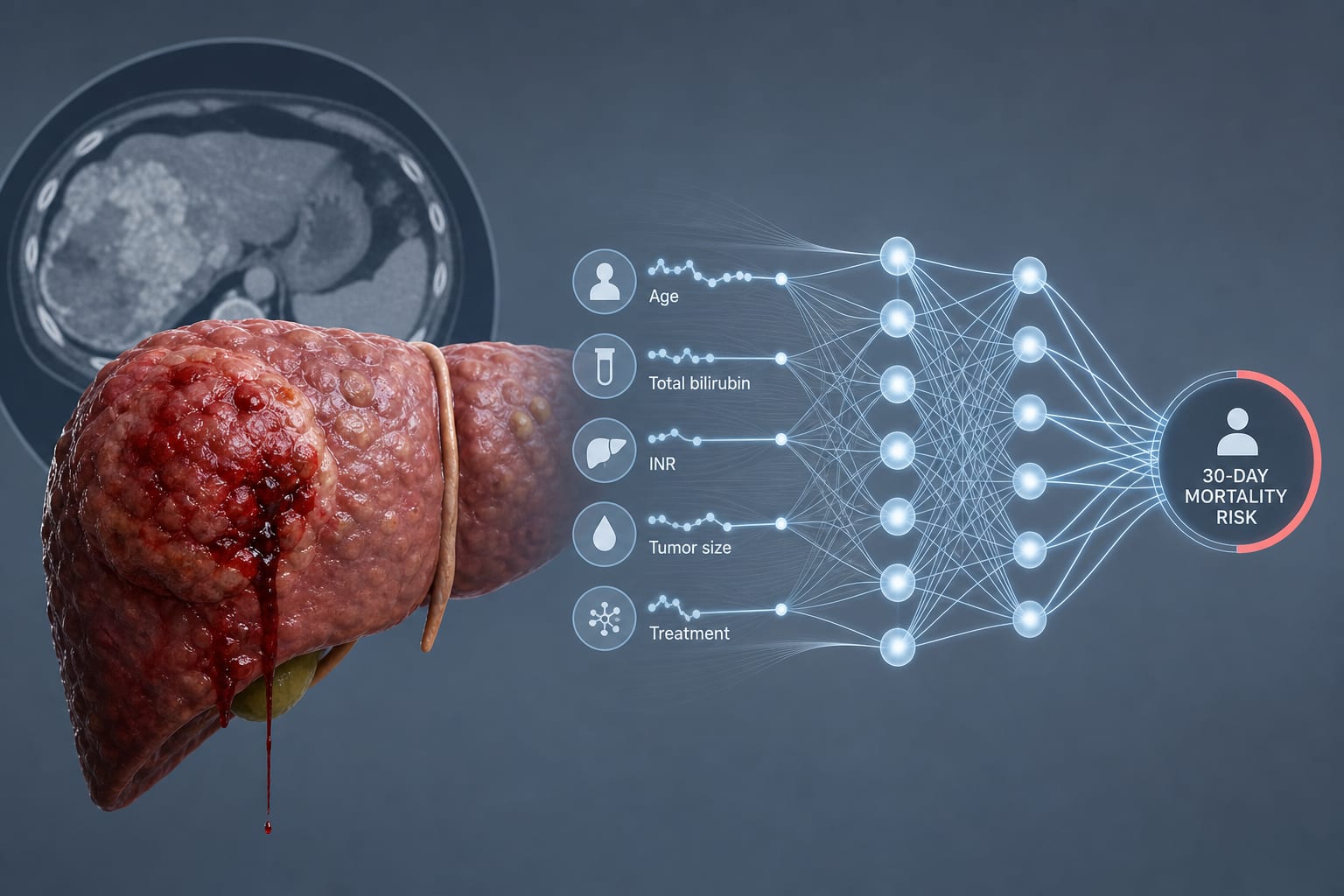
Machine learning prediction of 30-day all-cause mortality risk factors in HCC rupture
-
By
-
Shixiong Shi
-
Canbin Xie
-
Lin Long
-
June 23, 2026
-
Clinical Scorecard: Utilizing Machine Learning to Identify 30-Day Mortality Risk Factors in Patients with Ruptured Hepatocellular Carcinoma
At a Glance
| Category | Detail |
|---|
| Condition | Ruptured Hepatocellular Carcinoma |
| Key Mechanisms | Machine learning models predicting 30-day mortality based on clinical variables. |
| Target Population | Patients with newly diagnosed ruptured HCC in China. |
| Care Setting | Emergency management in a hospital setting. |
Key Highlights
- Decision tree model achieved sensitivity of 87.5% for predicting 30-day mortality.
- Key predictors identified include total bilirubin (TBIL) and INR.
- Nonlinear effects observed with TBIL > 40 μmol/L and INR > 2.5 significantly increasing mortality risk.
- Integration of TBIL and INR improved predictive accuracy (AUC = 0.87).
- Study emphasizes localized data for emergency management strategies.
Guideline-Based Recommendations
Diagnosis
- Diagnosis of HCC rupture based on clinical signs and imaging studies.
Management
- Utilization of machine learning models for risk assessment in emergency settings.
Monitoring & Follow-up
- Regular monitoring of TBIL and INR levels in patients with ruptured HCC.
Risks
- Increased mortality risk associated with elevated TBIL and INR levels.
Patient & Prescribing Data
Individuals with ruptured HCC treated at Hunan Provincial People's Hospital.
Focus on rapid assessment and intervention based on predictive modeling.
Clinical Best Practices
- Employ machine learning models for early mortality risk prediction.
- Assess TBIL and INR levels as critical indicators in patient management.
- Utilize SHAP analysis for understanding feature significance in predictive models.
Related Resources & Content