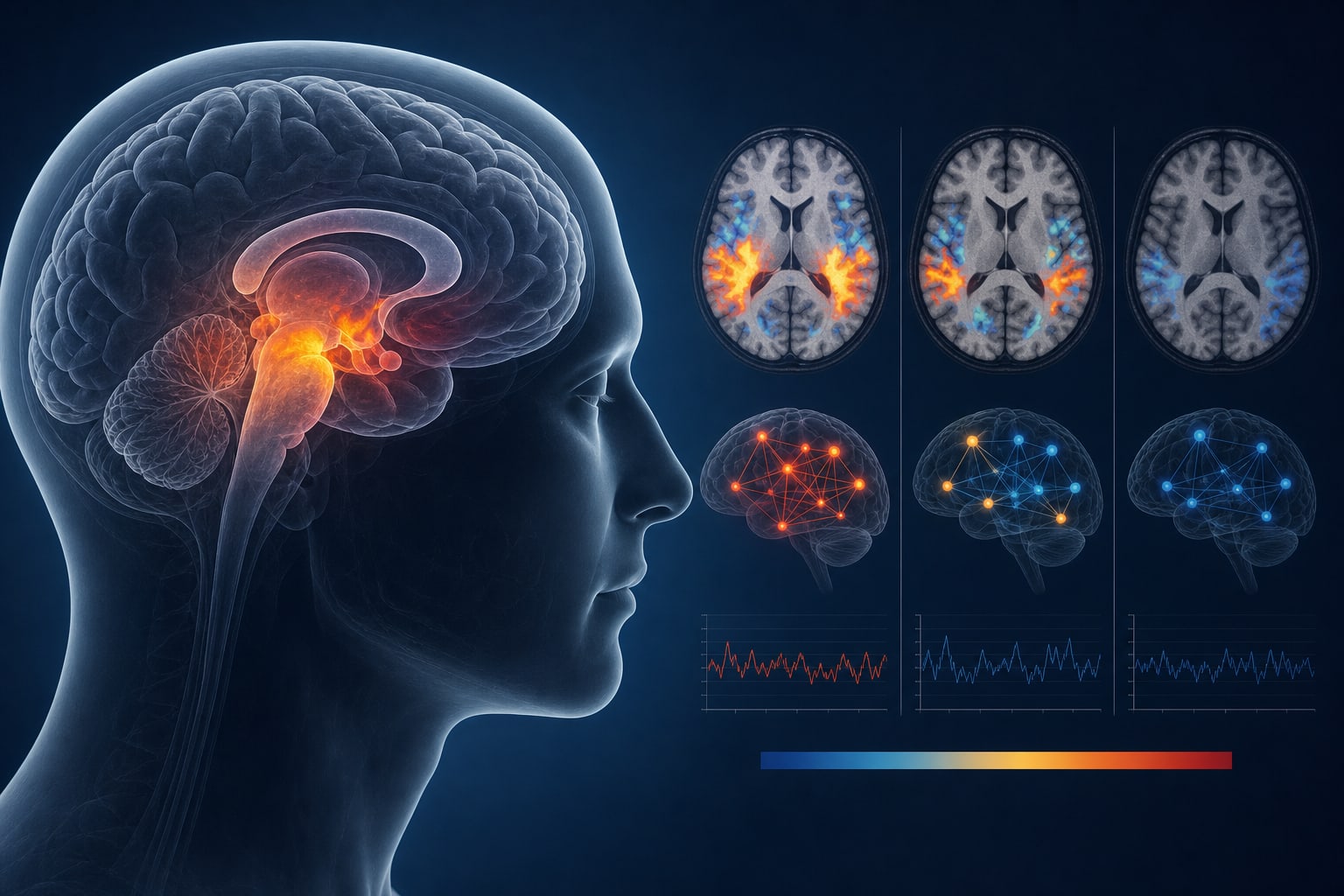
Functional Connectivity and Local Activity Variations in Patients with Distressing versus Non-Distressing Tinnitus Phenotypes During Resting State
By
Yongpeng Li
Lu Peng
Ying Lan
Binyu Mo
Shihua Yin
June 11, 2026
Clinical Scorecard: Functional Connectivity and Local Activity Variations in Patients with Distressing versus Non-Distressing Tinnitus Phenotypes During Resting State
At a Glance
Category Detail
Condition Tinnitus Key Mechanisms Resting-state functional connectivity, fractional amplitude of low-frequency fluctuations (fALFF), regional homogeneity (ReHo) Target Population Patients with bothersome tinnitus (BT), non-bothersome tinnitus (NBT), and non-tinnitus controls Care Setting Inpatient Department of Otolaryngology–Head and Neck Surgery
Key Highlights
Significant functional connectivity differences observed between BT and NBT groups. BT showed stronger connectivity than NBT but did not differ significantly from non-tinnitus controls. Lower ReHo values in NBT compared to both BT and controls. fALFF analyses indicated region-specific differences across multiple brain regions. Imaging differences may reflect tinnitus loudness or related clinical burden. Guideline-Based Recommendations
Diagnosis
Use Tinnitus Handicap Inventory (THI) scores to distinguish between BT (THI ≥ 30) and NBT (THI < 30). Management
Tailored clinical interventions for BT to mitigate distress and improve quality of life. Monitoring & Follow-up
Assess anxiety and depression symptoms using Self-Rating Anxiety Scale (SAS) and Self-Rating Depression Scale (SDS). Risks
Exclude patients with history of brain surgery, neurological disorders, left-handedness, severe psychiatric disorders. Patient & Prescribing Data
Patients with subjective tinnitus categorized into BT and NBT based on THI scores.
Clinical interventions should focus on the distress associated with BT rather than treating tinnitus as a single condition.
Clinical Best Practices
Conduct thorough clinical screening for tinnitus symptoms. Utilize neuroimaging to assess functional connectivity in tinnitus patients. Consider emotional and cognitive factors when evaluating tinnitus impact. Related Resources & Content