MERS-CoV in the Middle East and Africa: from surveillance gaps in humans and dromedary camels to One Health frameworks for spillover, prevention, research and response preparedness - Scorecard - MDSpire
Conexiant’s news site is now MDSpire News. Learn more
Advertisement
MERS-CoV in the Middle East and Africa: Addressing Surveillance Deficiencies in Humans and Dromedary Camels Through One Health Approaches for Spillover Prevention, Research, and Preparedness
Clinical Scorecard: MERS-CoV in the Middle East and Africa: Addressing Surveillance Deficiencies in Humans and Dromedary Camels Through One Health Approaches for Spillover Prevention, Research, and Preparedness
At a Glance
Category
Detail
Condition
Middle East respiratory syndrome coronavirus (MERS-CoV)
Key Mechanisms
Persistent enzootic circulation in dromedary camels, recurrent zoonotic spillover to humans, and potential healthcare-associated amplification after human infection.
Target Population
Camel-exposed populations and healthcare settings across the Middle East–Africa dromedary camel belt.
Care Setting
One Health (integrated human, animal, and environmental health) surveillance, public health preparedness, occupational health, and healthcare infection prevention and control.
Key Highlights
As of July 5, 2026, WHO had reported 2,637 laboratory-confirmed human MERS-CoV cases from 27 countries, including 965 deaths (36.6%).
Recognized human infection ranges from asymptomatic or mild respiratory illness to severe pneumonia, acute respiratory distress syndrome, renal impairment, multiorgan failure, and death.
The reported case-fatality proportion likely overestimates infection fatality because mild and asymptomatic infections are underdetected.
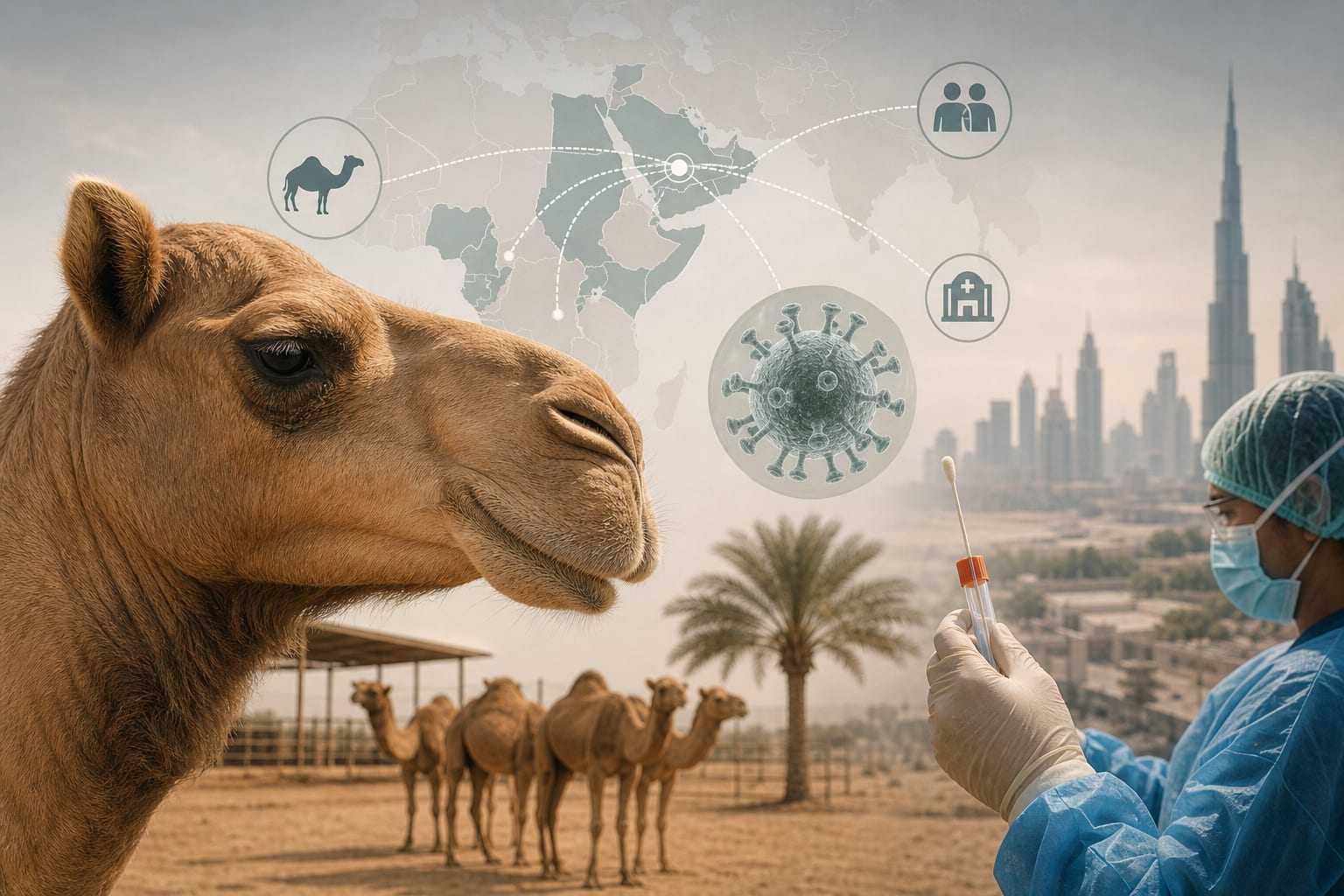
Dromedary camels are the principal reservoir for repeated zoonotic transmission of MERS-CoV to humans.
The “Africa paradox” refers to extensive evidence of MERS-CoV infection or exposure in African dromedaries despite very few PCR-confirmed human cases.
Guideline-Based Recommendations
Diagnosis
The authors propose sentinel MERS-CoV testing for severe acute respiratory infection, atypical pneumonia, unexplained respiratory deterioration, and healthcare-associated respiratory clusters, particularly where camel exposure is common.
Camel-exposure history should be incorporated into respiratory triage, and rapid MERS-CoV RT-PCR pathways should be available for suspected cases.
Management
Healthcare preparedness should include rapid isolation, appropriate personal protective equipment, respiratory protection, contact tracing, healthcare-worker monitoring, environmental cleaning, and infection prevention and control measures.
Clinical care remains supportive because no routinely deployed MERS-CoV-specific antiviral, monoclonal antibody, or licensed human vaccine is available for public-health use.
Monitoring & Follow-up
Surveillance should link camel PCR and serology with human respiratory surveillance, occupational cohorts, outbreak investigation, genomic sequencing, and shared human–animal data.
High-risk camel settings such as farms, markets, abattoirs, transport routes, and pastoralist systems should be included in ongoing surveillance.
Risks
Recurrent zoonotic spillover from dromedary camels remains a continuing risk.
Delayed recognition of human infection can permit healthcare-associated amplification and large outbreaks.
Patient & Prescribing Data
The review focuses on populations with potential MERS-CoV exposure, particularly people with occupational or other contact with dromedary camels and patients presenting with severe or atypical respiratory illness in camel-exposed regions.
No routinely deployed MERS-CoV-specific antiviral, monoclonal antibody, or licensed human vaccine is available for public-health use. Clinical care therefore remains supportive, while surveillance, early diagnosis, infection prevention and control, exposure reduction, contact tracing, and preparedness remain central public-health tools.
Clinical Best Practices
Integrate human, animal, occupational, clinical, environmental, and genomic surveillance within a One Health framework.
Record camel exposure when evaluating severe acute respiratory infection or atypical pneumonia in at-risk regions.
Maintain rapid diagnostic and healthcare infection prevention and control pathways for suspected MERS-CoV.
Strengthen reciprocal Middle Eastern and African leadership in surveillance, laboratory capacity, genomic analysis, research, data interpretation, and benefit sharing.
Related Resources & Content
Zumla A, Hui DS, Perlman S. “Middle East respiratory syndrome.” The Lancet. 2015;386(9997):995–1007.
Hui DS, Azhar EI, Kim YJ, Memish ZA, Oh MD, Zumla A. “Middle East respiratory syndrome coronavirus: risk factors and determinants of primary, household, and nosocomial transmission.” The Lancet Infectious Diseases. 2018;18(8):e217–e227.
Sikkema RS, Farag EABA, Islam M, Atta M, Reusken CBEM, Al-Hajri MM, et al. “Global status of Middle East respiratory syndrome coronavirus in dromedary camels: a systematic review.” Epidemiology and Infection. 2019;147:e84.
Azhar EI, Velavan TP, Rungsung I, Traore T, Hui DS, McCloskey B, et al. “Middle East respiratory syndrome coronavirus—a 10-year (2012–2022) global analysis of human and camel infections, genomic sequences, lineages, and geographical origins.” International Journal of Infectious Diseases. 2023;131:87–94.
Arabi YM, Asiri AY, Assiri AM, Balkhy HH, Al Bshabshe A, Al Jeraisy M, et al. “Interferon beta-1b and lopinavir–ritonavir for Middle East respiratory syndrome.” New England Journal of Medicine. 2020;383:1645–1656.
by Esam I. Azhar, Manaf Alqahtani, Abdullah M. Assiri, Seif S. Al-Abri, Tieble Traore, Francine Ntoumi, Moses Bockarie, Eskild Petersen, Giuseppe Ippolito, David S. Hui, Brian McCloskey, Stanley Perlman, Alimuddin Zumla
Research highlights expanding diagnostic capabilities but persistent gaps in antiviral therapy and vaccine coverage for pediatric enterovirus infections.