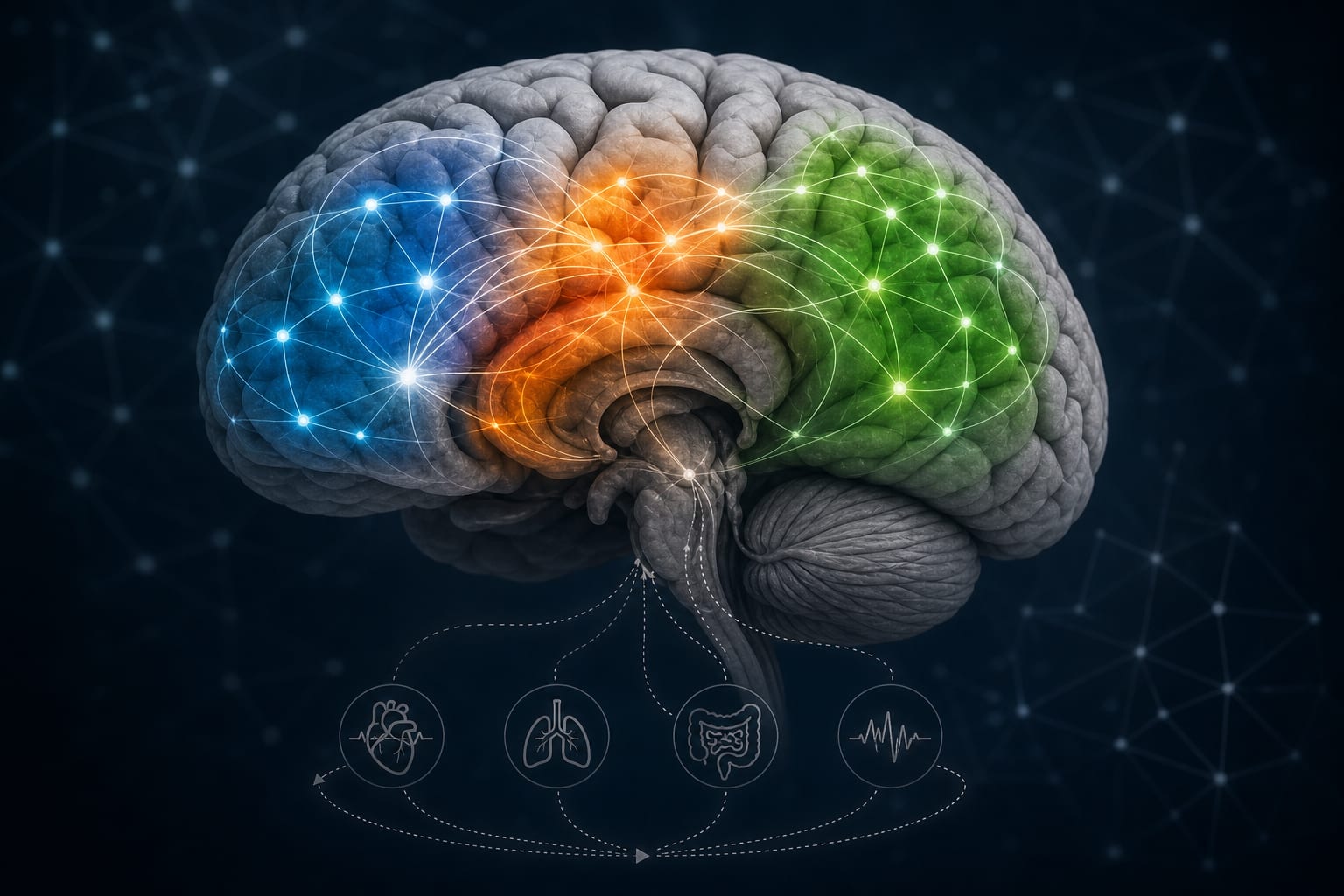
Chronic pain as a state-constrained brain network disorder: a dynamical systems model integrating physiological regulation and self-organisation
By
Tim Ho
Mark Ryan
June 22, 2026
Clinical Scorecard: Chronic Pain as a Disorder of Brain Network Dynamics: A Systems Model Incorporating Physiological Regulation and Self-Organization
At a Glance
Category Detail
Condition Chronic Pain
Key Mechanisms Alterations in salience network (SN), default mode network (DMN), and central executive network (CEN) dynamics.
Target Population Individuals with chronic pain.
Care Setting Neuroimaging and clinical neuroscience.
Key Highlights
Chronic pain is linked to disturbances in large-scale brain network organization. Physiological regulation influences brain network dynamics in chronic pain. The triple-network model integrates SN, DMN, and CEN interactions. Neuromodulatory interventions like rTMS may enhance network flexibility. Stable pain states may arise from self-organization of brain networks.
Guideline-Based Recommendations
Diagnosis
Assess alterations in SN, DMN, and CEN through neuroimaging.
Management
Consider multimodal treatment strategies that address physiological regulation.
Monitoring & Follow-up
Evaluate changes in brain network dynamics and physiological states over time.
Risks
Potential for persistent pain states due to dysregulated network interactions.
Patient & Prescribing Data
Individuals experiencing chronic pain.
Restoration of physiological regulation may be necessary for durable recovery.
Clinical Best Practices
Incorporate assessments of physiological regulation in chronic pain management. Utilize neuroimaging to understand brain network dynamics in patients. Explore neuromodulatory treatments to enhance network flexibility.
Related Resources & Content