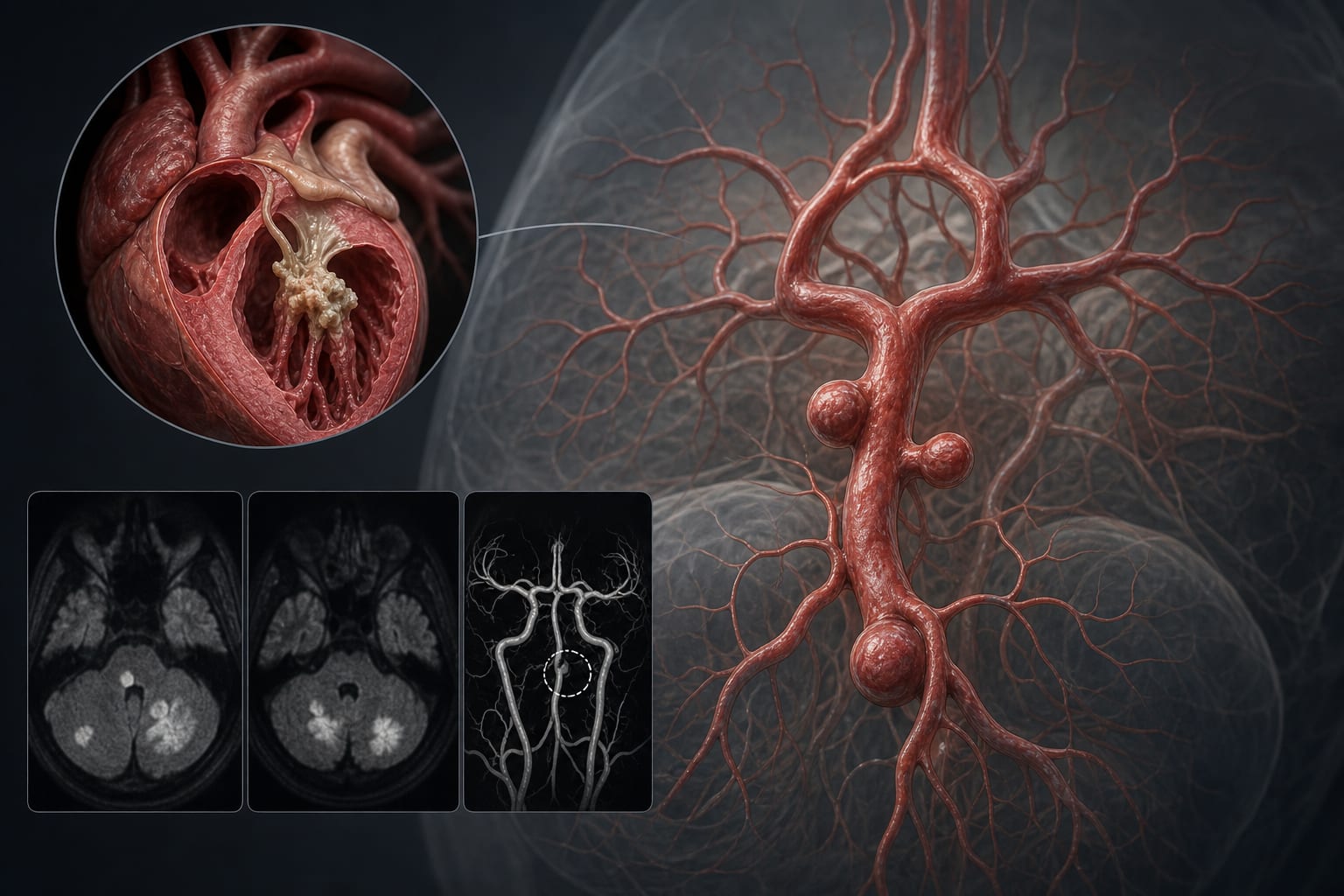
Case Report: Medical management of a rare infectious basilar artery aneurysm
By
Jie Wang
Yuhua Lv
Lihao Liu
June 4, 2026
Clinical Scorecard: Clinical Case Study: Conservative Treatment Approaches for a Rare Infectious Aneurysm of the Basilar Artery
At a Glance
Category Detail
Condition Infectious Basilar Artery Aneurysm Key Mechanisms Infective endocarditis leading to inflammatory embolization and aneurysm formation. Target Population Patients with systemic infections and neurological symptoms. Care Setting Emergency department and outpatient follow-up.
Key Highlights
Unruptured infectious basilar artery aneurysms can achieve complete resolution with conservative treatment. The case involved a 30-year-old male with infective endocarditis and multiple basilar artery aneurysms. Follow-up imaging showed complete resolution of aneurysms after conservative management. Cerebrovascular imaging is recommended for patients with systemic infection and neurological symptoms. Management strategies for infectious aneurysms must be individualized. Guideline-Based Recommendations
Diagnosis
Cerebrovascular imaging is recommended for patients with systemic infection and neurological symptoms. Management
Conservative medical therapy may be effective for unruptured infectious basilar artery aneurysms. Monitoring & Follow-up
Serial vascular assessments are advised to monitor aneurysm progression. Risks
Conservative management carries a mortality rate of 26.7%. Patient & Prescribing Data
A 30-year-old male with infective endocarditis and multiple aneurysms.
The patient was treated with aggressive anti-infective therapy and maintained on antiplatelet therapy.
Clinical Best Practices
Individualize management strategies for infectious aneurysms. Consider conservative treatment options for unruptured cases. Related Resources & Content