Reply: Data Interpretation and Temporal Risk of Semaglutide-Associated NAION
-
By
-
Kent R. Heberer
-
Adam P. Bress
-
Jennifer S. Lee
-
October 1, 2026
Clinical Scorecard: Reply: Data Interpretation and Temporal Risk of Semaglutide-Associated NAION
At a Glance
| Category | Detail |
|---|---|
| Condition | Nonarteritic anterior ischemic optic neuropathy (NAION) associated with semaglutide |
| Key Mechanisms | The reply addresses risk estimation, censoring, proportional hazards, and potential NAION misclassification in electronic health record data; it does not describe a biological mechanism. |
| Target Population | Patients initiating semaglutide, considered in comparison with patients receiving sodium-glucose cotransporter-2 inhibitors (SGLT2i). |
| Care Setting | Clinical counseling about rare NAION risk following semaglutide initiation, informed by observational cohort analyses. |
Key Highlights
- The authors report that the at-risk table reconciles to the full SGLT2i cohort at day 0, including patients censored on day 0.
- Censoring included deaths, prespecified competing events, and end of follow-up; the authors report no indication that censoring was informative regarding treatment.
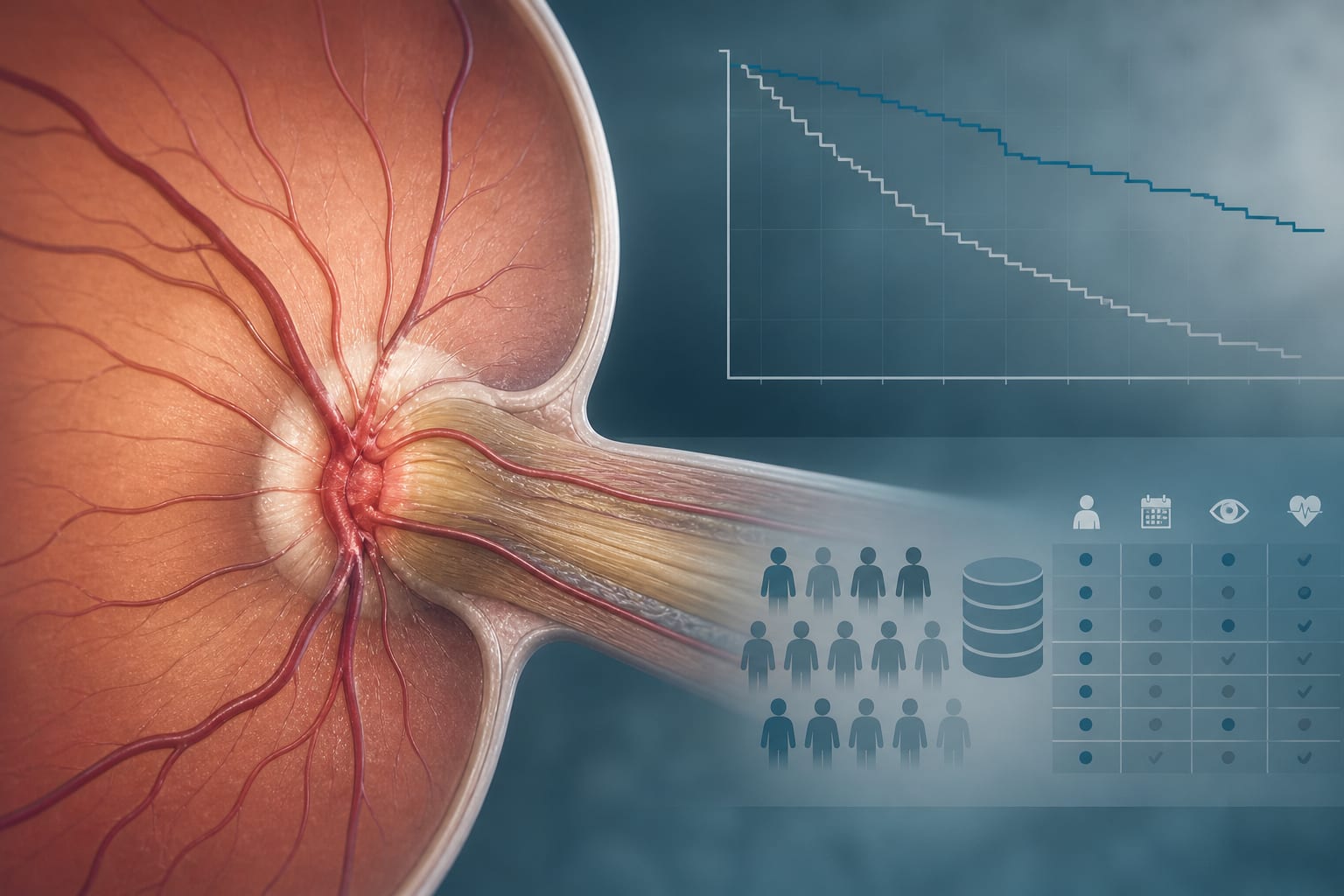
- Cause-specific treatment hazard ratios were 1.78 (95% CI, 0.90-3.51) in year 1 and 2.93 (95% CI, 1.75-4.91) thereafter; the between-period contrast was not significant (P=.25).
- Scaled Schoenfeld residuals showed no detected temporal trend (χ²₁=0.084; P=.77), supporting interpretation of the reported hazard ratio as an effect summary across follow-up.
- The authors report an approximately 74.5% positive predictive value for the ICD-10 algorithm used to identify NAION and state that misclassification did not appear to vary by treatment group.
Guideline-Based Recommendations
Diagnosis
- The reply describes NAION identification using an International Statistical Classification of Diseases and Related Health Problems, Tenth Revision (ICD-10) algorithm in electronic health record data.
Management
- The authors state that consideration should be given to counseling patients about the rare risk of NAION following semaglutide initiation.
Monitoring & Follow-up
- The reply reports assessment of proportional hazards using separate cause-specific hazard ratios for year 1 and later follow-up, and scaled Schoenfeld residuals.
Risks
- The authors characterize the absolute risk of NAION as low but describe it as an evident risk following semaglutide initiation.
- The NAION coding algorithm had an approximately 74.5% positive predictive value; the authors state that nondifferential misclassification would bias the hazard ratio toward the null.
Patient & Prescribing Data
Patients initiating semaglutide, compared with an SGLT2i group in the reported observational analyses.
The authors recommend considering counseling about the rare NAION risk after semaglutide initiation; the reply provides no absolute event rate.
Clinical Best Practices
- When interpreting the reported risk estimates, account for the study’s convention that numbers at risk refer to the time immediately before each time point, while cumulative events and censoring include occurrences through that time point.
- Consider the authors’ reported checks of proportional hazards and their interpretation of the hazard ratio as an effect summary averaged across follow-up.
- Recognize the stated limitations of administrative coding for NAION and the authors’ assessment that misclassification did not vary by treatment group.
- Consider counseling patients about the rare NAION risk following semaglutide initiation, as stated by the authors.
Related Resources & Content
Based on findings from:
Data and Temporal Risk Concerns of Semaglutide and NAION—Reply
Kent R. Heberer, Adam P. Bress, Jennifer S. Lee. Jama Ophthalmology, 2026.
https://jamanetwork.com/journals/jamaophthalmology/fullarticle/2853327
This content is an AI-generated, fully rewritten summary based on a published scholarly article. It does not reproduce the original text and is not a substitute for the original publication. Readers are encouraged to consult the source for full context, data, and methodology.