Predictive models for the occurrence of expansive intracranial hematomas and outcomes after surgical evacuation in patients with traumatic brain injury in Uganda: a prospective cohort study - Scorecard - MDSpire
Conexiant’s news site is now MDSpire News. Learn more
Advertisement
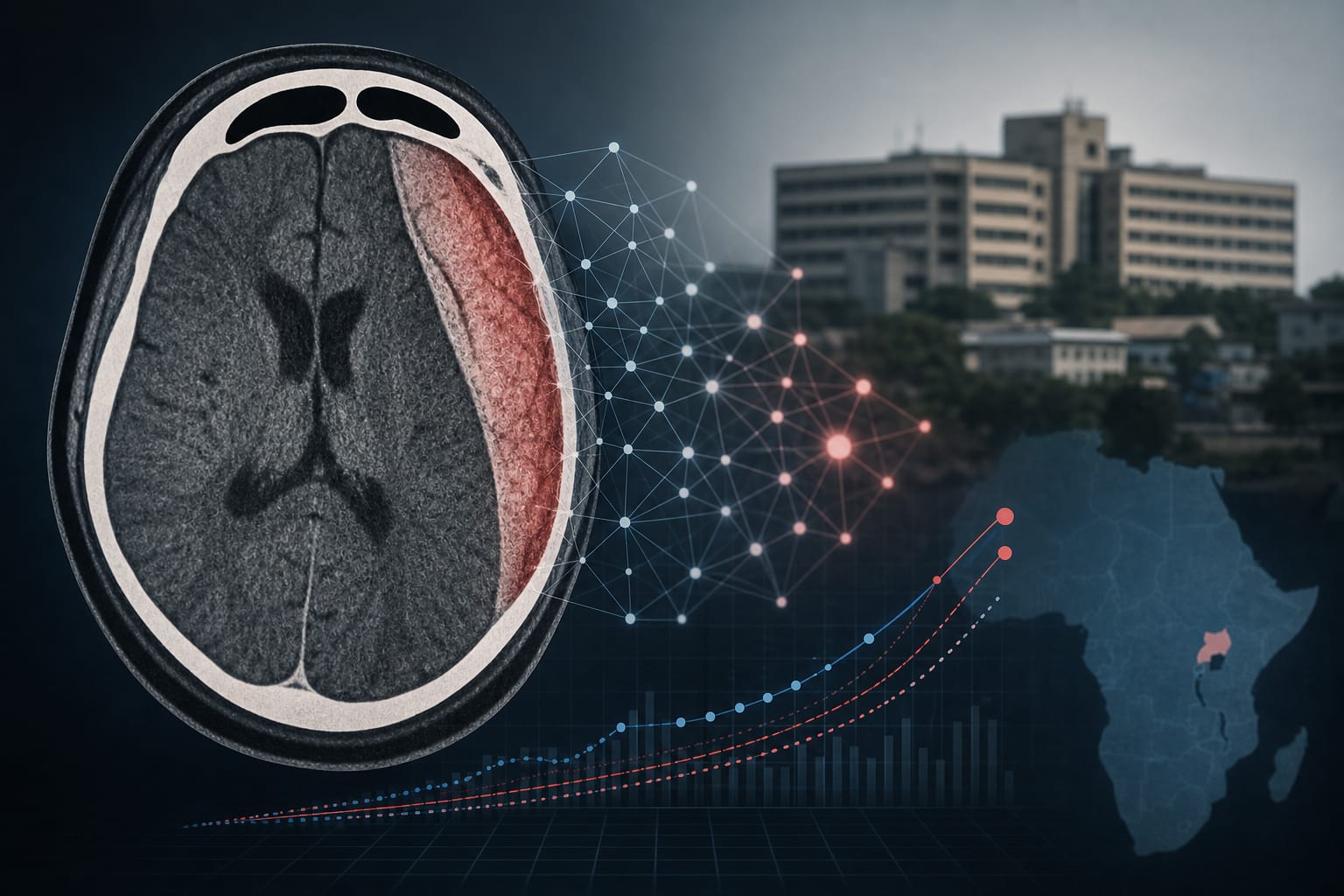
Exploratory Predictive Models for Expansive Intracranial Hematoma Development and Surgical Outcomes in Traumatic Brain Injury Patients in Uganda: A Prospective Cohort Analysis
Clinical Scorecard: Exploratory Predictive Models for Expansive Intracranial Hematoma Development and Surgical Outcomes in Traumatic Brain Injury Patients in Uganda: A Prospective Cohort Analysis
At a Glance
Category
Detail
Condition
Expansive Intracranial Hematoma (EIH)
Key Mechanisms
Hematoma growth exceeding 33% or an absolute increase of more than 6 mL during the 72 h following injury.
Target Population
Adults with traumatic brain injury (TBI) in Uganda.
Care Setting
Prospective cohort study at Mulago National Referral Hospital.
Key Highlights
59.3% of patients experienced EIH.
EIH was associated with worse quality-of-life measures at postoperative months 3 and 6.
The Firth bias-reduced model showed an AUC of 0.854 for EIH prediction.
Penalized logistic models performed comparably to random forest in predictive accuracy.
Exploratory models require external multicenter validation before clinical implementation.
Guideline-Based Recommendations
Diagnosis
Use serial non-contrast computed tomography to assess hematoma expansion.
Management
Consider clinical and radiological variables for early identification of EIH risk.
Monitoring & Follow-up
Monitor postoperative outcomes and quality-of-life measures in patients with EIH.
Risks
EIH can lead to mass effect, elevated intracranial pressure, and unfavorable functional recovery.
Patient & Prescribing Data
Adults with traumatic brain injury (TBI) in low-resource settings.
Exploratory predictive models can aid in identifying patients at risk for EIH.
Clinical Best Practices
Incorporate neurological examination findings and Glasgow Coma Scale scores in assessments.
Utilize machine learning approaches for complex predictive modeling in TBI.
by Larrey Kasereka Kamabu, Godfrey S. Bbosa, Ronald Oboth, Ssenyondwa John Baptist, Martin N. Kaddumukasa, Daniel Deng, Hervé Monka Lekuya, Louange Maha Kataka, Joel Kiryabwire, Moses Galukande, Martha Sajatovic, Mark Kaddumukasa, Anthony T. Fuller, Michael M. Haglund
The largest study of former National Football League players found excess persisted even after accounting for the lower overall mortality associated with elite athletic participation.