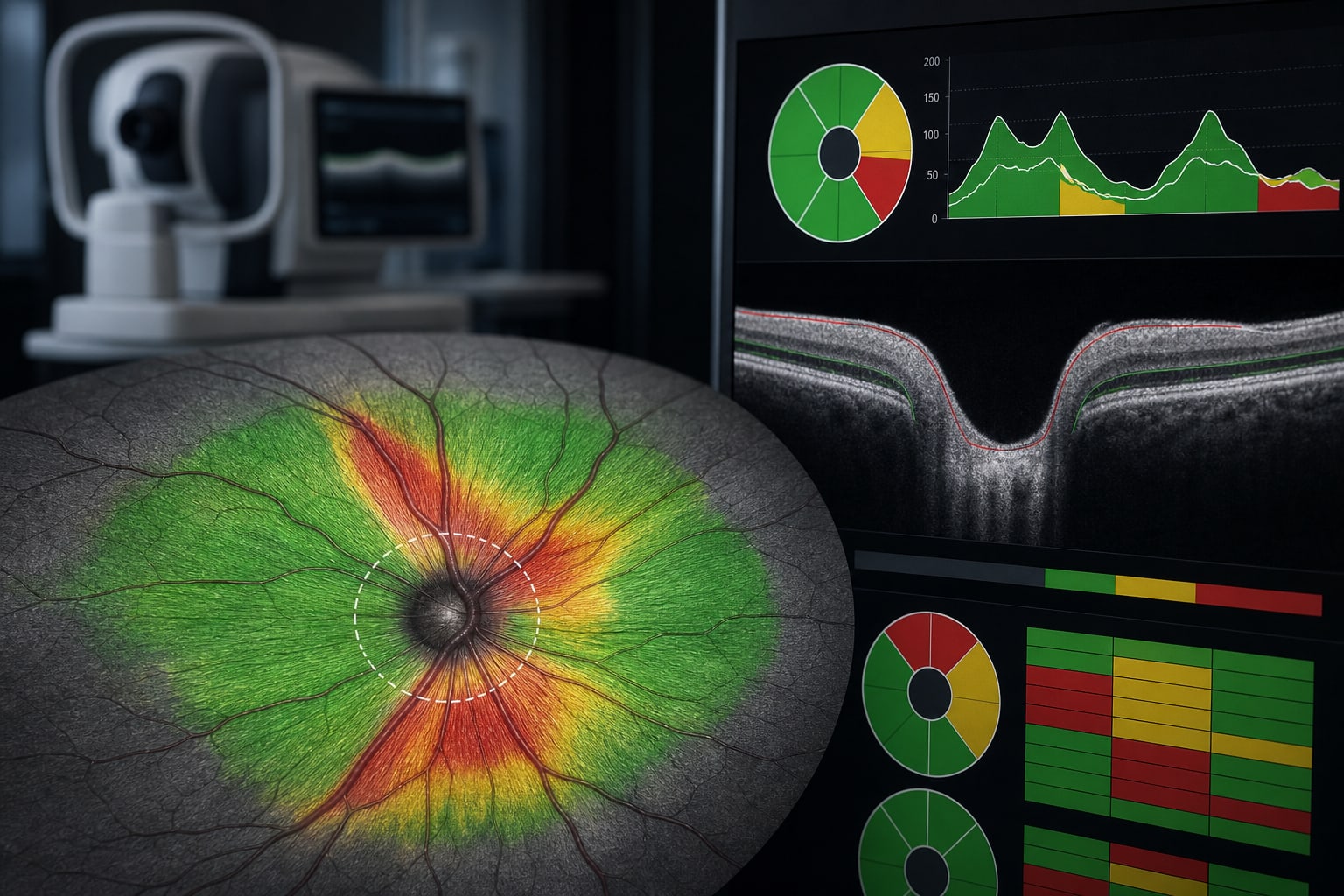
Color-Coded OCT RNFL Analysis in Glaucoma Diagnosis: Risks of Overdependence on Red-Green Indicators
-
By
-
Venkata S. Jonnakuti
-
Misha F. Syed
-
Praveena Gupta
-
June 10, 2026
Clinical Scorecard: Color-Coded OCT RNFL Analysis in Glaucoma Diagnosis: Risks of Overdependence on Red-Green Indicators
At a Glance
| Category | Detail |
|---|
| Condition | Glaucoma |
| Key Mechanisms | Optical coherence tomography (OCT) color-coded neuroretinal rim and peripapillary retinal nerve fibre layer (RNFL) maps. |
| Target Population | Patients undergoing glaucoma and neuro-ophthalmic care. |
| Care Setting | Clinical practice involving glaucoma specialists. |
Key Highlights
- Color-coded RNFL maps are derived from limited normative datasets.
- Diverse demographic representation is lacking in existing reference populations.
- Physiological differences can lead to misclassification of healthy eyes.
- OCT outputs should be interpreted as statistical summaries, not categorical diagnoses.
- Longitudinal assessment and multi-modal correlation are recommended for accurate interpretation.
Guideline-Based Recommendations
Diagnosis
- Integrate OCT data with optic disc appearance and functional testing.
Management
- Educate clinicians on the limitations of color-coded RNFL maps.
Monitoring & Follow-up
- Use longitudinal assessment and inter-eye symmetry for reliable OCT interpretation.
Risks
- Over-reliance on automated outputs can mislead diagnosis.
Patient & Prescribing Data
Patients with glaucoma or at risk for glaucoma, including those with high myopia or under-represented ancestries.
Consider individual anatomical variations when interpreting OCT results.
Clinical Best Practices
- Encourage transparency about the normative dataset used in OCT reports.
- Promote the use of diverse and large-scale normative datasets for OCT interpretation.
- Implement algorithmic fairness audits for OCT outputs.
Related Resources & Content