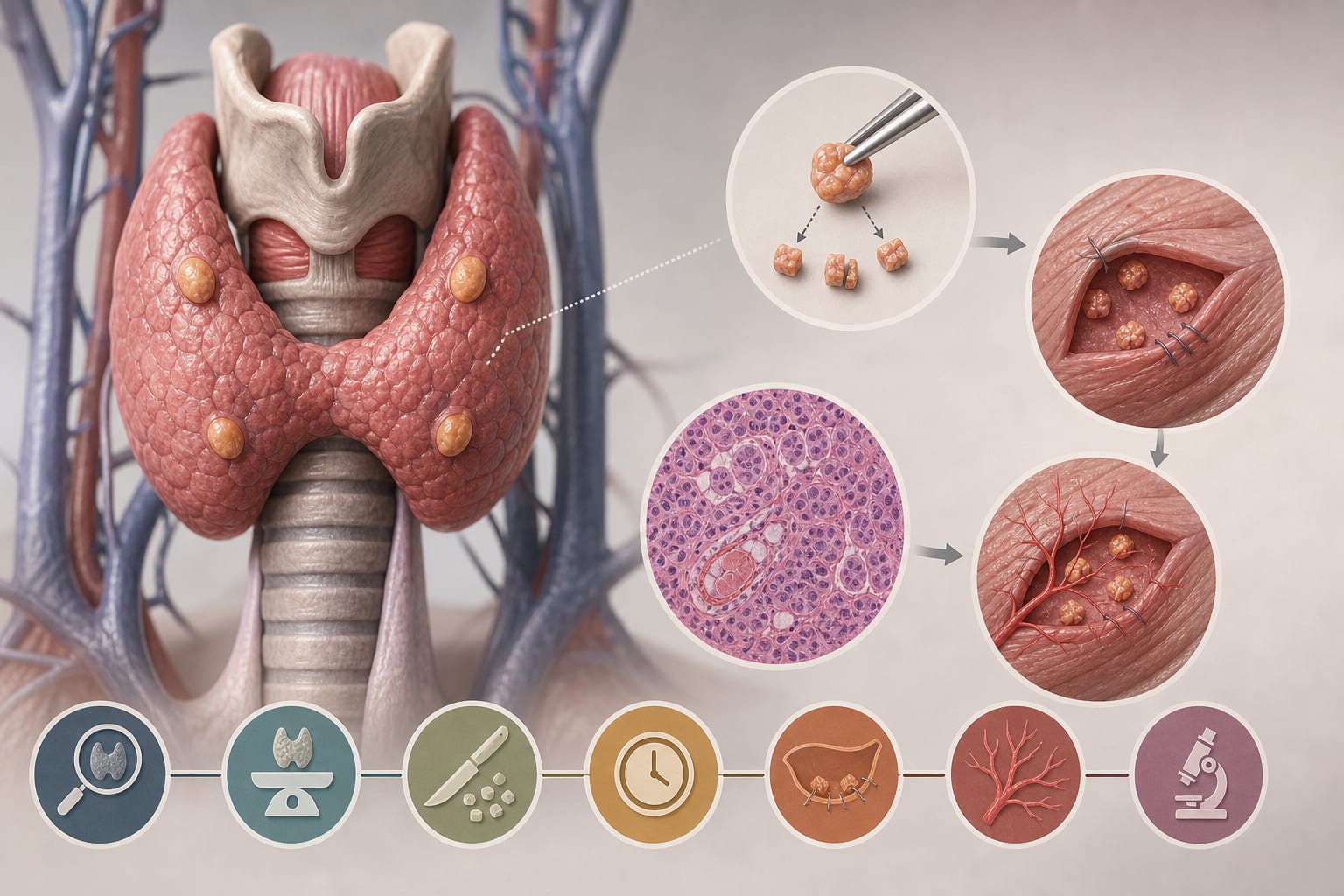
Parathyroid autotransplantation: a phase-based framework for surgical decision-making
-
By
-
Hanyun Tu
-
Yuhan Jiang
-
Tianyuchen Jiang
-
Yi Yang
-
Anping Su
-
July 9, 2026
-
Clinical Scorecard: A Framework for Surgical Decision-Making in Parathyroid Autotransplantation Based on Phases
At a Glance
| Category | Detail |
|---|
| Condition | Parathyroid Autotransplantation |
| Key Mechanisms | Involves excising parathyroid tissue and transplanting it to a new site to prevent or treat hypoparathyroidism. |
| Target Population | Individuals undergoing neck surgeries at risk of hypoparathyroidism. |
| Care Setting | Surgical settings involving thyroidectomy and management of hyperparathyroidism. |
Key Highlights
- PAT is crucial for preventing and treating hypoparathyroidism.
- Success depends on multiple surgical decisions and the regenerative capacity of parathyroid cells.
- A structured, phase-based framework guides surgical decision-making.
- Intraoperative identification and evaluation of parathyroid glands are essential for success.
- Personalized surgical strategies are required based on individual patient characteristics.
Guideline-Based Recommendations
Diagnosis
- Accurate intraoperative identification of parathyroid glands is essential.
Management
- Decisions on the quantity of tissue to transplant and timing (immediate vs. delayed) are critical.
Monitoring & Follow-up
- Postoperative evaluation of autograft function is necessary.
Risks
- Inadvertent injury or devascularization of parathyroid glands during surgery can lead to hypoparathyroidism.
Patient & Prescribing Data
Patients undergoing surgeries that may affect parathyroid glands.
PAT is widely applied across various surgical indications, including thyroidectomy and management of hyperparathyroidism.
Clinical Best Practices
- Utilize visual recognition and anatomical knowledge for intraoperative identification of parathyroid glands.
- Assess gland viability through color changes and capsule bleeding during surgery.
- Consider individual patient characteristics when planning PAT.
Related Resources & Content