Clinical Scorecard: Creation of a virtual surgical platform for maxillofacial procedures utilizing biomechanical characteristics of facial soft tissue
At a Glance
Category
Detail
Condition
Maxillofacial soft tissue surgery requiring precise incisions
Key Mechanisms
Biomechanical modeling of facial soft tissue with real-time deformation and haptic feedback in a virtual reality platform
Target Population
Maxillofacial surgeons and surgical trainees
Care Setting
Surgical training and preoperative planning environments
Key Highlights
Facial soft tissue exhibits complex biomechanical properties including nonlinearity, anisotropy, and viscoelasticity, complicating surgical simulation.
A haptics-enabled virtual surgical system was developed incorporating biomechanical force models based on experimental cadaver data to simulate incision-making.
Hybrid modeling techniques and collision detection algorithms enable real-time deformation and tactile feedback for improved surgical training.
Guideline-Based Recommendations
Diagnosis
Use high-resolution craniofacial CT and 3D photogrammetry to construct accurate anatomical models for simulation.
Management
Incorporate biomechanical parameters from experimental data into virtual soft tissue models to enhance realism.
Employ haptic devices to provide tactile feedback during virtual incision simulation.
Monitoring & Follow-up
Continuously evaluate deformation and force feedback accuracy during simulation to ensure realistic training experience.
Risks
Traditional training methods have limited resources and opportunities, potentially delaying skill acquisition.
Inaccurate modeling or feedback may impair surgical skill development.
Patient & Prescribing Data
Patients with dento-maxillofacial deformities used as data sources for model construction
Patient-specific anatomical and biomechanical data improve the fidelity of virtual surgical simulations.
Clinical Best Practices
Segment multiple facial soft tissue layers and skeletal structures accurately using CT and photogrammetry data.
Use hybrid mesh and point cloud models to balance deformation accuracy and computational efficiency.
Incorporate experimentally derived cutting force data for authentic haptic rendering.
Utilize open-source toolkits and haptic devices to build flexible and interactive virtual surgical platforms.
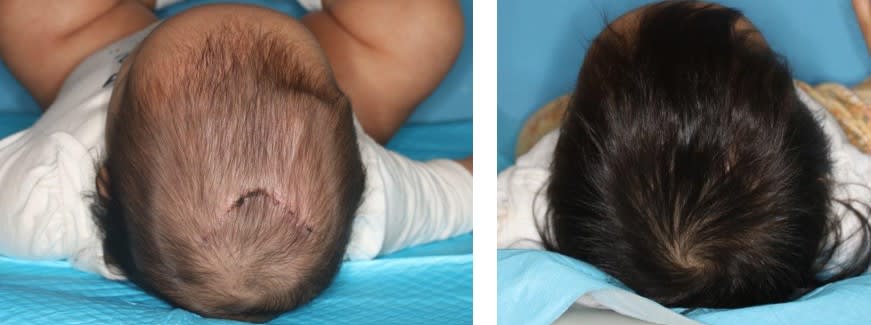
In our cohort of non-syndromic sagittal synostosis treated with SMC, 33% of patients was found to have UCS in the early postoperative period on CT imaging.