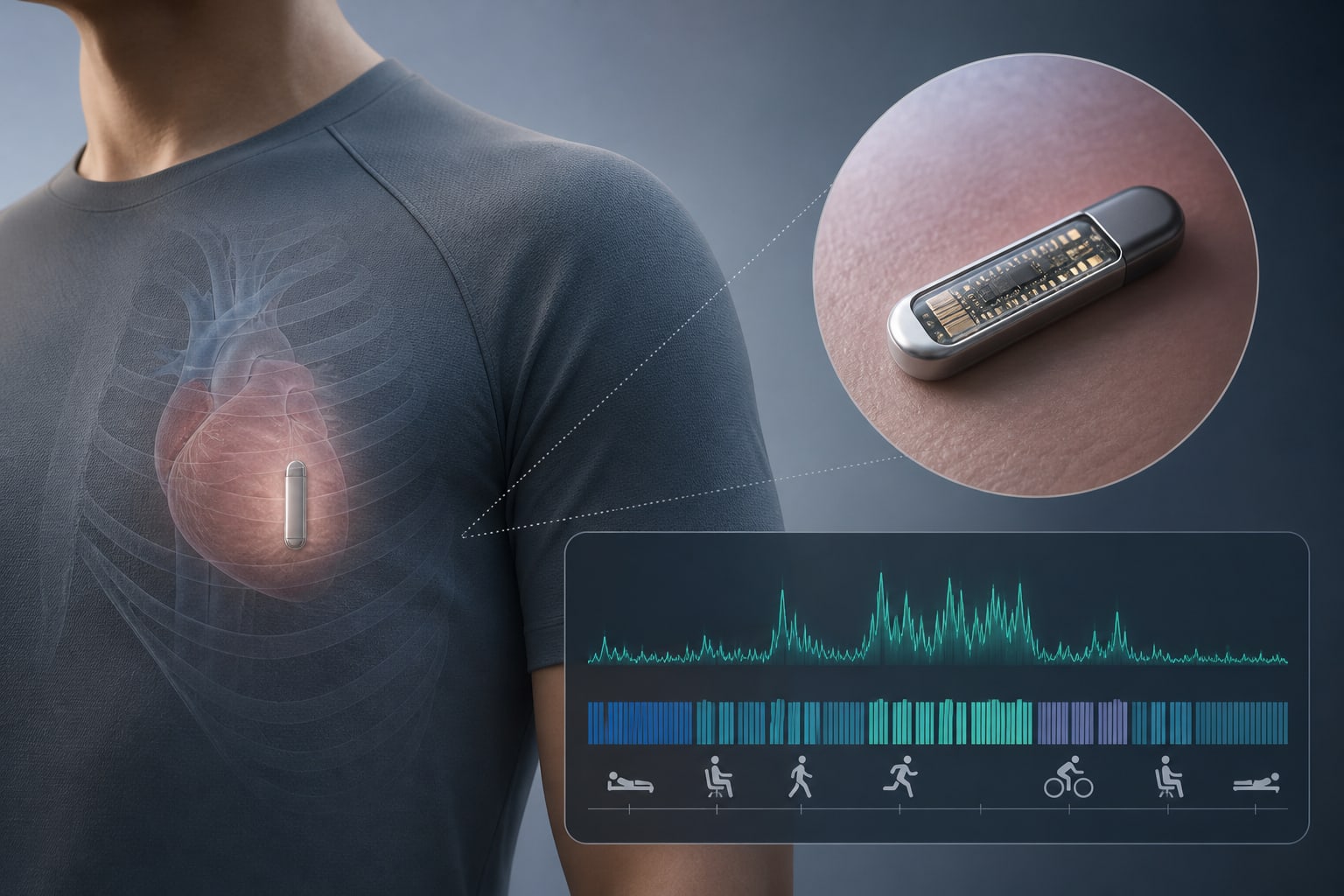
Accelerometer-Based Activity Sensing by an Insertable Cardiac Monitor In Ambulatory Patients: A Subanalysis of LUX-Dx TRENDS (LUX-Dx Heart Failure Sensors in an Insertable Cardiac Monitor System Clinical Study) - Scorecard - MDSpire
Conexiant’s news site is now MDSpire News. Learn more
Advertisement
Activity Monitoring With an Insertable Cardiac Monitor in Ambulatory Patients: Subanalysis of the LUX-Dx TRENDS Clinical Study of Heart Failure Sensors
Clinical Scorecard: Activity Monitoring With an Insertable Cardiac Monitor in Ambulatory Patients: Subanalysis of the LUX-Dx TRENDS Clinical Study of Heart Failure Sensors
At a Glance
Category
Detail
Condition
Activity monitoring using an insertable cardiac monitor (ICM) in ambulatory patients with heart failure.
Key Mechanisms
An embedded accelerometer detects the frequency and amplitude of patient motion. A proprietary algorithm uses a device-programmed threshold to classify activity as active or not active.
Target Population
Adults with New York Heart Association class II or III heart failure across the spectrum of left ventricular ejection fraction who are considered suitable for exercise testing.
Care Setting
Multicenter US clinical study; exercise assessments occur at the 30–90-day postimplant visit and include stationary postures and progressively faster treadmill stages.
Key Highlights
The exercise substudy includes 104 participants at 26 US sites; 101 contribute to the 2 analysis datasets, and 3 do not contribute because device data are unavailable.
Accelerometer activity signals increase by an estimated 33.7 mG per 1-mph increase in treadmill walking speed in dataset 1 and 32.3 mG in dataset 2; both associations have P < .0001.
In dataset 2, activity-classification agreement with the prespecified reference standard is κ = 0.971 (95% CI, 0.947–0.985), exceeding the prespecified goal of κ > 0.8.
Sensitivity is 0.974, specificity is 0.994, positive predictive value is 0.991, and negative predictive value is 0.982.
Guideline-Based Recommendations
Diagnosis
The article does not provide guideline-based diagnostic recommendations. It evaluates activity sensing and classification using an investigational ICM.
Management
The study does not establish treatment recommendations. The authors identify real-world applications for detection, risk stratification, and patient management as areas for future research.
Monitoring & Follow-up
The findings support the potential for subcutaneous devices to provide objective activity measurements in ambulatory patients with ICMs. The article does not establish a clinical follow-up schedule.
Risks
Treadmill testing continues until predefined safety stopping criteria are met or participants reach physical tolerance limits.
External mechanical vibration may mimic patient motion and produce false-positive activity classifications.
Patient & Prescribing Data
Participants have a mean age of 69.6 years; 33% are women. Left ventricular ejection fraction is preserved in 63%, moderately reduced in 19%, and reduced in 18%. This subanalysis evaluates activity-monitoring performance rather than medication effects and does not provide prescribing recommendations.
Clinical Best Practices
Interpret the findings within the controlled testing conditions and prespecified reference standard: treadmill walking at ≥1.2 mph is active, and stationary postures are inactive.
The primary analysis excludes walking at 0.7 mph because intermittent walking may introduce classification ambiguity. The performance goal remains met when sensitivity analyses classify this stage as active or inactive.
Consider the study’s limitations: other activities are not studied, selection may exclude frailer or gait-limited patients, and performance is not evaluated within patient subgroups.
Related Resources & Content
Kadhiresan VA, Pastore J, Auricchio A, et al. A novel method—the activity log index—for monitoring physical activity of patients with heart failure. Am J Cardiol. 2002;89:1435–1437.
Richards M, Olshansky B, Sharma AD, et al. Addition of minute ventilation to rate-response pacing improves heart rate score more than accelerometer alone. Heart Rhythm. 2018;15:1730–1735.
Stansfield B, Hajarnis M, Sudarshan R. Characteristics of very slow stepping in healthy adults and validity of the activPAL3 activity monitor in detecting these steps. Med Eng Phys. 2015;37:42–47.
Frodi DM, Kolk MZH, Langford J, et al. Long-term adherence to a wearable for continuous behavioural activity measuring in the SafeHeart implantable cardioverter defibrillator population. Eur Heart J Digit Health. 2024;5:622–632.
Kolk MZH, Frodi DM, Andersen TO, et al. Accelerometer-assessed physical behavior and the association with clinical outcomes in implantable cardioverter-defibrillator recipients: a systematic review. Cardiovasc Digit Health J. 2022;3:46–55.
Singh B, Chastin S, Miatke A, et al. Real-world accuracy of wearable activity trackers for detecting medical conditions: systematic review and meta-analysis. JMIR Mhealth Uhealth. 2024;12:e56972.
by ANDREW J. SAUER, E. MATTHEW QUIN, KARAN BHALLA, SASHI ADIGOPULA, BIN MI, EMILY THOMPSON, DEEPA MAHAJAN, MING DUANMU, CRAIG M. STOLEN, MOLLY E. KUPFER, ALYSIA ROSNER, SELÇUK ADABAG, SCOTT D. SOLOMON, ELAINE Y. WAN