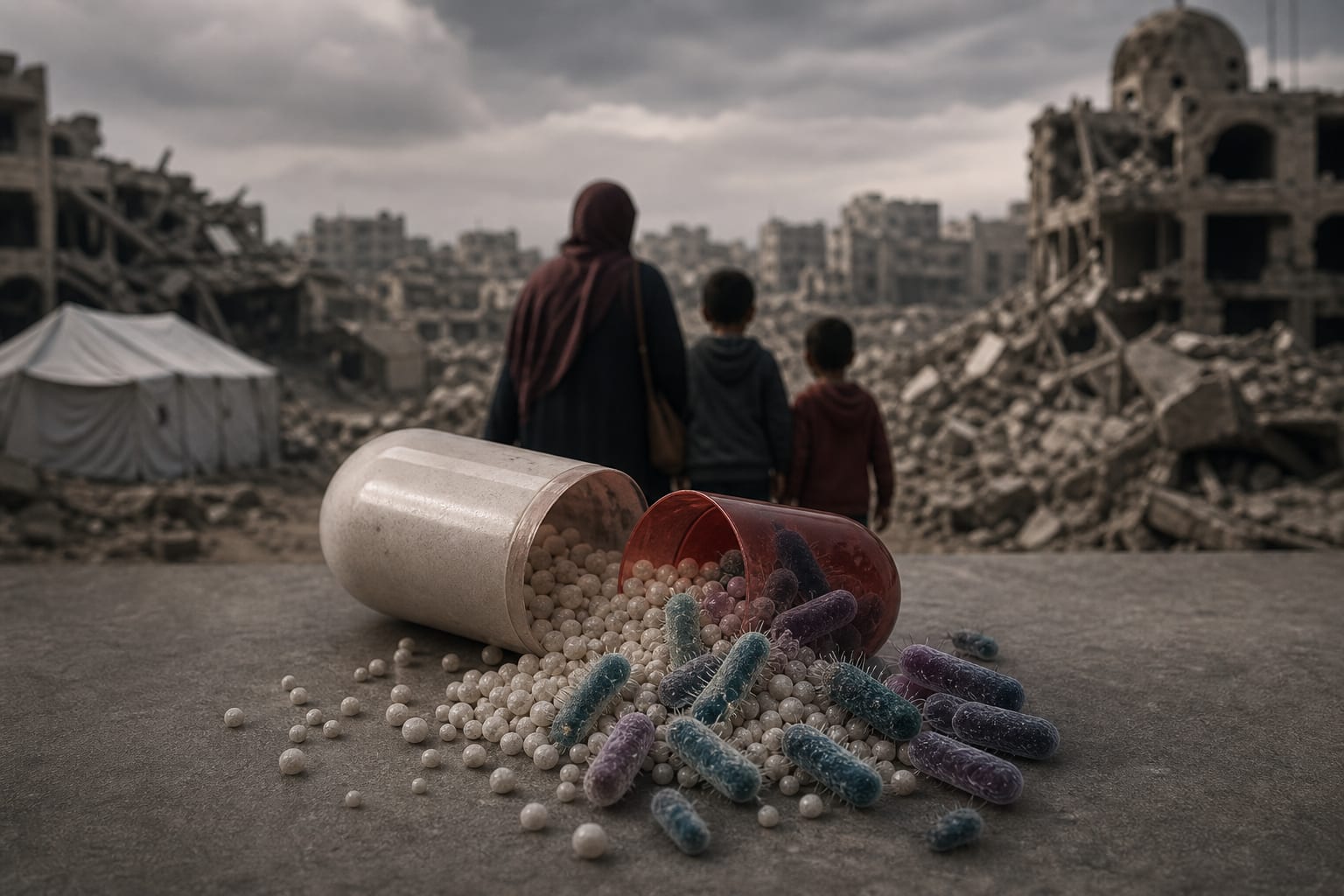
Public Awareness and Self-Medication with Antibiotics During the 2023 Gaza Conflict: A Cross-Sectional Study
-
By
-
Sundus A. Altalla
-
Ayman M. Abu Mustafa
-
Abdelraouf A. Elmanama
-
September 18, 2026
Clinical Scorecard: Public Awareness and Self-Medication with Antibiotics During the 2023 Gaza Conflict: A Cross-Sectional Study
At a Glance
Category | Detail |
|---|---|
Condition | Antibiotic self-medication (SMA) |
Key Mechanisms | Participants reported using antibiotics without a prescription amid barriers to healthcare. Inappropriate antibiotic use can contribute to adverse effects, treatment failure, and antimicrobial resistance, but this survey did not measure resistance. |
Target Population | Adults aged 18 years or older who lived in the Gaza Strip during the 2023 conflict. |
Care Setting | Recruitment at primary healthcare centers, community pharmacies, and displacement shelters; questionnaires were completed on paper or online. |
Key Highlights
Among 422 surveyed participants, reported antibiotic self-medication rose from 60.4% before the war to 80.6% during it.
During the war, participants cited difficulty accessing healthcare (75.4%), overcrowded facilities (74.6%), and treatment costs (69.0%) as reasons for self-medication.
Reported pharmacy purchases without a prescription rose from 23.7% to 80.6%; black-market acquisition rose from 2.1% to 41.0%.
The overall knowledge, attitudes, and practices score averaged 67.46%. Only 41.2% correctly identified that antibiotics are ineffective against influenza.
The survey’s results describe its participants; convenience recruitment does not support population-wide prevalence estimates for Gaza.
Guideline-Based Recommendations
The supplied paper is a survey, not a clinical guideline. The sections below describe its findings and the authors’ proposed responses.
Diagnosis
The study did not evaluate a diagnostic test. Participants’ self-diagnosis and use of antibiotics without medical advice formed part of the behavior being investigated.
Management
The authors call for improved access to healthcare, public education, antibiotic stewardship, and stronger oversight of antibiotic distribution.
Monitoring & Follow-up
The survey compared participants’ recalled antibiotic use before the war with their reported use during it. It did not follow patients over time or measure antimicrobial resistance patterns.
Risks
Participants reported adverse effects after self-medication, including stomach pain and diarrhea. The paper discusses treatment failure and antimicrobial resistance as risks of inappropriate antibiotic use, but this survey did not measure those outcomes.
Patient & Prescribing Data
The survey included 422 adults; 92.4% reported displacement during the conflict, and 84.1% had a university degree. In the questionnaire, participants reported antibiotic use and sources, including nonprescription pharmacy purchases, leftover medication, and informal markets.
Clinical Best Practices
The authors propose combining education about appropriate antibiotic use with better access to formal care and stronger antibiotic stewardship and distribution oversight. Their survey found that awareness did not always align with reported practices. It did not test whether the proposed measures reduce self-medication.
Related Resources & Content
The following publication details appear in the supplied paper or its reference list:
Altalla SA, Abu Mustafa AM, Elmanama AA. “Antibiotic self-medication and public awareness during the 2023 Gaza war: a cross-sectional investigation.” International Journal of Infectious Diseases. 2026;172:109090.
Kumar R, Tanous O, Mills D, et al. “Antimicrobial resistance in a protracted war setting: a review of the literature from Palestine.” mSystems. 2025;10:e01679-24.
Moussally K, Abu-Sittah G, Gomez FG, Abou Fayad A, Farra A. “Antimicrobial resistance in the ongoing Gaza war: a silent threat.” The Lancet. 2023;402:1972–1973.
Naseef H, Joza’ D, Awawdeh A, et al. “Evaluation of self-medication with antibiotics in primary care clinics in Palestine.” Patient Preference and Adherence. 2022;16:2877–2892.
Cabral C, Zhang T, Oliver I, Little P, Yardley L, Lambert H. “Influences on use of antibiotics without prescription by the public in low-and middle-income countries: a systematic review and synthesis of qualitative evidence.” JAC-Antimicrobial Resistance. 2024;6:dlae165.
World Health Organization. “Capturing the evidence on access to essential antibiotics in refugee and migrant populations.” World Health Organization. 2022.
Based on findings from:
Antibiotic self-medication and public awareness during the 2023 Gaza war: a cross-sectional investigation
Sundus A. Altalla, Ayman M. Abu Mustafa, Abdelraouf A. Elmanama. International Journal Of Infectious Diseases, 2026.
https://www.sciencedirect.com/science/article/pii/S1201971226007253
This content is an AI-generated, fully rewritten summary based on a published scholarly article. It does not reproduce the original text and is not a substitute for the original publication. Readers are encouraged to consult the source for full context, data, and methodology.