Tuberculosis enhanced transmission due to interterritorial mobility and prolonged diagnostic delay: a call for an integrated genomic analysis - Scorecard - MDSpire
Clinical Scorecard: Increased Tuberculosis Transmission Linked to Cross-Border Mobility and Extended Diagnostic Delays: Advocating for Comprehensive Genomic Analysis
At a Glance
Category
Detail
Condition
Tuberculosis (TB)
Key Mechanisms
Movement between Almería and Madrid, a prolonged diagnostic delay in one patient with advanced TB, and possible exposures at social gatherings complicated the investigation of a transmission cluster.
Target Population
The 13 people in the cluster included migrants of several nationalities and people born in Spain.
Care Setting
TB surveillance and epidemiological investigation across Almería and Madrid, Spain.
Key Highlights
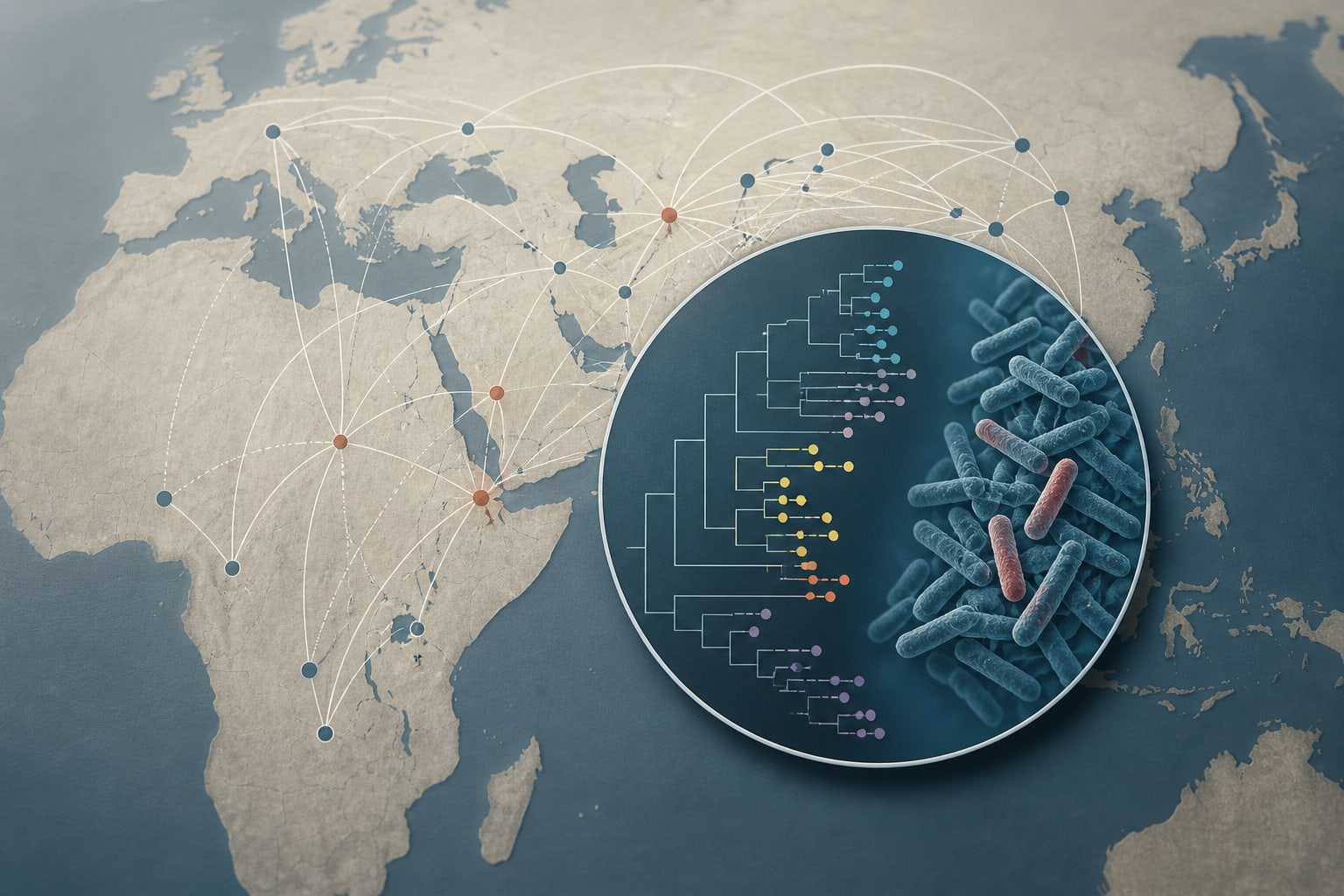
Integrating genomic data from Almería and Madrid helped identify a 13-case cluster spanning both regions.
One patient had symptoms for at least a year before diagnosis. The authors considered the prolonged delay a likely contributor to extensive transmission.
Follow-up interviews uncovered movements and possible exposure settings that initial investigations had not established.
Targeted sequencing of 164 Madrid isolates identified four additional candidate cases, subsequently confirmed by whole-genome sequencing.
Madrid lacked population-wide genomic surveillance, so the full extent of the cluster remains uncertain.
Guideline-Based Recommendations
The supplied paper is a transmission investigation, not a clinical guideline. The points below distinguish its findings from the authors’ proposed surveillance approaches.
Diagnosis
One patient was diagnosed after at least a year of symptoms and had advanced TB at presentation. The study did not evaluate a new diagnostic test or provide diagnostic guidance.
Management
The authors propose integrating genomic data across relevant regions to identify related cases that separate surveillance programs may miss.
Monitoring & Follow-up
The authors propose detailed, genomically informed interviews to investigate possible links among clustered cases. They also describe targeted sequencing of strain-marker variants to track a cluster where comprehensive sequencing is unavailable.
Risks
Prolonged diagnostic delay may permit further transmission. Geographic gaps in sequencing and epidemiological data may leave related cases or exposure links unidentified.
Patient & Prescribing Data
The investigation identified 13 related TB cases diagnosed in Almería and Madrid. The paper describes their epidemiological and genomic relationships; it does not evaluate prescribing practices or compare treatments.
Clinical Best Practices
The authors propose linking genomic surveillance and epidemiological investigation across regional boundaries, using structured follow-up interviews to clarify possible exposures, and examining genetic differences within clusters to refine possible transmission chronologies. The study illustrates these approaches in one cluster; it does not establish a formal clinical practice guideline.
Related Resources & Content
The following publication details appear in the supplied paper or its reference list:
Saleeb SM, Vallejo-Godoy S, Marcos-Abellán A, et al. “Tuberculosis enhanced transmission due to interterritorial mobility and prolonged diagnostic delay: a call for an integrated genomic analysis.” International Journal of Infectious Diseases. 2026;172:109061.
Walker TM, Ip CLC, Harrell RH, et al. “Whole-genome sequencing to delineate Mycobacterium tuberculosis outbreaks: a retrospective observational study.” The Lancet Infectious Diseases. 2013;13:137–146.
Golub J, Bur S, Cronin WA, et al. “Delayed tuberculosis diagnosis and tuberculosis transmission.” International Journal of Tuberculosis and Lung Disease. 2006;10:24–30.
Rodríguez-Grande C, Vallejo-Godoy S, Martínez-Lirola M, et al. “Long-term refined genomic analysis of tuberculosis clusters to distinguish between ongoing transmission, reactivations or diagnostic delays, Almería, Spain, 2003 to 2024.” Eurosurveillance. 2026;31:2500301.
Gardy JL, Johnston JC, Sui SJH, et al. “Whole-genome sequencing and social-network analysis of a tuberculosis outbreak.” New England Journal of Medicine. 2011;364:730–739.
Li M, Quan Z, Xu P, Takiff H, Gao Q. “Internal migrants as drivers of long-distance cross-regional transmission of tuberculosis in China.” Clinical Microbiology and Infection. 2025;31:71–77.
by Sheri M. Saleeb, Silvia Vallejo-Godoy, Andrea Marcos-Abellán, Pilar Barroso-García, Marta López-Llaría, Miguel Martínez-Lirola, Francisca Escabias-Machuca, María Teresa Cabezas Fernández, Guadalupe Bernal, Linfeng Wang, Elisa Fernandez-Fuertes, Sergio Buenestado-Serrano, Francisco Jose Martínez Martínez, Mariana G. López, Iñaki Comas, Mercedes Guida Piqueras, Andrea López-Suárez, Patricia Muñoz, Begoña Santiago-García, Laura Pérez-Lago