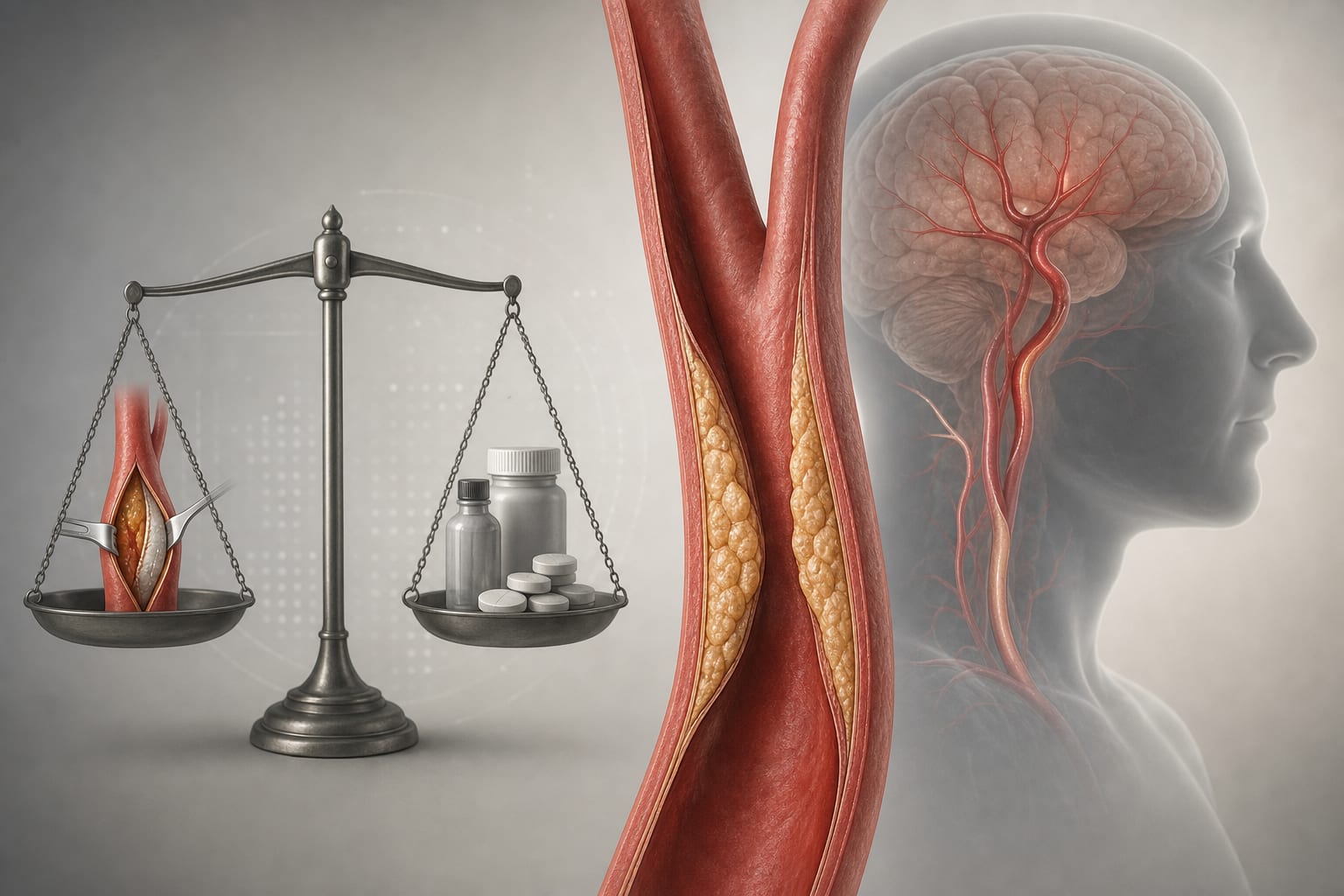
Controversies in the management of asymptomatic carotid stenosis: from best medical therapy to a redefinition of surgical indications
By
Jianghao Zhou
Wei Zhu
Yong Lu
Huiming Dou
Guochu Peng
Changyang Zhong
July 2, 2026
Clinical Scorecard: Debates Surrounding the Treatment of Asymptomatic Carotid Stenosis: Evolving Perspectives on Medical Therapy and Surgical Criteria
At a Glance
Category Detail
Condition Asymptomatic Carotid Artery Stenosis Key Mechanisms Endothelial dysfunction, lipid deposition, macrophage infiltration, smooth muscle cell proliferation Target Population Individuals over 60 years with stenosis ≥50% Care Setting Cerebrovascular medicine
Key Highlights
Management is shifting from stenosis-based assessment to biological risk stratification. Best medical therapy has evolved with intensive lipid-lowering strategies and improved control of vascular risk factors. Recent trials challenge the reliance on luminal stenosis as the primary criterion for intervention. High-resolution imaging and biomarkers are being explored for identifying high-risk disease. An individualized precision-management framework is proposed. Guideline-Based Recommendations
Diagnosis
Asymptomatic carotid artery stenosis diagnosed via Doppler ultrasonography or imaging methods. Management
Consider both medical therapy and surgical options based on individual risk assessment. Monitoring & Follow-up
Regular assessment of vascular risk factors and response to medical therapy. Risks
Perioperative risk of stroke and death remains at approximately 3%. Patient & Prescribing Data
Patients with asymptomatic carotid artery stenosis, particularly those over 60 years.
Contemporary best medical therapy includes potent antiplatelet therapy and novel lipid-lowering treatments.
Clinical Best Practices
Utilize high-intensity medical therapy for vascular protection. Incorporate multimodal biomarkers for risk assessment. Reassess traditional criteria for surgical intervention based on modern evidence. Related Resources & Content