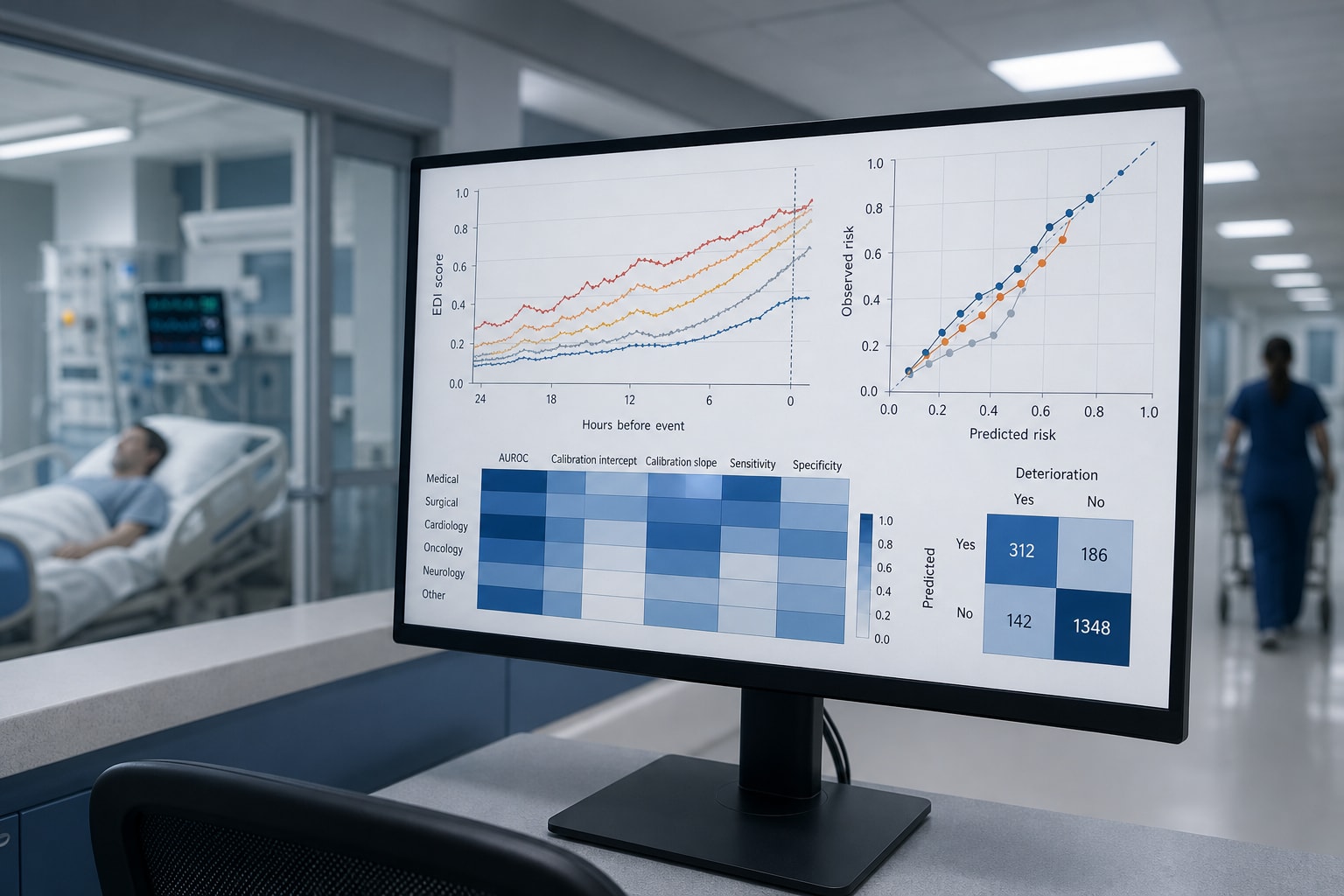
Clinical Scorecard: Performance of a Commercial Clinical Deterioration Prediction Model Varies Across Patient Care Settings
At a Glance
Category
Detail
Condition
Inpatient clinical deterioration prediction using the Epic Deterioration Index (EDI).
Key Mechanisms
The EDI is a proprietary AI-enabled model that generates values at 15-minute intervals. The study defined deterioration as ICU transfer, rapid response team activation, initiation of comfort care, or death.
Target Population
Adults admitted to the University of California, Davis Medical Centre, a Northern California academic tertiary-care centre, from 1 March 2021 through 29 June 2024; 77,478 encounters were analysed.
Care Setting
Inpatient hospital care, evaluated across clinical service lines and hospital locations at one academic tertiary-care centre.
Key Highlights
The retrospective cross-sectional study included 77,478 encounters and 10,579 deterioration events.
Overall EDI discrimination was AUROC 0.763 (95% CI 0.759–0.768).
Discrimination varied by service line: it was highest in haematology/oncology/bone marrow transplant (AUROC 0.815) and lowest in cardiology (0.670) and neurosciences (0.677).
The authors report substantial performance variation across clinical subpopulations and comparable variation across hospital locations.
The EDI was evaluated retrospectively; the supplied source does not state whether it was used clinically during the study period.
Guideline-Based Recommendations
Diagnosis
The study evaluated EDI prediction of a composite deterioration outcome; it does not provide diagnostic criteria for a disease.
Management
The authors conclude that understanding performance variation among clinically meaningful subgroups is important for safe, effective, and precise deployment of predictive models.
Monitoring & Follow-up
EDI values were produced at 15-minute intervals. The study evaluated prediction using a 12-hour window and conducted sensitivity analyses at 2, 4, 8, and 24 hours.
Risks
The authors suggest that a one-size-fits-all approach may conceal subgroup performance differences and could lead to insufficient predictions, alert fatigue, or diminished care quality for some patients.
Patient & Prescribing Data
Adults admitted to the University of California, Davis Medical Centre between 1 March 2021 and 29 June 2024; 77,478 encounters were analysed.
This was a model-performance study, not a treatment study. The supplied source excerpt does not establish whether the EDI was used clinically during the study period.
Clinical Best Practices
The authors emphasize evaluating predictive performance across clinically meaningful patient subgroups and hospital locations, rather than relying only on hospital-wide estimates.
Interpret the reported performance in the context of the study population and setting: one academic medical centre.
Distinguish model evaluation from clinical implementation; the supplied source excerpt does not establish whether EDI was used clinically during the study period.