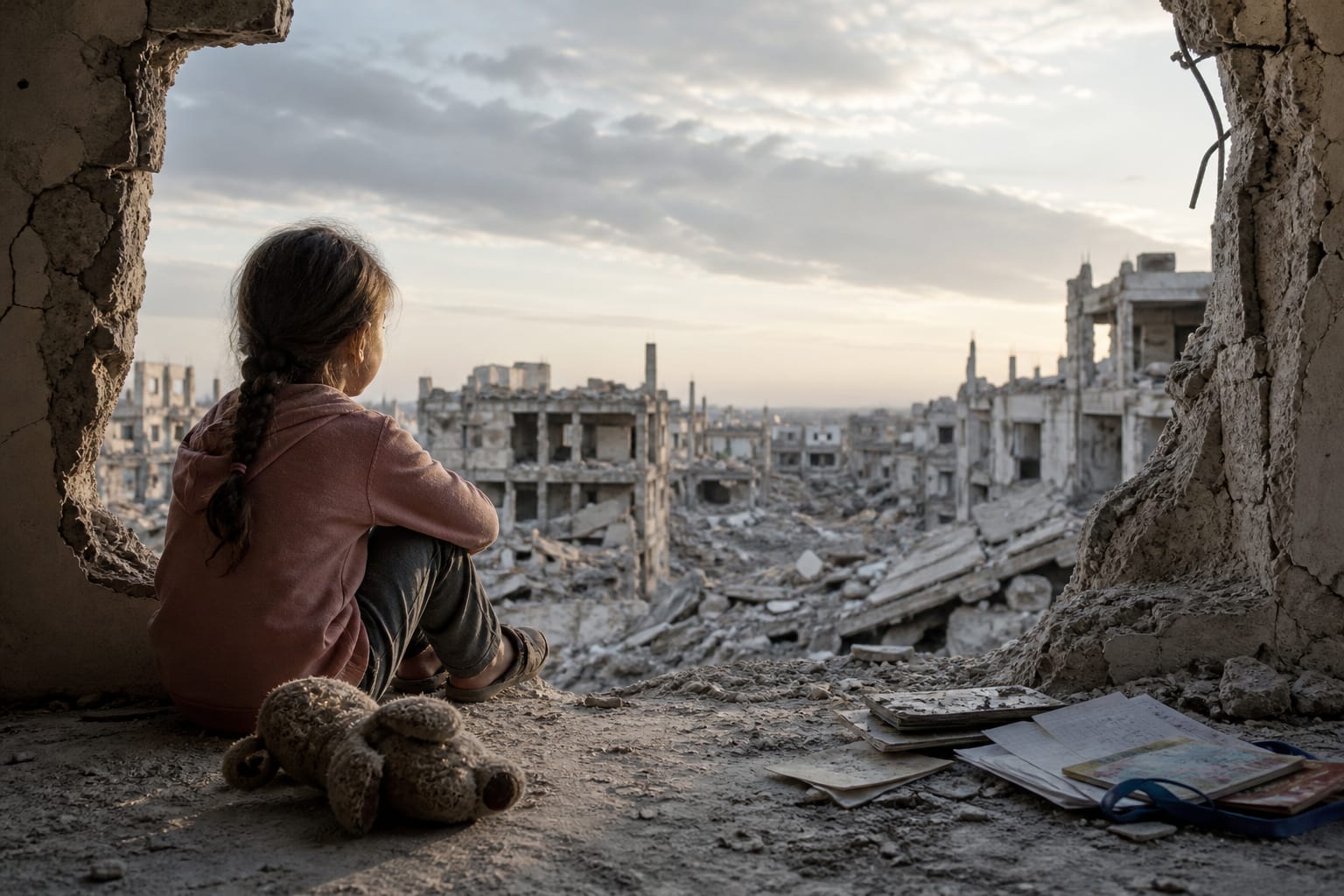
The Impact of War on Children’s Wellbeing and Development
-
By
-
Erwin Jiayuan Khoo
-
Barbara Rubio
-
Jeffrey Goldhagen
-
October 8, 2026
Clinical Scorecard: The Impact of War on Children’s Wellbeing and Development
At a Glance
| Category | Detail |
|---|---|
| Condition | Effects of armed conflict on children’s wellbeing, development, health, education, and recovery |
| Key Mechanisms | Violence and displacement; damage to schools and healthcare facilities; disruption of health services and workforce; and loss of conditions needed for survival, learning, development, and recovery |
| Target Population | Children affected by armed conflict, including children in the occupied Palestinian territory discussed in the article |
| Care Setting | Conflict-affected communities and humanitarian, health, and education systems; the article also addresses the responsibilities of healthcare professionals |
Key Highlights
- The article frames war as a political determinant affecting conditions underlying children’s health and development.
- The UN Convention on the Rights of the Child provisions cited address survival and development, protection from violence, health, education, and recovery from trauma.
- The article reports extensive damage to Gaza’s educational infrastructure and repeated strikes on healthcare facilities.
- Attacks on healthcare can deplete infrastructure, personnel, and expertise needed to sustain care and support recovery.
Guideline-Based Recommendations
Diagnosis
Management
- International Humanitarian Law principles cited include distinction, proportionality, humanity, and military necessity; Article 58 of Additional Protocol I requires parties, wherever feasible, to move civilians and civilian objects away from military objectives.
Monitoring & Follow-up
- The article reports that insecurity can prevent adequate documentation of violence against healthcare, leading to underestimation of its burden.
Risks
- Conflict-related destruction and disruption can deprive children of safety, healthcare, education, development, and recovery.
- Violence against healthcare personnel and facilities can weaken health systems and their capacity to maintain care.
Patient & Prescribing Data
Children affected by armed conflict; no medication or prescribing population is specified.
The article is a commentary on children’s rights, conflict-related harms, and healthcare responsibilities; it provides no drug treatment guidance.
Clinical Best Practices
- Consider the child’s best interests as a primary consideration in actions concerning children, as stated in UNCRC Article 3.
- Recognize the cited UNCRC obligations concerning children’s survival and development, protection from violence, health, education, and recovery.
Related Resources & Content
- United Nations Convention on the Rights of the Child (1989), as cited in the article
- International Humanitarian Law principles and Additional Protocol I, Article 58, as cited in the article
- International Committee of the Red Cross, Health Care in Danger study, as cited in the article
- World Health Organization, International Committee of the Red Cross, and Médecins Sans Frontières joint statement (May 2026), as cited in the article
Based on findings from:
War and the destruction of wellbeing in children
Erwin Jiayuan Khoo, Barbara Rubio, Jeffrey Goldhagen. Bmj Paediatrics Open, 2026.
https://bmjpaedsopen.bmj.com/content/10/1/e005215
This content is an AI-generated, fully rewritten summary based on a published scholarly article. It does not reproduce the original text and is not a substitute for the original publication. Readers are encouraged to consult the source for full context, data, and methodology.