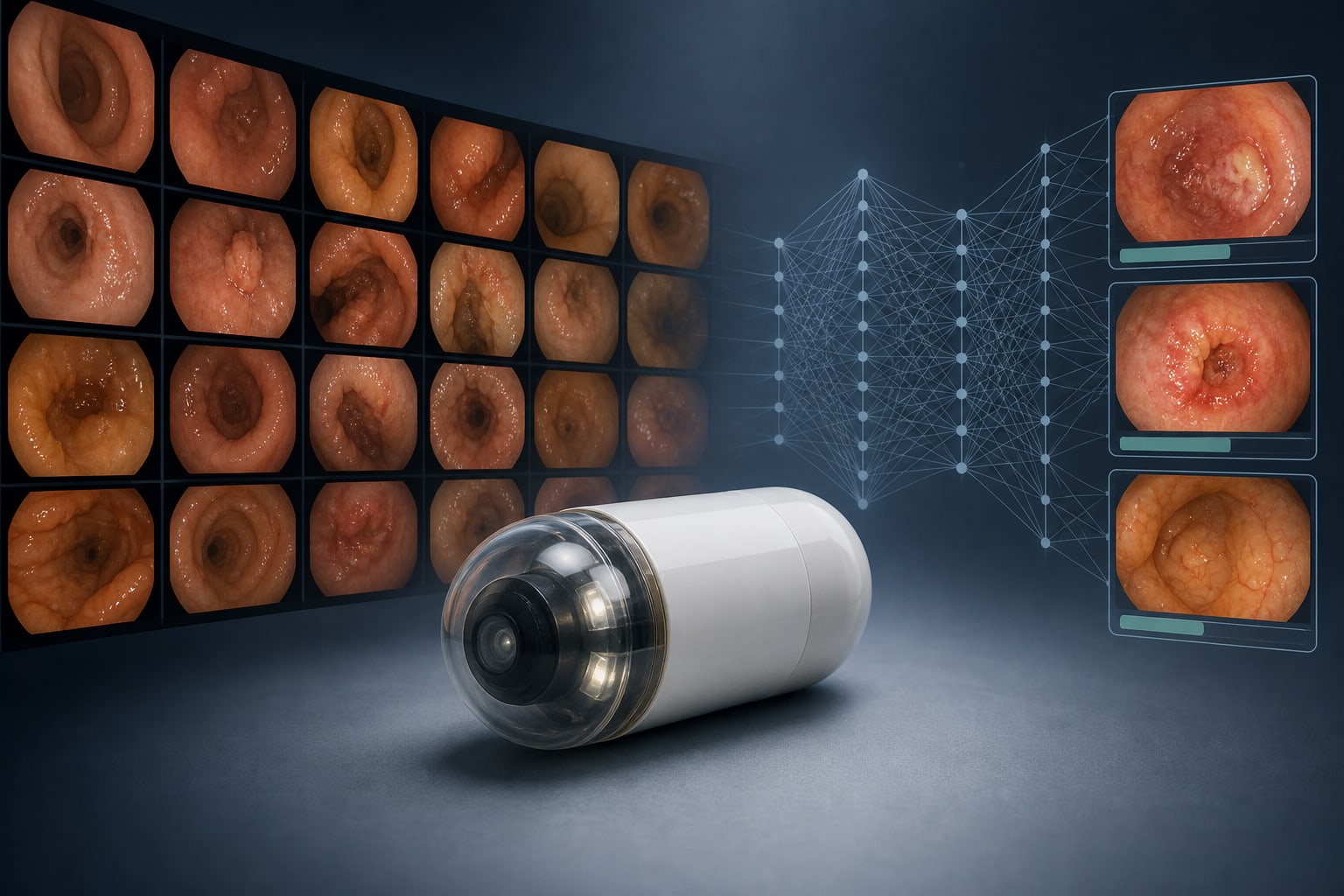
Automated Assessment of Lewis Scores in Small-Bowel Crohn Disease With Capsule Endoscopy: A Retrospective Cohort Study
-
By
-
Yingying Meng
-
Min Gao
-
Jie Wu
-
Ying Huang
-
October 13, 2026
Clinical Scorecard: Automated Assessment of Lewis Scores in Small-Bowel Crohn Disease With Capsule Endoscopy: A Retrospective Cohort Study
At a Glance
| Category | Detail |
|---|---|
| Condition | Small-bowel Crohn disease and mucosal inflammatory activity assessed with the Lewis score |
| Key Mechanisms | Eval-Model combines lesion detection and localization, edema and ulcer segmentation, stenosis classification, and LSTM-based temporal regression to estimate an examination-level Lewis score from sequential capsule endoscopy images. |
| Target Population | Patients with small-bowel Crohn disease undergoing small-bowel capsule endoscopy; study cohort details are not provided in the supplied text. |
| Care Setting | Small-bowel capsule endoscopy interpretation and assessment of inflammatory activity in Crohn disease. |
Key Highlights
- Small-bowel capsule endoscopy visualizes Crohn disease lesions throughout the small intestine, but examinations may contain tens of thousands of frames.
- The Lewis score quantifies small-bowel mucosal inflammatory activity using villous edema, ulceration, and stenosis.
- Manual Lewis score calculation requires extensive image review and is vulnerable to interobserver variability.
- Eval-Model integrates lesion identification and localization, edema and ulcer segmentation, stenosis categorization, and sequence-level temporal regression.
- The supplied article excerpt describes the model and study rationale but does not provide cohort results or performance estimates.
Guideline-Based Recommendations
Diagnosis
- The Lewis score is used to quantify small-bowel mucosal inflammatory change based on villous edema, ulceration, and stenosis.
- Small-bowel capsule endoscopy enables visualization of Crohn disease lesions throughout the small intestine.
Management
Monitoring & Follow-up
- The source states that small-bowel mucosal activity affects treatment selection, monitoring strategies, and prognosis.
Risks
- Bile, bubbles, food residue, and incomplete mucosal visualization can impair capsule endoscopy image quality and may increase variability in lesion interpretation.
- Manual Lewis score calculation is time-consuming and vulnerable to interobserver variability.
Patient & Prescribing Data
Patients with small-bowel Crohn disease undergoing capsule endoscopy; specific eligibility criteria and cohort characteristics are not included in the supplied excerpt.
The article excerpt describes an automated assessment model, not a treatment or prescribing intervention. It notes that mucosal activity affects treatment selection but provides no treatment recommendations.
Clinical Best Practices
- Assess small-bowel inflammatory activity in the context of capsule endoscopy findings and the Lewis score components described in the source.
- Recognize that image quality limitations, including bile, bubbles, food residue, and incomplete mucosal visualization, can affect lesion interpretation.
- Treat Eval-Model as an automated estimation approach described in the study; the supplied excerpt does not establish its clinical performance or replace manual interpretation.
Related Resources & Content
- Gralnek IM, et al. Development of a capsule endoscopy scoring index for small bowel mucosal inflammatory change. Aliment Pharmacol Ther. 2008;27(2):146-154.
- Torres J, et al. Crohn's disease. Lancet. 2017;389(10080):1741-1755.
- Esaki M, Sakata Y. Clinical impact of endoscopic evaluation of the small bowel in Crohn's disease. Digestion. 2023;104(1):51-57.
Based on findings from:
Automated Lewis Score Estimation for Small Bowel Crohn Disease Using Capsule Endoscopy: Retrospective Cohort Study
Yingying Meng, Min Gao, Jie Wu, Ying Huang. Jmir Medical Informatics, 2026.
https://medinform.jmir.org/2026/1/e92416
This content is an AI-generated, fully rewritten summary based on a published scholarly article. It does not reproduce the original text and is not a substitute for the original publication. Readers are encouraged to consult the source for full context, data, and methodology.