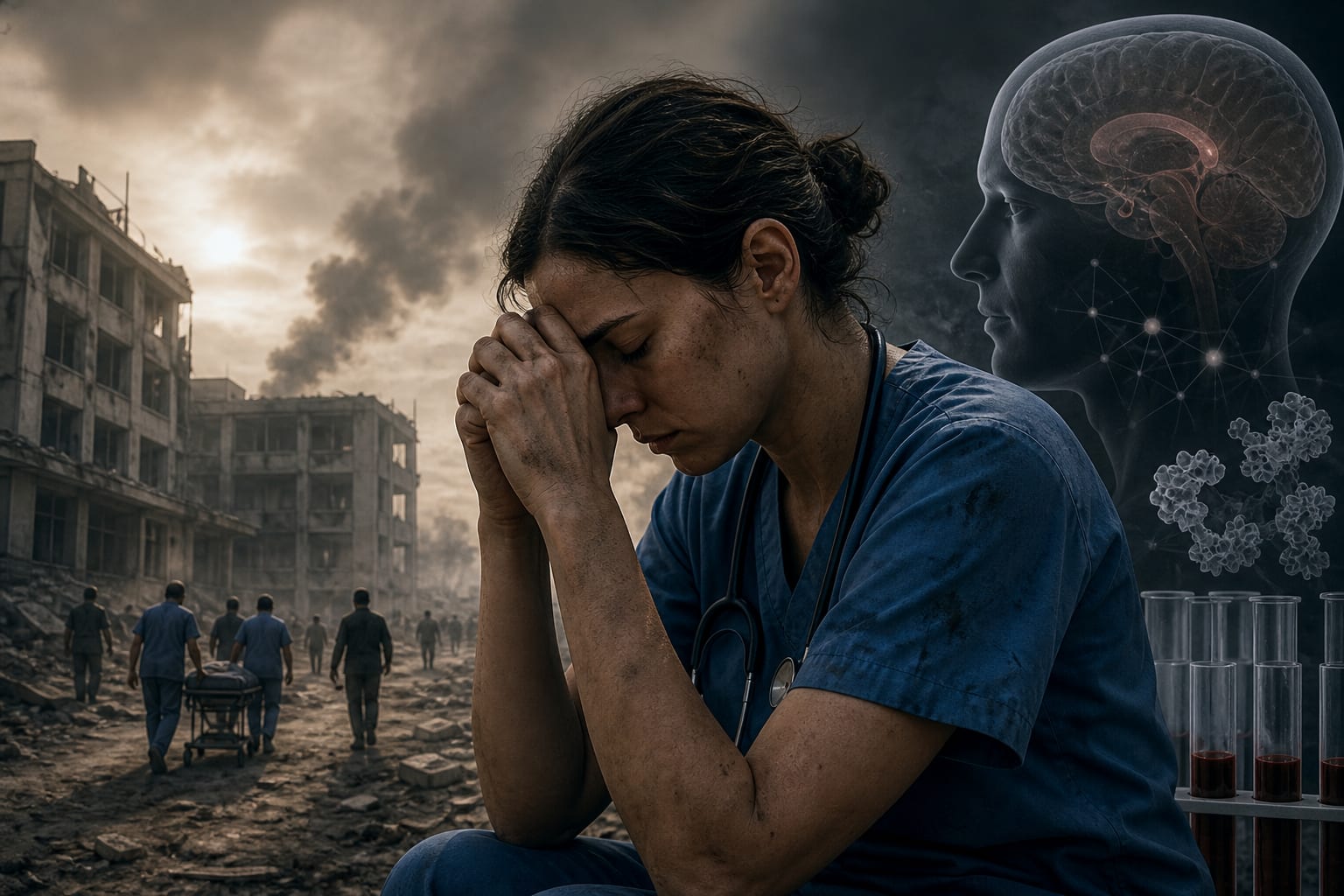
War’s Impact on Healthcare Workers: Psychological and Biological Effects of Conflict Exposure
-
By
-
Arnon Blum
-
Zvi Shimoni
-
Jonathan Lellouche
-
November 3, 2026
Clinical Scorecard: War’s Impact on Healthcare Workers: Psychological and Biological Effects of Conflict Exposure
At a Glance
| Category | Detail |
|---|---|
| Condition | Clinical topic addressed by the source article: War’s Impact on Healthcare Workers |
| Key Mechanisms | Chronic or severe stress is associated with altered hypothalamic–pituitary–adrenal (HPA) axis functioning and low-grade systemic inflammation. IL-6, TNF-α, and CRP have been associated with PTSD, depression, and occupational burnout; sustained inflammation is linked in the article to several longer-term disease risks. |
| Target Population | Population described in the source article. |
| Care Setting | Care setting described in the source article. |
Key Highlights
- Healthcare workers in conflict zones experience anxiety, depression, PTSD symptoms, and burnout amid persistent threat and clinical responsibilities.
- Psychological distress is associated with impaired workability, absenteeism, diminished clinical performance, and premature workforce departure.
- Chronic or severe stress is associated with altered HPA-axis functioning and inflammatory biomarkers, including IL-6, TNF-α, and CRP.
- A prospective cohort of 90 healthy healthcare professionals in central Israel during missile attacks in October 2023 showed psychological distress; reported stress severity was associated with elevated IL-6 and TNF-α.
- The article calls for psychosocial support, occupational biomonitoring, recovery-oriented staffing, and longitudinal research.
Guideline-Based Recommendations
Diagnosis
- The article suggests that integrated profiling with inflammatory markers and validated stress and PTSD scales may help identify healthcare workers vulnerable to persistent impairment.
Management
- The article recommends integrating accessible psychological first aid, peer support, and confidential mental health services into hospital operations.
- The article describes structured psychological care, modified duty cycles, and focused medical follow-up as possible supportive interventions following early detection.
- The article calls for recovery-oriented staffing models that include mandatory rest, trauma-exposure rotation, and surge staffing.
Monitoring & Follow-up
Risks
Patient & Prescribing Data
Healthcare professionals exposed to armed conflict; the described prospective cohort included 90 healthy healthcare professionals in central Israel during October 2023 missile attacks.
No medication or prescribing regimen is described. The article discusses psychosocial support, selective biomarker assessment, structured psychological care, modified duty cycles, and focused medical follow-up.
Clinical Best Practices
- The article calls for treating healthcare workers in conflict zones as a priority population for surveillance, prevention, and intervention.
- The article recommends integrating accessible psychosocial support into hospital operations and emergency preparedness.
- The article suggests selective occupational biomonitoring alongside validated psychological assessments.
- The article calls for staffing approaches that provide rest, rotate trauma exposure, and support surge capacity.
- The article recommends monitoring, documentation, and accountability mechanisms concerning attacks on healthcare personnel and facilities.
Related Resources & Content
Based on findings from:
The Hidden Wounds of Care: Biological and Psychological Consequences of War on Healthcare Workers
Arnon Blum, Zvi Shimoni, Jonathan Lellouche. Journal Of General Internal Medicine, 2026.
https://link.springer.com/article/10.1007/s11606-026-10977-4
This content is an AI-generated, fully rewritten summary based on a published scholarly article. It does not reproduce the original text and is not a substitute for the original publication. Readers are encouraged to consult the source for full context, data, and methodology.