Conexiant’s news site is now MDSpire News. Learn more
Advertisement
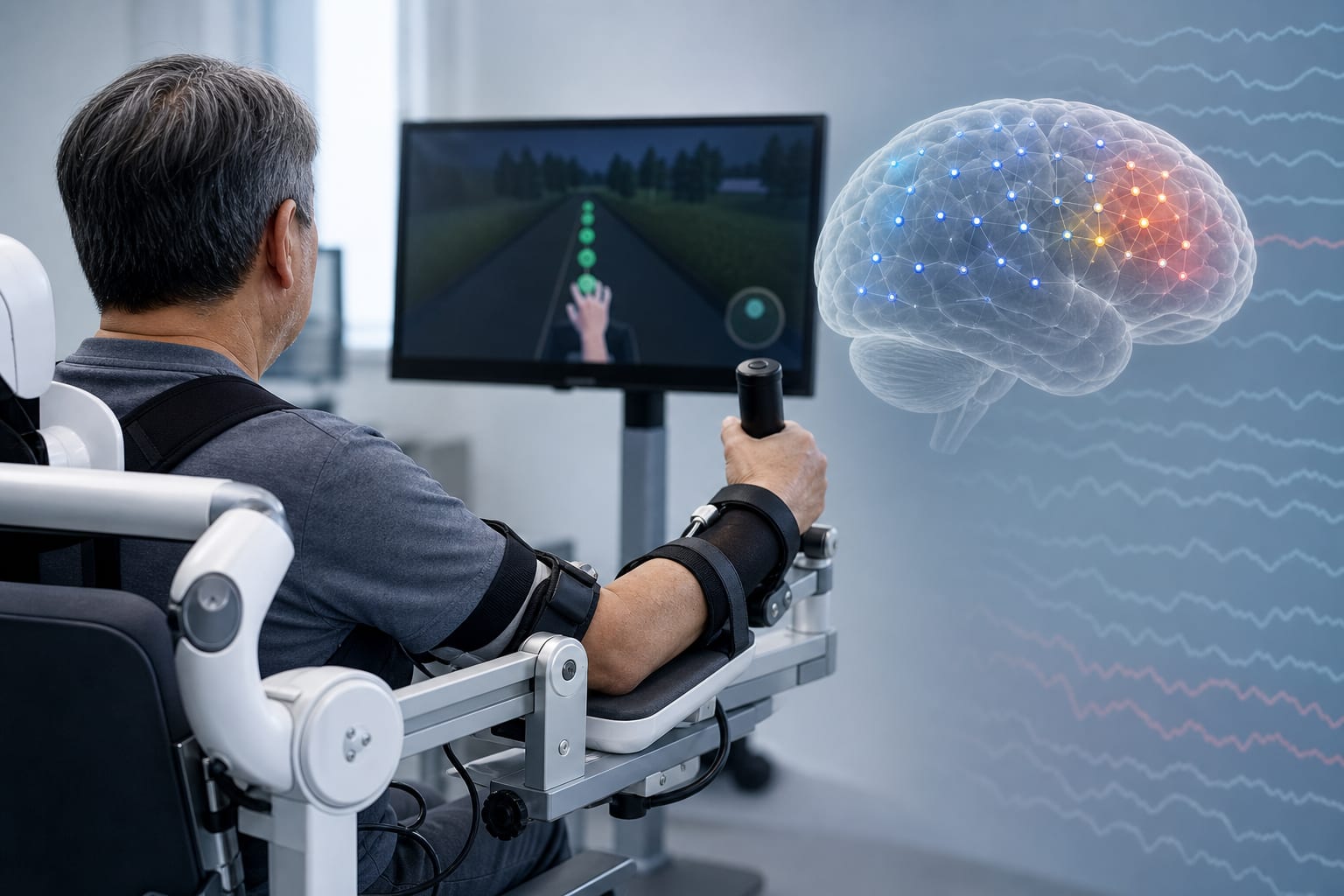
Effectiveness and Cortical Network Alterations of a Multimodal Sensory Feedback Robot for Upper-Limb Rehabilitation in Post-Stroke Patients: A Randomized Controlled Study
Clinical Scorecard: Effectiveness and Cortical Network Alterations of a Multimodal Sensory Feedback Robot for Upper-Limb Rehabilitation in Post-Stroke Patients: A Randomized Controlled Study
At a Glance
Category
Detail
Condition
Post-stroke upper-limb rehabilitation
Key Mechanisms
Multimodal sensory feedback and robot-assisted training enhance patient engagement and sensorimotor integration.
Target Population
Individuals aged 40-75 years, right-handed, 2 weeks to 1 year post-stroke.
Care Setting
Department of Rehabilitation Medicine at Zhoupu Hospital, Pudong New Area, Shanghai.
Key Highlights
Multimodal sensory-feedback robot-assisted training improved Fugl-Meyer Assessment scores significantly compared to conventional rehabilitation.
Functional near-infrared spectroscopy (fNIRS) indicated increased fronto-motor connectivity in the experimental group post-intervention.
No significant baseline differences in cortical measures between groups; significant changes observed post-intervention.
Guideline-Based Recommendations
Diagnosis
Stroke diagnosed using 2019 Chinese key diagnostic criteria and verified through CT or MRI.
Management
Supplement conventional rehabilitation with multimodal sensory-feedback robot-assisted training.
Monitoring & Follow-up
Utilize fNIRS to assess cortical activation and connectivity during rehabilitation.
Risks
Exclusion criteria include clinical worsening, psychiatric illness, and orthopedic disorders affecting limb movement.
Patient & Prescribing Data
38 individuals with stroke, aged 40-75 years.
Robot-assisted training provides scalable, intensive rehabilitation opportunities.
Clinical Best Practices
Incorporate multimodal sensory feedback in rehabilitation protocols.
Ensure patient engagement through interactive and adaptive training methods.
Baptist Health will bring together leading physicians, researchers and healthcare professionals from South Florida and across the country for the 14th Annual Baptist Health Miami Neuroscience Symposium, taking place Nov. 4-6, 2026, at Hilton Miami Dadeland and virtually via Zoom.