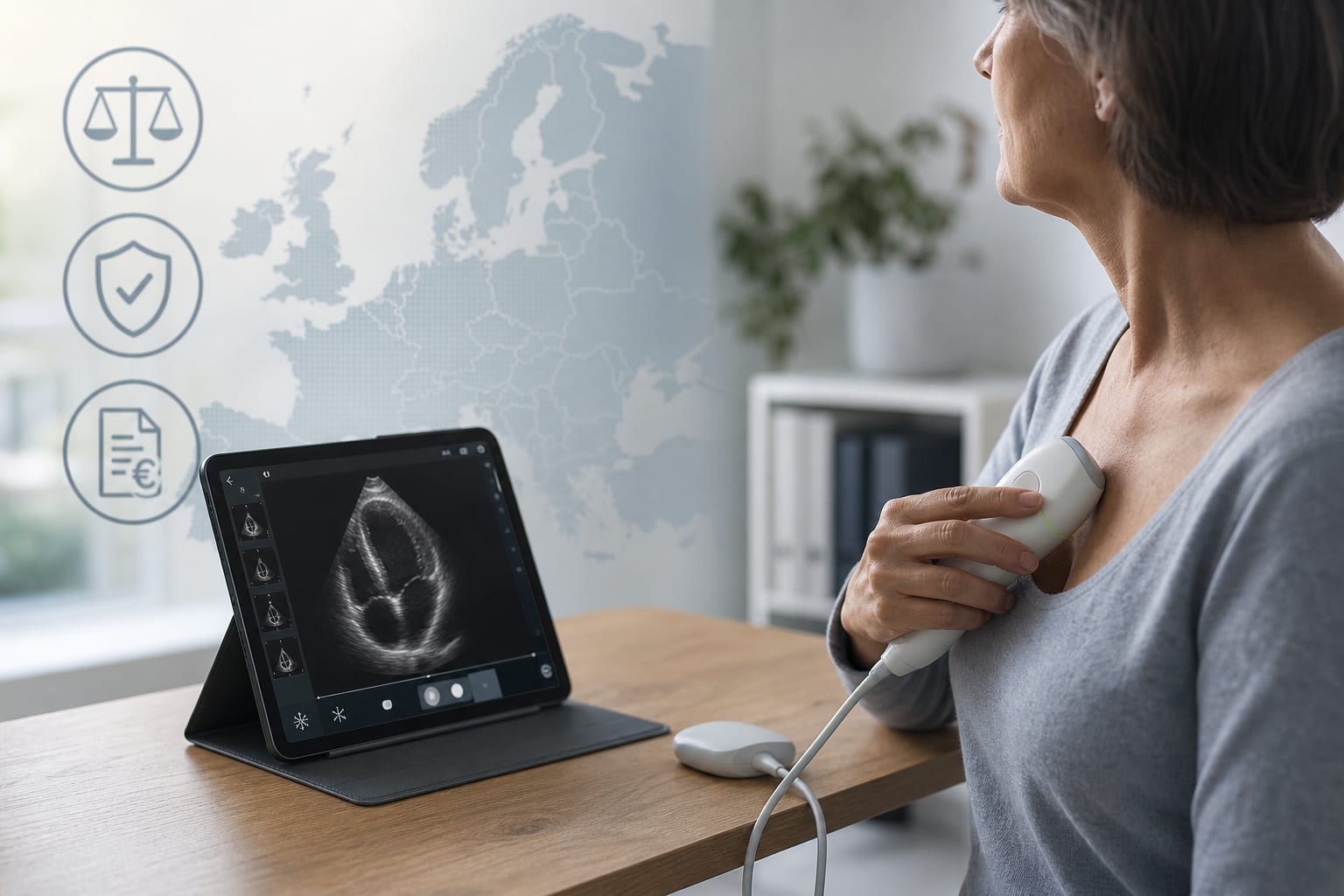
Patient-operated imaging for clinical assessment: regulatory and reimbursement challenges in European health systems
-
By
-
Chifra Fenton
-
Charles Tibi
-
Jacob Glazer
-
Nadia Prisant
-
July 1, 2026
-
Clinical Scorecard: Challenges in Regulation and Reimbursement of Patient-Operated Imaging for Clinical Evaluation in European Healthcare Systems
At a Glance
| Category | Detail |
|---|
| Condition | Patient-operated imaging for clinical assessment (POICA) |
| Key Mechanisms | Decentralization of image acquisition while preserving clinician-led interpretation. |
| Target Population | Patients utilizing imaging technologies for clinical evaluation. |
| Care Setting | European healthcare systems integrating patient-operated medical technologies. |
Key Highlights
- Patient-operated imaging challenges traditional regulatory and reimbursement models.
- Decentralization of imaging acquisition raises issues of clinical reliability and responsibility.
- Regulatory frameworks must adapt to ensure adequacy and usability of patient-acquired images.
- Reimbursement models need to evolve to accommodate distributed clinical workflows.
- Integration into health systems depends on demonstrable reliability of patient-acquired images.
Guideline-Based Recommendations
Diagnosis
- Evaluate patient-operated imaging against existing regulatory frameworks.
Management
- Ensure clear allocation of responsibility between patients and clinicians.
Monitoring & Follow-up
- Establish mechanisms for validating interpretative reliability of patient-acquired images.
Risks
- Address acquisition-dependent risks that cannot be mitigated through repetition.
Patient & Prescribing Data
Patients involved in decentralized imaging acquisition.
Patient-operated imaging requires validation of clinical utility and economic value.
Clinical Best Practices
- Maintain clinician interpretive authority while allowing patient acquisition.
- Integrate usability validation into regulatory processes for home-use medical devices.
- Align physician incentives with high-quality care in reimbursement models.
Related Resources & Content