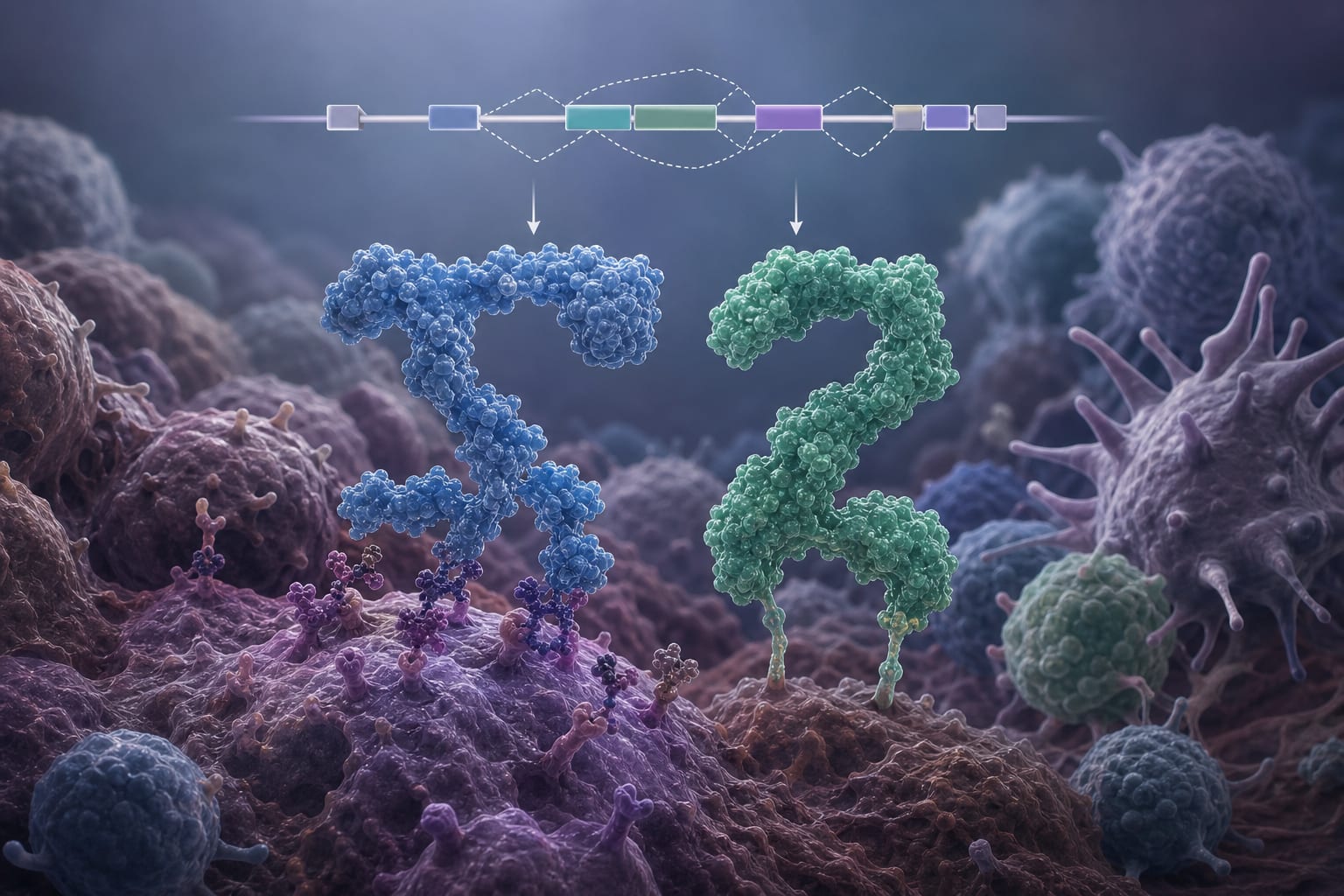
Interpreting CFH Expression Across Cancers: Why Resolving the Factor H–Like 1 Isoform Matters
-
By
-
Simon J. Clark
-
October 11, 2026
Clinical Scorecard: Interpreting CFH Expression Across Cancers: Why Resolving the Factor H–Like 1 Isoform Matters
At a Glance
| Category | Detail |
|---|---|
| Condition | CFH expression and complement regulation in cancer |
| Key Mechanisms | CFH encodes full-length factor H (FH) and alternatively spliced factor H–like 1 (FHL-1). FHL-1 retains factor I cofactor function, regulates C3b, and can be retained in the extracellular matrix. |
| Target Population | Cancer research populations studied for CFH expression, prognosis, immune infiltration, or therapeutic stratification; no specific patient cohort is defined in this article. |
| Care Setting | Oncology biomarker research using tumour and circulating measurements; the article discusses implications for diagnostic, prognostic, and immunotherapy-stratification research. |
Key Highlights
- The cited pan-cancer study associated CFH transcription with tumour stage, survival, immune-cell infiltration, tumour mutational burden, and microsatellite instability.
- The study’s N-terminal qRT-PCR primers target exons shared by FH and FHL-1, so the measured signal represents combined transcription rather than full-length FH alone.
- The shRNA constructs also target shared N-terminal sequences and would be expected to suppress both FH and FHL-1.
- FHL-1 is expressed in several tissues and has been reported in lung and pancreatic tumour cells, where it contributes to local complement regulation.
- The article identifies splice-junction–specific qPCR, long-read RNA sequencing, and isoform-discriminating proteomics as approaches for future isoform-resolved research.
Guideline-Based Recommendations
Diagnosis
- The article does not provide clinical diagnostic guidelines; it cautions that assays targeting shared CFH exons do not distinguish FH from FHL-1.
Management
- The article does not provide treatment recommendations; it discusses CFH as a candidate biomarker for cancer prognosis and immunotherapy stratification.
Monitoring & Follow-up
- For future biomarker-focused research, the article identifies splice-junction–specific qPCR, long-read RNA sequencing, and proteomic methods capable of differentiating FH from FHL-1.
Risks
- Unresolved FH/FHL-1 expression may produce biologically heterogeneous CFH measurements and complicate interpretation across tumour types, stages, tissue, and circulation.
- Associations attributed to CFH may reflect FHL-1, full-length FH, or both; the article notes that their distinct effects could affect assay sensitivity, specificity, and predictive value.
Patient & Prescribing Data
No prescribing population, medication, dose, or treatment regimen is specified. The article concerns cancer biomarker research.
The cited study reports that CFH knockdown inhibited pancreatic cancer cell proliferation and migration in vitro. Because the shRNA targets shared sequences, the knockdown would be expected to affect both FH and FHL-1.
Clinical Best Practices
- Interpret CFH measurements made with shared-exon assays as combined FH/FHL-1 expression, not as full-length FH-specific measurements.
- When investigating CFH as a cancer biomarker, distinguish isoforms where the research question requires it and report the assay’s isoform specificity.
- Consider tissue and circulating measurements separately; the article describes FHL-1 retention in the extracellular matrix and potentially distinct local effects.
Related Resources & Content
- Zheng et al. Pan-cancer investigation of CFH as an immune-related prognostic marker. BMC Cancer, 2025.
- Reference 2: FH and FHL-1 structure and function, as cited in the article.
- References 3–8: FHL-1 expression, tumour complement regulation, extracellular-matrix retention, and tissue distribution, as cited in the article.
Based on findings from:
Diagnostic interpretation of CFH expression in pan-cancer analyses: the importance of factor H–like 1 isoform resolution
Simon J. Clark. Bmc Cancer, 2026.
https://link.springer.com/article/10.1186/s12885-026-17134-4
This content is an AI-generated, fully rewritten summary based on a published scholarly article. It does not reproduce the original text and is not a substitute for the original publication. Readers are encouraged to consult the source for full context, data, and methodology.