Fitting Irregular Corneas Secondary to Penetrating Keratoplasty
Clinical Scorecard: Fitting Irregular Corneas Secondary to Penetrating Keratoplasty
At a Glance
| Category | Detail |
|---|
| Condition | Irregular corneas secondary to penetrating keratoplasty |
| Key Mechanisms | Use of semiscleral lenses to vault irregular corneal surfaces and manage graft-host junction complexities. |
| Target Population | Patients with post-penetrating keratoplasty irregular corneas. |
| Care Setting | Ophthalmology practice specializing in contact lens fitting. |
Key Highlights
- Semiscleral lenses can effectively fit irregular corneas post-PK.
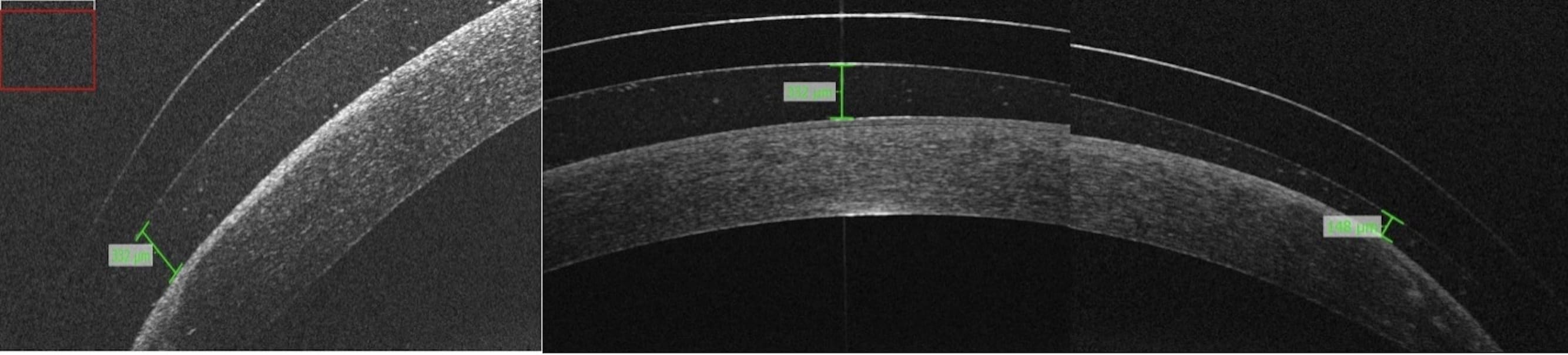
- Tomography and AS-OCT are essential for assessing corneal topography.
- A steeper base curve improved lens fitting and clearance over the graft-host junction.
- The patient achieved 14 hours of comfortable wear with stable visual performance.
- Monitoring tear layer thickness is crucial for lens fitting success.
Guideline-Based Recommendations
Diagnosis
- Utilize corneal tomography and AS-OCT for evaluating corneal topography.
Management
- Select semiscleral lenses for complex grafts to ensure adequate vaulting.
Monitoring & Follow-up
- Regularly assess nasal clearance and tear layer thickness post-fitting.
Risks
- Mechanical trauma due to inadequate lens clearance over elevated graft-host junction.
Patient & Prescribing Data
A 52-year-old male with a post-PK irregular cornea.
Final lens parameters included a 7.1 mm base curve and 15.0 mm diameter for optimal fitting.
Clinical Best Practices
- Prioritize vaulting the highest elevation point of the cornea during lens fitting.
- Adjust base curve based on corneal elevation rather than mean curvature alone.
- Incorporate AS-OCT for ongoing monitoring of lens performance and corneal health.
Related Resources & Content