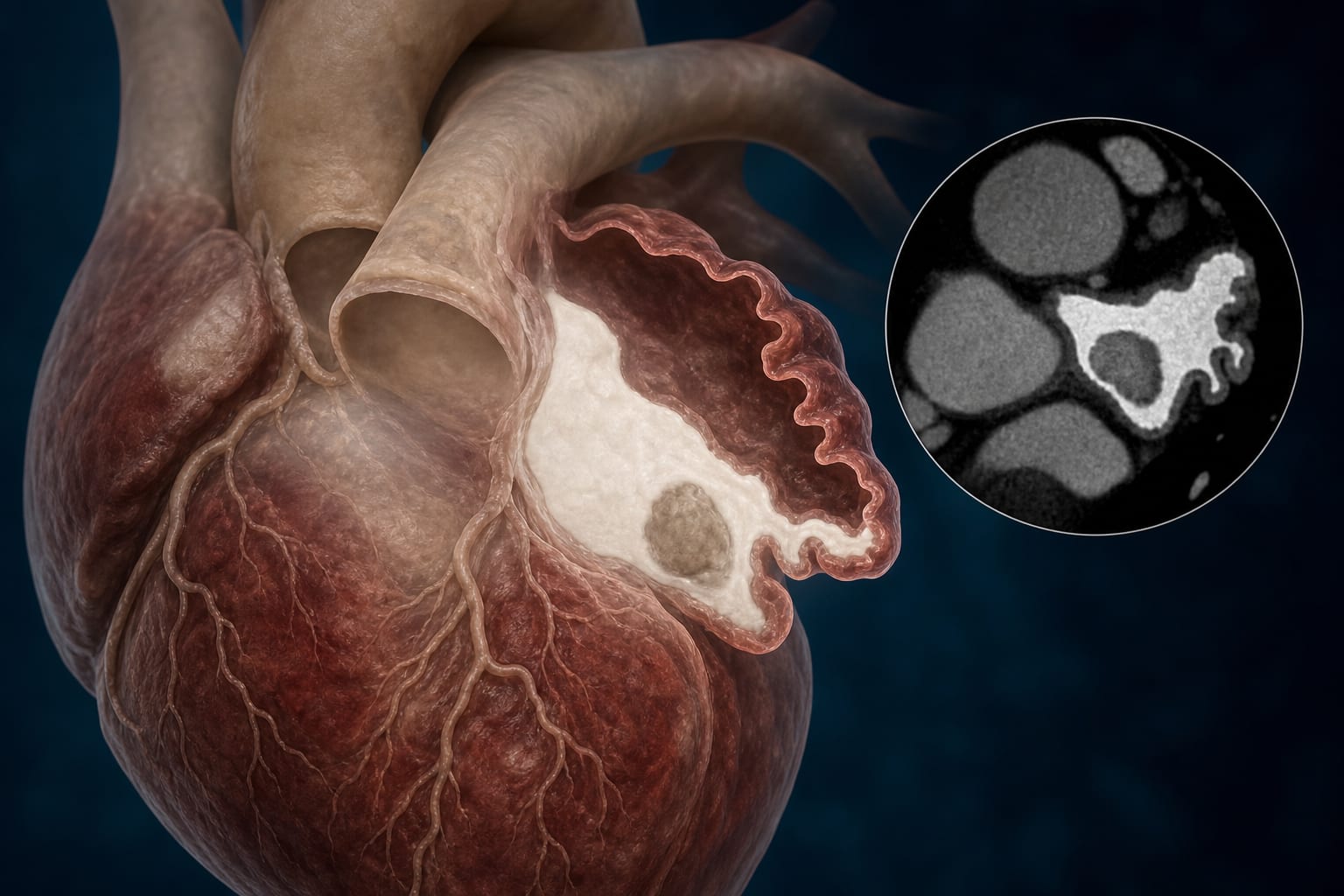
Enhancing Imaging of the Left Atrial Appendage: Assessing the Diagnostic Efficacy of Left Lateral Decubitus Cardiac CT Angiography
By
Zihao Wang
ChenJing Wu
Yi Mang
Zhuang Zhuang
Xinshi Huang
Zhenzhang Wang
June 5, 2026
Clinical Scorecard: Enhancing Imaging of the Left Atrial Appendage: Assessing the Diagnostic Efficacy of Left Lateral Decubitus Cardiac CT Angiography
At a Glance
Category Detail
Condition Left Atrial Appendage Thrombus Detection Key Mechanisms Single-phase left lateral decubitus cardiac CT angiography (LLD-CCTA) improves contrast filling and reduces radiation dose. Target Population Patients with atrial fibrillation undergoing assessment for LAA thrombus. Care Setting Single-center retrospective study.
Key Highlights
LLD-CCTA achieved 100% sensitivity and 94% specificity for thrombus detection. Mean effective radiation dose reduced from 7.84 mSv to 3.89 mSv. Early filling defect rate decreased from 28% to 8.8% with LLD position. Guideline-Based Recommendations
Diagnosis
Transesophageal echocardiography (TEE) is the reference standard for LAA thrombus detection. CCTA can be used as a routine diagnostic tool before and after LAA occlusion surgery. Management
Consider LLD-CCTA as an alternative to biphasic supine CCTA for LAA assessment. Monitoring & Follow-up
Follow-up with TEE within 48 hours after CCTA. Risks
Increased radiation exposure with conventional biphasic supine CCTA. Patient & Prescribing Data
114 patients with nonvalvular atrial fibrillation.
LLD-CCTA maintains diagnostic accuracy while reducing radiation exposure.
Clinical Best Practices
Utilize LLD positioning during CCTA to enhance LAA opacification. Adhere to ethical guidelines and obtain informed consent from patients. Related Resources & Content