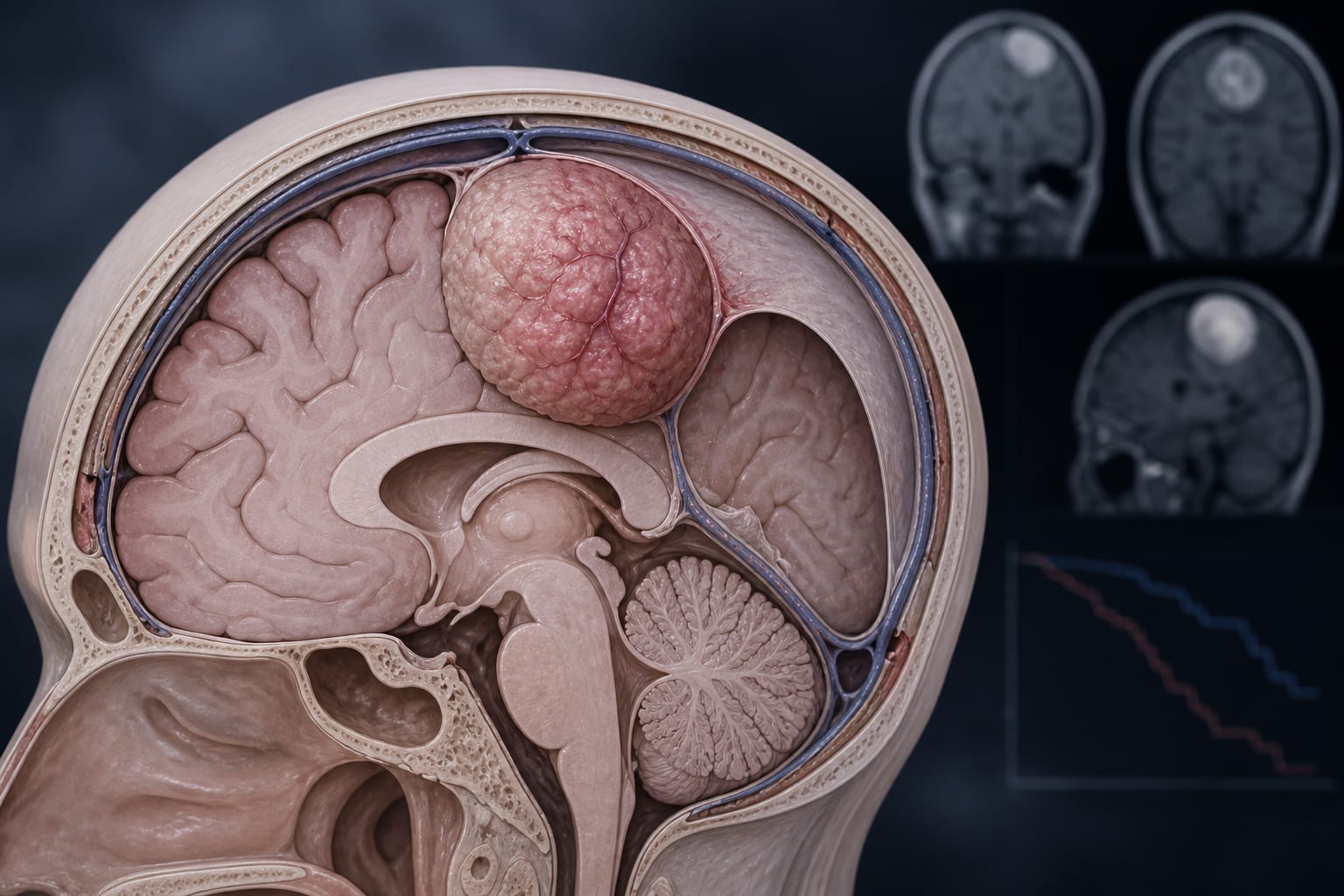
Clinical Scorecard: Cranial Meningiomas Induced by Radiation Linked to Earlier Disease Recurrence: A Propensity Score-Matched Analysis
At a Glance
Category
Detail
Condition
Radiation-Induced Meningiomas
Key Mechanisms
Radiation-induced chromosomal instability and molecular alterations.
Target Population
Patients aged ≥ 18 years with a history of cranial irradiation.
Care Setting
Neurosurgical treatment and follow-up in a clinical institution.
Key Highlights
Meningiomas are the most frequent primary intracranial neoplasm, with a population-based rate of 8–9 per 100,000 person-years.
Radiation-induced meningiomas typically arise 15–35 years after cranial irradiation.
RI meningiomas are more often multiple, synchronous, and have a higher proportion of atypical histology.
Recurrence rates for RI meningiomas are reportedly higher compared to sporadic tumors.
Propensity score matching was utilized to assess recurrence risk in RI versus sporadic meningiomas.
Guideline-Based Recommendations
Diagnosis
Diagnosis of RI meningiomas requires prior cranial irradiation, a latency of at least 5 years, and histological confirmation.
Management
Surgical resection is the primary treatment for RI meningiomas.
Monitoring & Follow-up
Postoperative imaging is recommended at 3, 6, and 12 months, followed by annual examinations.
Risks
Higher recurrence rates and aggressive clinical course associated with RI meningiomas.
Patient & Prescribing Data
Adults aged ≥ 18 years with a history of cranial irradiation.
Surgical intervention is critical, with careful monitoring for recurrence.
Clinical Best Practices
Utilize propensity score matching to reduce confounding in outcome assessments.
Adhere to institutional surveillance protocols for postoperative imaging.
Related Resources & Content
Journal of Neuro-Oncology, 2023 -- Radiation-induced cranial meningiomas are associated with earlier relapse: a propensity score–matched cohort study
Journal of Neuro-Oncology — Differences in Recurrence Risk Estimates for Meningiomas Across Observational Studies: Impact of Time Period, WHO Classifications, Geographic Locations, and Healthcare Systems
Journal of Neuro-Oncology — Clinical Outcomes and Growth Rates of Meningiomas Induced by Radiation: Treatment Approaches and Active Surveillance
Journal of Neuro-Oncology — Effects of Resection Extent and Adjuvant Radiotherapy on Survival Outcomes in High-Grade Meningioma Management
Journal of Neuro-Oncology — Patterns of Recurrence and Radiation Exposure in IDH Wild-Type Glioblastoma During Initial Radiographic Relapse After Chemoradiation
CBTRUS Statistical Report: Primary Brain and Other Central Nervous System Tumors Diagnosed in the United States in 2017–2021 - PMC
The 2021 WHO classification of central nervous system tumors: what neurologists need to know - PMC
EANO guideline on the diagnosis and management of meningiomas - PMC
Radiation-induced cranial meningiomas are associated with earlier relapse: a propensity score–matched cohort study | Journal of Neuro-Oncology | Springer Nature Link
Joint EANM/EANO/RANO/SNMMI practice guideline/procedure standards for diagnostics and therapy (theranostics) of meningiomas using radiolabeled somatostatin receptor ligands: version 1.0
Radiation-induced meningiomas: A systematic review and meta-analysis of 927 meningiomas - PMC
by Leon Schmidt, Dragan Jankovic, Santhosh Thavarajasingam, Reem Fakak, Michael Kosterhon, Alice Dauth, Marc Brockmann, Clemens Sommer, Florian Ringel, Darius Kalasauskas