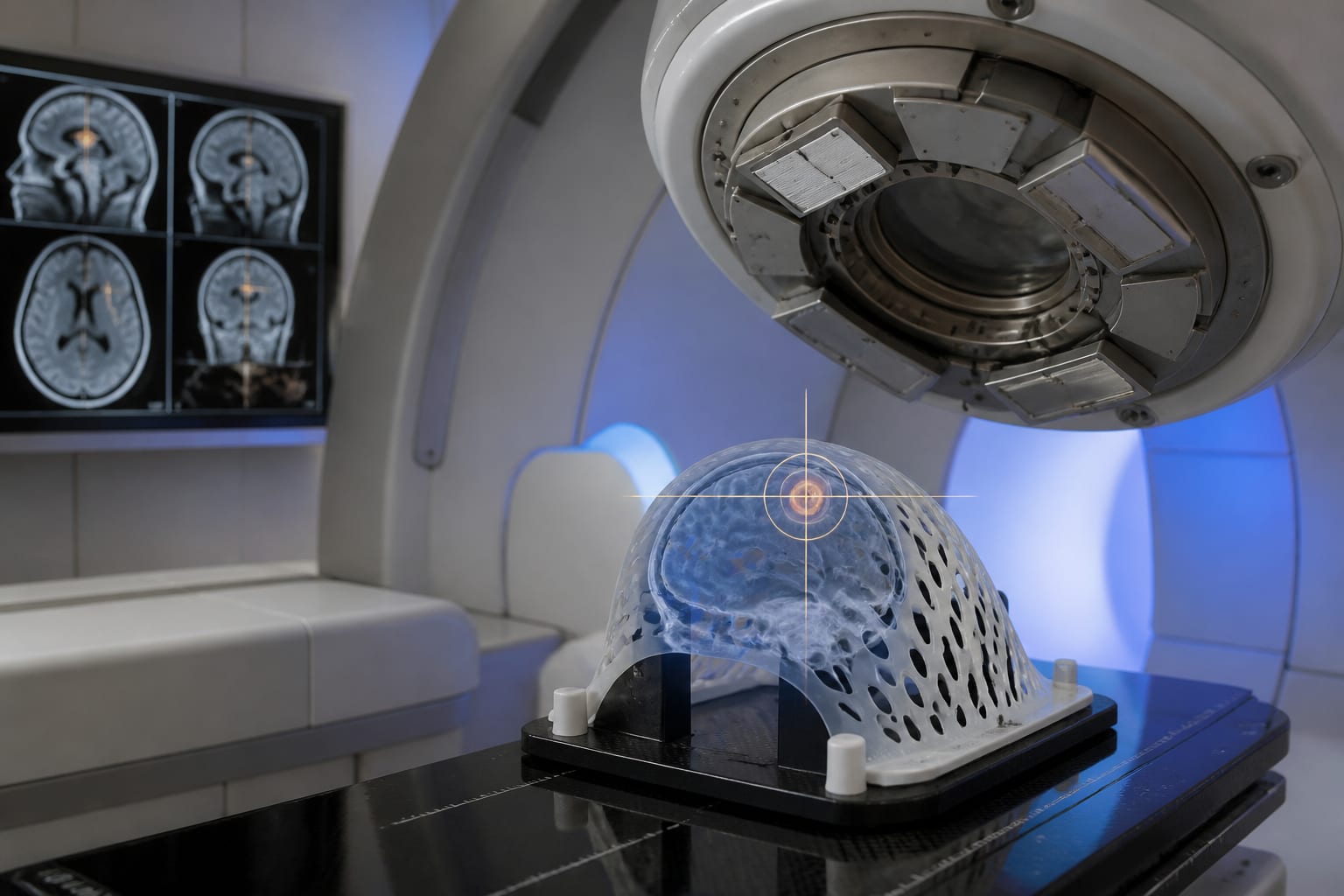
Stereotactic Radiosurgery for Localized Leptomeningeal Metastases: Establishing a Role for Focal Therapy
-
By
-
Bardia Hajikarimloo
-
Salem M. Tos
-
Jason P. Sheehan
-
November 20, 2026
Clinical Scorecard: Stereotactic Radiosurgery for Localized Leptomeningeal Metastases: Establishing a Role for Focal Therapy
At a Glance
| Category | Detail |
|---|---|
| Condition | Nodular or localized leptomeningeal metastases, distinguished radiographically from linear or mixed leptomeningeal disease and from postoperative dural seeding. |
| Key Mechanisms | Discrete nodules may reflect tumor-cell spillage into CSF-contacting spaces during resection, but this proposed mechanism is unproven; CSF dissemination may also occur beyond visible targets. |
| Target Population | Selected patients with discrete, safely treatable nodular deposits, preserved functional status, and a meaningful prospect of benefiting from ongoing oncologic therapy. |
| Care Setting | Multidisciplinary CNS oncology care using neurologic assessment, contrast-enhanced brain and spine MRI, and CSF evaluation when appropriate; focal radiotherapy may be considered within multimodality treatment. |
Key Highlights
- Contrast-enhanced MRI is the reference standard for characterizing leptomeningeal disease patterns; imaging classification does not establish biologic confinement.
- EANO-ESMO guidance supports focal stereotactic irradiation for appropriately selected nodular disease.
- Small clinical series report feasibility and responses of treated deposits, but do not establish a definitive survival benefit from SRS.
- Distant leptomeningeal progression remains possible after focal treatment; untreated meningeal sites may require broader or systemic treatment.
- Evidence is insufficient to define an optimal stereotactic regimen specifically for localized leptomeningeal metastasis.
Guideline-Based Recommendations
Diagnosis
- Assess disease pattern with contrast-enhanced MRI, the reference standard, distinguishing linear, nodular, and mixed presentations.
- Use an integrated assessment including neurologic examination, contrast-enhanced MRI of the brain and spine, and CSF evaluation when appropriate.
- Do not interpret negative CSF cytology as confirmation that disease is confined; positive cytology does not automatically preclude treatment of a symptomatic nodule.
Management
- Consider focal stereotactic irradiation for appropriately selected nodular disease; the EANO-ESMO framework supports this approach.
- Consider SRS within a broader multimodality strategy, including CNS-penetrant systemic therapy when appropriate.
- Reconsider focal treatment as the principal approach when there is extensive linear enhancement, rapidly increasing nodules, or neurologic decline disproportionate to the visible target.
- Account for target delineation, prior radiation-dose overlap, and the implications of marginal progression in treatment planning.
Monitoring & Follow-up
- Assess for distant leptomeningeal progression after SRS; distant disease occurred in seven of 16 patients in one reported series.
- Report single-fraction SRS, hypofractionated SRS, and fractionated stereotactic radiotherapy as distinct interventions.
Risks
- Focal treatment may control an irradiated deposit while untreated meningeal sites remain vulnerable to progression.
- Available comparative findings do not establish therapeutic equivalence between focal radiotherapy and WBRT; treatment groups may differ in disease distribution, functional status, or systemic treatment options.
- Meningeal lesions may be thin or irregular and near previously irradiated tissue or critical neural structures.
Patient & Prescribing Data
Patients with discrete nodular leptomeningeal deposits that are amenable to safe treatment may be considered; proposed selection principles are not validated eligibility criteria.
SRS may control a targeted deposit, but evidence does not establish a survival benefit or an optimal regimen. Distant leptomeningeal progression can occur, and focal therapy may be combined with CNS-penetrant systemic treatment.
Clinical Best Practices
- Distinguish genuine leptomeningeal involvement from postoperative pachymeningeal seeding and avoid inferring confinement from proximity to a surgical cavity.
- Interpret MRI pattern alongside neurologic findings, brain and spine imaging, and CSF evaluation when appropriate.
- Consider whether a nodule threatens a defined neurologic function or represents limited progression amid otherwise effective treatment.
- Document prior irradiation and explicitly assess target definition, dose overlap, and marginal progression risk.
- Avoid treating stereotactic regimens as interchangeable; the source reports insufficient evidence to establish a preferred regimen.
Related Resources & Content
Based on findings from:
Stereotactic radiosurgery for locoregional leptomeningeal metastasis: defining a role for focal treatment
Bardia Hajikarimloo, Salem M. Tos, Jason P. Sheehan. Journal Of Neuro-Oncology, 2026.
https://link.springer.com/article/10.1007/s11060-026-05875-y
This content is an AI-generated, fully rewritten summary based on a published scholarly article. It does not reproduce the original text and is not a substitute for the original publication. Readers are encouraged to consult the source for full context, data, and methodology.