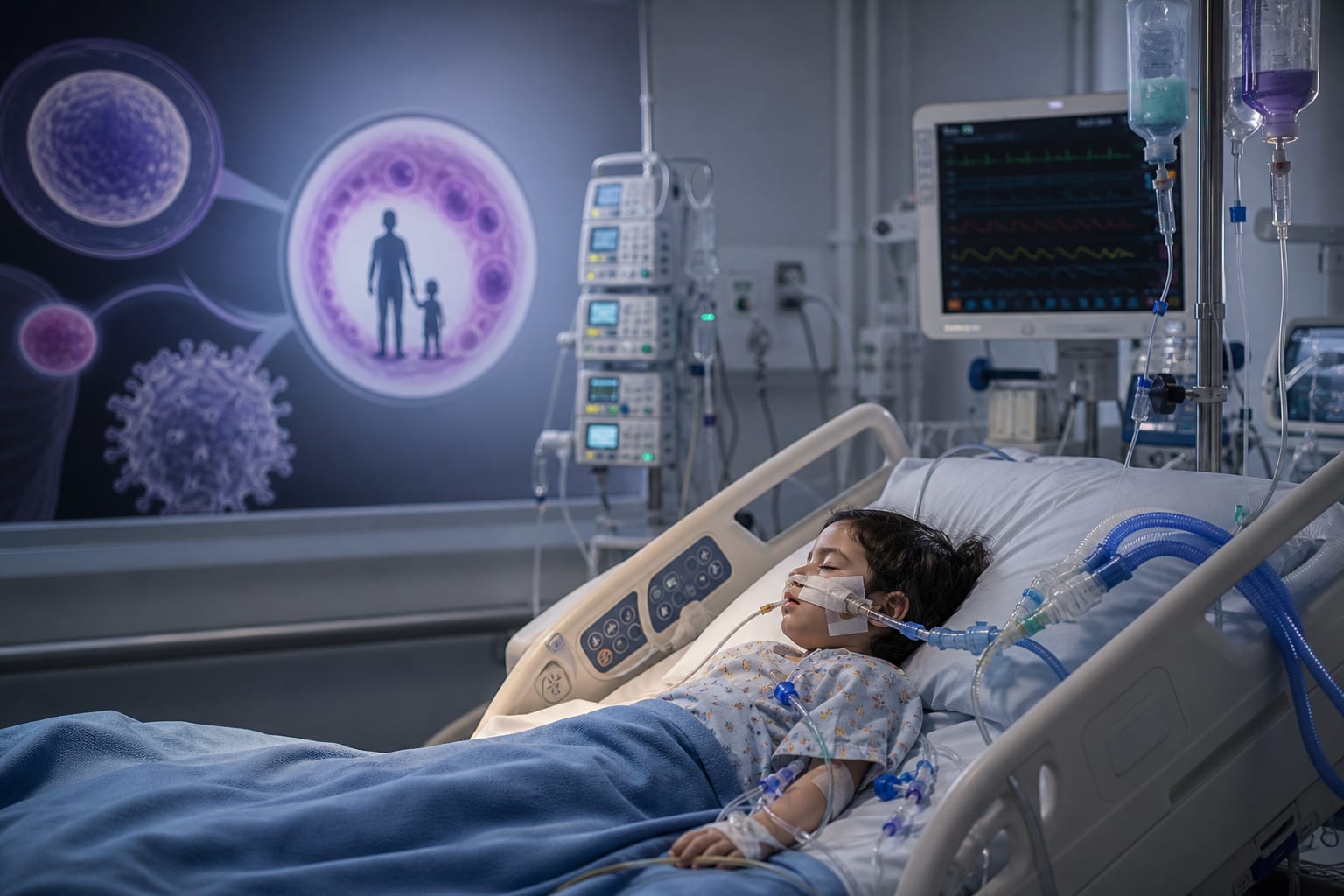
Outcomes of critically ill pediatric patients after haploidentical stem cell transplantation
-
By
-
Da Hyun Kim
-
Ho Joon Im
-
Won Kyoung Jhang
-
Sung Han Kang
-
May 29, 2026
Clinical Scorecard: Results for Critically Ill Children Following Haploidentical Stem Cell Transplantation
At a Glance
| Category | Detail |
|---|
| Condition | Critically Ill Pediatric Patients Post-Haploidentical Stem Cell Transplantation |
| Key Mechanisms | Haploidentical peripheral blood hematopoietic stem cell transplantation (haploPBSCT) with ex vivo αβ+ T-cell and CD19+ B-cell depletion. |
| Target Population | Pediatric patients undergoing haploPBSCT admitted to the PICU. |
| Care Setting | Pediatric Intensive Care Unit (PICU) |
Key Highlights
- 30-day mortality rate: 33.3%
- In-hospital mortality rate: 50.8%
- Chronic graft-vs.-host disease associated with increased 30-day mortality.
- Ventilator use independently predicts in-hospital mortality.
- Pneumonia was the most common cause of death among survivors beyond 30 days.
Guideline-Based Recommendations
Diagnosis
- Monitor for respiratory complications post-haploPBSCT.
Management
- Implement early detection and prevention strategies for respiratory failure.
Monitoring & Follow-up
- Assess for chronic graft-vs.-host disease and ventilator dependence.
Risks
- Increased mortality associated with chronic graft-vs.-host disease and ventilator use.
Patient & Prescribing Data
Pediatric patients who underwent haploPBSCT and required PICU admission.
HaploPBSCT is performed using ex vivo αβ+ T-cell and CD19+ B-cell depletion.
Clinical Best Practices
- Ensure close monitoring of respiratory status in critically ill patients post-transplant.
- Consider the implications of chronic graft-vs.-host disease in patient management.
Related Resources & Content