Effects of mandibular advancement devices vs. CPAP on blood pressure in obstructive sleep apnea: a systematic review and meta-analysis of randomized controlled trials - Scorecard - MDSpire

Effects of mandibular advancement devices vs. CPAP on blood pressure in obstructive sleep apnea: a systematic review and meta-analysis of randomized controlled trials

  • By

  • Ting Cheng

  • Qiang Wang

  • Wei Wei

  • May 20, 2026

  • 0 min

Share

Clinical Scorecard: Comparative Analysis of Blood Pressure Outcomes in Obstructive Sleep Apnea: Mandibular Advancement Devices Versus CPAP in Randomized Controlled Trials - A Systematic Review and Meta-Analysis

At a Glance

CategoryDetail
ConditionObstructive Sleep Apnea (OSA)
Key MechanismsIntermittent hypoxia and increased sympathetic activity leading to elevated blood pressure.
Target PopulationAdult patients (aged ≥18 years) diagnosed with OSA.
Care SettingClinical settings conducting randomized controlled trials.

Key Highlights

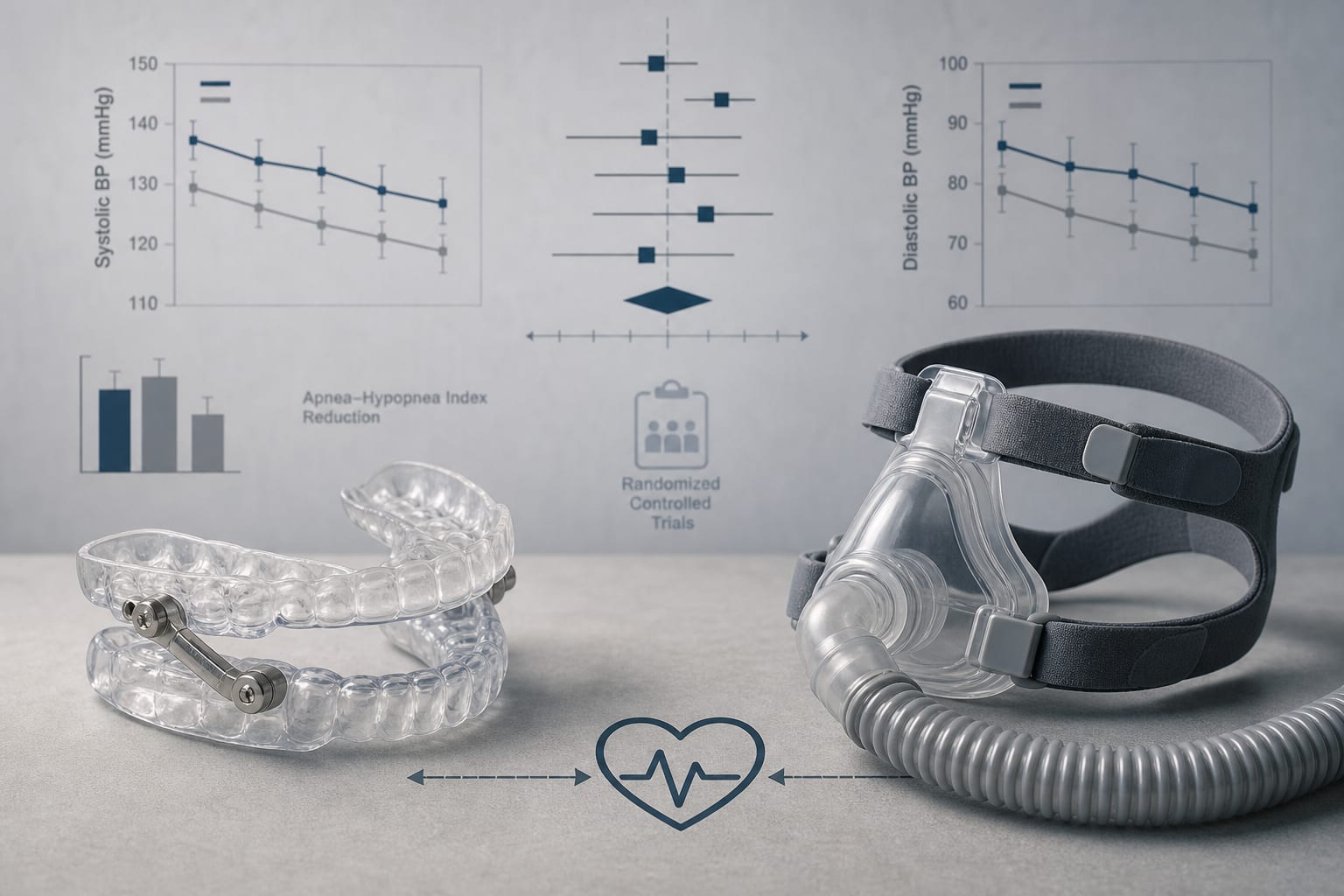
  • Mandibular advancement devices (MAD) show comparable cardiovascular benefits to CPAP.
  • MAD achieved a greater reduction in daytime systolic blood pressure compared to CPAP.
  • CPAP is superior in reducing the apnea-hypopnea index (AHI).
  • MAD demonstrated significantly longer nightly adherence than CPAP.
  • MAD may serve as a viable alternative for OSA patients intolerant to CPAP.

Guideline-Based Recommendations

Diagnosis

  • Screen hypertensive patients for OSA.
  • Diagnosis via polysomnography or home sleep monitoring.

Management

  • CPAP is the first-line treatment for OSA.
  • MAD is recommended for patients intolerant to CPAP.

Monitoring & Follow-up

  • Track blood pressure pre- and post-treatment.
  • Monitor adherence to treatment using objective data.

Risks

  • Suboptimal adherence to CPAP can limit its effectiveness.
  • Potential cardiovascular risks associated with untreated OSA.

Patient & Prescribing Data

Patients with obstructive sleep apnea, particularly those with cardiovascular risk.

MAD may provide cardiovascular benefits and improved adherence for some patients.

Clinical Best Practices

  • Utilize objective adherence tracking for treatment evaluation.
  • Consider MAD for patients with mild-to-moderate OSA or those intolerant to CPAP.

Related Resources & Content

Original Source(s)

Related Content