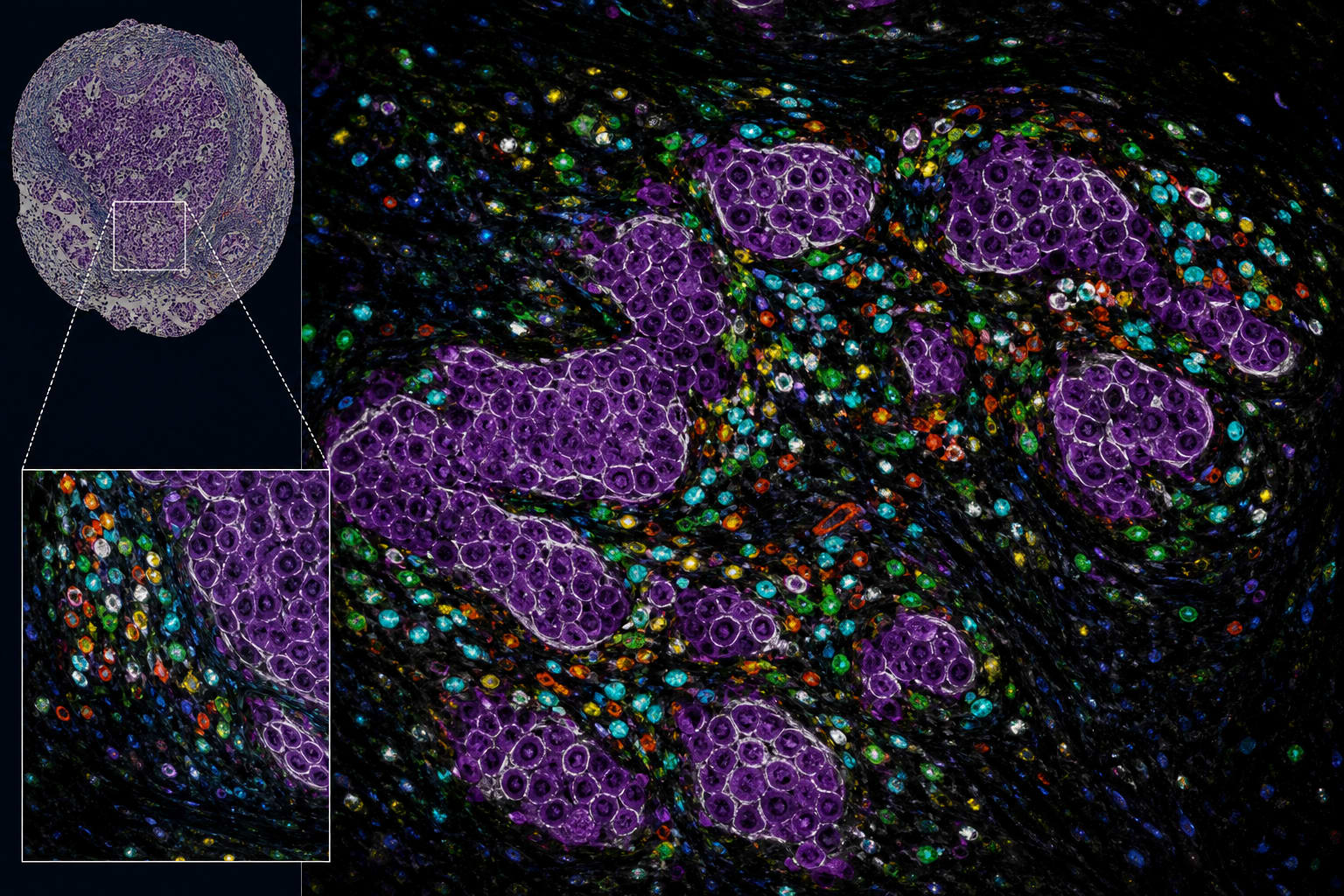
Spatial organization of the tumor immune microenvironment in LAR+ triple-negative breast cancer
-
By
-
Donatella Lucchetti
-
Alba Di Leone
-
Giulia Sabbatinelli
-
Federica Toma
-
Franco Antonio
-
Beatrice Cellini
-
Filomena Colella
-
Erica Pazzaglia
-
Chiara Parrillo
-
Luciano Giacó
-
Angela Santoro
-
Alessia Piermattei
-
Rita Colonna
-
Gianluca Franceschini
-
Alessandro Sgambato
-
May 22, 2026
-
Clinical Scorecard: Spatial Arrangement of the Immune Microenvironment in LAR+ Triple-Negative Breast Cancer
At a Glance
| Category | Detail |
|---|
| Condition | |
| Key Mechanisms | Tumor immune microenvironment (TIME) and its spatial organization influence treatment responses. |
| Target Population | |
| Care Setting | |
Key Highlights
- LAR+ TNBC is characterized by reduced proliferative activity and lower sensitivity to chemotherapy.
- Patients achieving pathological complete response (pCR) showed higher pre-treatment densities of specific immune subsets.
- Distinct spatial patterns were observed between responders and non-responders to neoadjuvant therapy.
- Immunosuppressive tumor cells exhibited different spatial dynamics post-treatment in non-responders.
Guideline-Based Recommendations
Diagnosis
- Characterization of immune cell composition and spatial relationships in LAR+ TNBC.
Management
- Neoadjuvant chemotherapy remains the main treatment option for early-stage TNBC.
Monitoring & Follow-up
- Assessment of immune microenvironment changes post-neoadjuvant therapy.
Risks
- Patients with residual disease post-neoadjuvant therapy have significantly increased risks of recurrence and death.
Patient & Prescribing Data
Patients with LAR+ TNBC, particularly those undergoing neoadjuvant therapy.
Approximately 30-40% of patients achieve pCR after neoadjuvant chemotherapy.
Clinical Best Practices
- Utilize multiplex immunofluorescence for detailed immune composition analysis.
- Consider spatial organization of immune cells when evaluating treatment responses.
Related Resources & Content