Efficacy and safety of abaloparatide, denosumab, teriparatide, oral bisphosphonates, and intravenous bisphosphonates in the treatment of postmenopausal osteoporosis: a systematic review and Bayesian network meta-analysis - Scorecard - MDSpire

Efficacy and safety of abaloparatide, denosumab, teriparatide, oral bisphosphonates, and intravenous bisphosphonates in the treatment of postmenopausal osteoporosis: a systematic review and Bayesian network meta-analysis

  • By

  • Yan Wang

  • Xiaoyan Wang

  • Guihong Yu

  • Libao Zhang

  • Changhui Xue

  • Wanchen Gong

  • Jiashou Luo

  • Chengwu Lu

  • Linfeng Wang

  • July 9, 2026

  • 0 min

Share

Clinical Scorecard: Comparative Analysis of Abaloparatide, Denosumab, Teriparatide, Oral and Intravenous Bisphosphonates for Treating Postmenopausal Osteoporosis: A Systematic Review and Bayesian Network Meta-Analysis
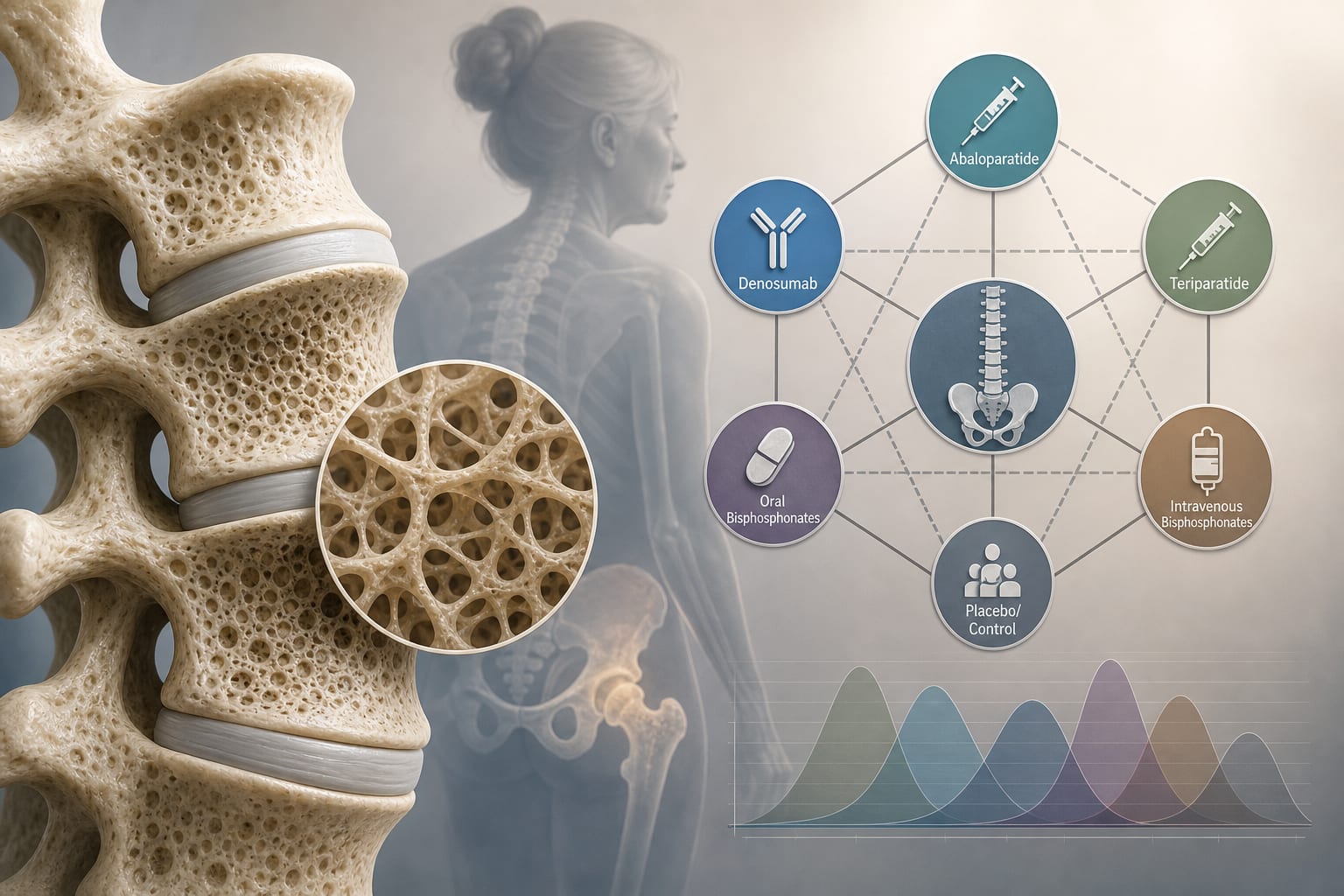
At a Glance

CategoryDetail
ConditionPostmenopausal Osteoporosis
Key MechanismsAnabolic agents stimulate osteoblast activity; antiresorptive agents inhibit osteoclast activity.
Target PopulationPostmenopausal women with osteoporosis
Care SettingClinical decision-making for osteoporosis management

Key Highlights

  • ABA showed the greatest improvement in lumbar spine and femoral neck BMD.
  • TER and OBP had the lowest risk for adverse events.
  • Anabolic agents significantly improved BMD at the spine and femoral neck.
  • IBP and DEN provided moderate benefits, superior to placebo.
  • Safety profiles were favorable for TER, OBP, and ABA.

Guideline-Based Recommendations

Diagnosis

  • Diagnosis of osteoporosis in postmenopausal women should include assessment of bone mineral density (BMD).

Management

  • Consider anabolic agents (ABA, TER) for improving BMD at the lumbar spine and femoral neck.

Monitoring & Follow-up

  • Monitor changes in BMD and adverse events during treatment.

Risks

  • Assess fracture risk and high-risk skeletal sites when selecting treatment.

Patient & Prescribing Data

Postmenopausal women with osteoporosis

Individualized treatment selection based on fracture risk and skeletal site.

Clinical Best Practices

  • Utilize Bayesian network meta-analysis for comparative efficacy evaluation.
  • Incorporate safety profiles into treatment decisions.

Related Resources & Content

Original Source(s)

Related Content