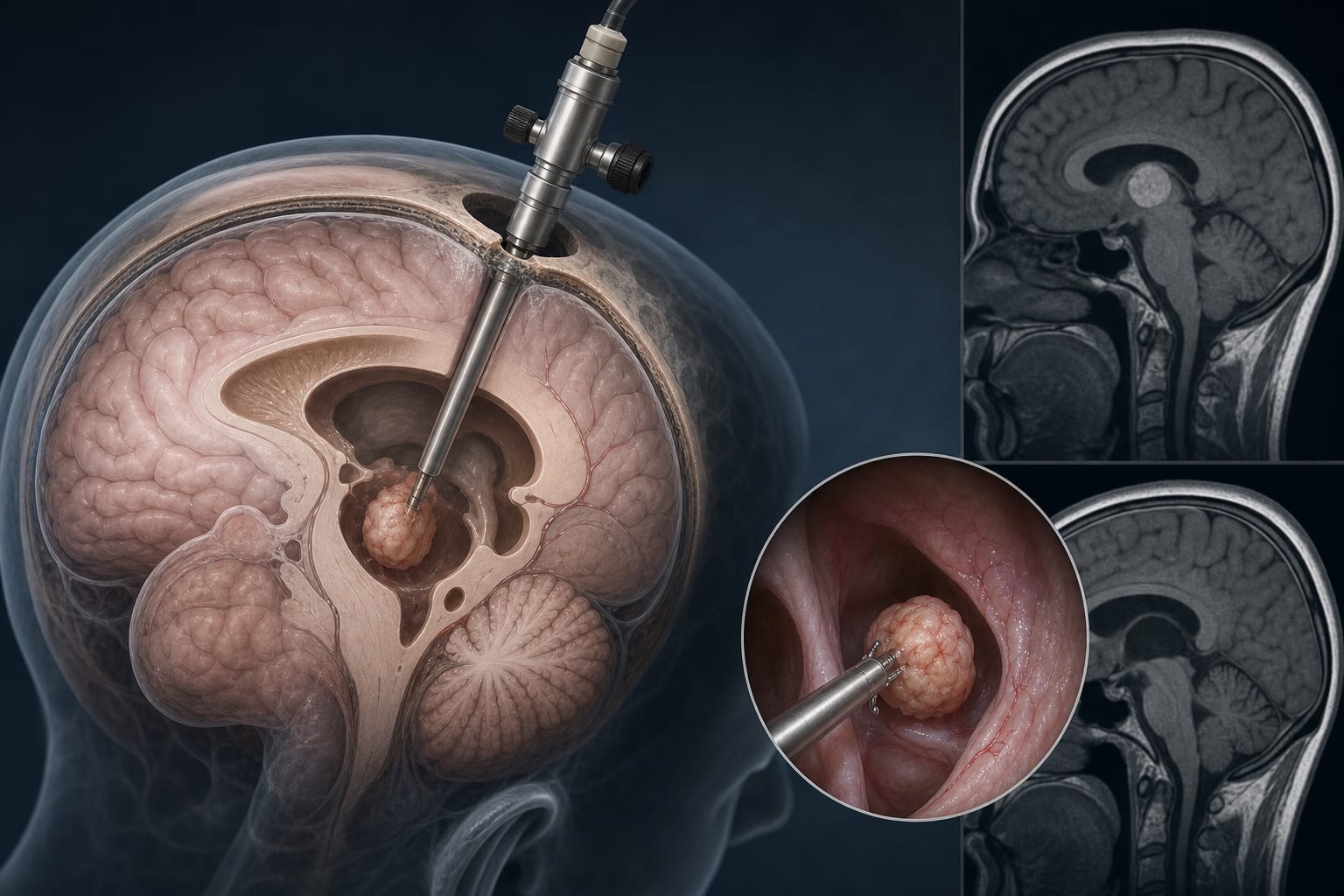
Single Burr-Hole Ventriculoscopy for the Minimally Invasive Resection of Solid Intraventricular Lesions
By
Xinghua Xu
Jiashu Zhang
Zhichao Gan
Qun Wang
Haoyang Zheng
Shiyu Zhang
Xiaolei Chen
June 15, 2026
Clinical Scorecard: Single Burr-Hole Ventriculoscopy for the Minimally Invasive Resection of Solid Intraventricular Lesions
At a Glance
Category Detail
Condition Solid intraventricular lesions Key Mechanisms Single burr-hole pure ventriculoscopic resection Target Population Patients with solid intraventricular lesions Care Setting Neurosurgical department
Key Highlights
Gross-total resection achieved in 92.1% of cases No seizures, cerebrospinal fluid leakage, or permanent neurological deficits reported Transient diplopia in 5.3% of patients; one intracranial infection in 2.6% Mean follow-up of 60 months with no definite lesion recurrence High-resolution 3D-SPACE MRI used for individualized trajectory planning Guideline-Based Recommendations
Diagnosis
Use high-resolution 3D-SPACE MRI for imaging solid intraventricular lesions Management
Consider single burr-hole pure ventriculoscopic resection for selected small solid intraventricular lesions Monitoring & Follow-up
Postoperative MRI to evaluate extent of resection and follow-up for neurological outcomes Risks
Potential for transient diplopia, intracranial infection, and delayed hydrocephalus Patient & Prescribing Data
Patients with radiologically confirmed solid intraventricular lesions
Surgical approach minimizes invasiveness and preserves surrounding neural structures
Clinical Best Practices
Utilize virtual ventriculoscopy for preoperative planning Ensure careful selection of patients based on lesion characteristics and anatomical considerations Related Resources & Content