STAG2 Mutation Is Associated With Improved Posttransplant Survival in Acute Myeloid Leukemia After Low-Intensity Induction
-
By
-
Yu-Sung Chang
-
Hsin-An Hou
-
October 31, 2026
Clinical Scorecard: STAG2 Mutation and Posttransplant Survival After Low-Intensity Induction in AML and Myelodysplastic Neoplasm/AML
At a Glance
| Category | Detail |
|---|---|
| Condition | Newly diagnosed myelodysplastic neoplasm/AML or AML treated with low-intensity induction followed by first allogeneic HSCT. |
| Key Mechanisms | The study evaluated associations of STAG2, DNMT3A, and age with posttransplant survival; it did not establish a biological mechanism for the STAG2 association. |
| Target Population | Adults with newly diagnosed myelodysplastic neoplasm/AML or AML who received low-intensity induction and a first allogeneic transplant at National Taiwan University Hospital. |
| Care Setting | Retrospective, single-center transplant cohort; findings concern post-HSCT outcomes after low-intensity induction. |
Key Highlights
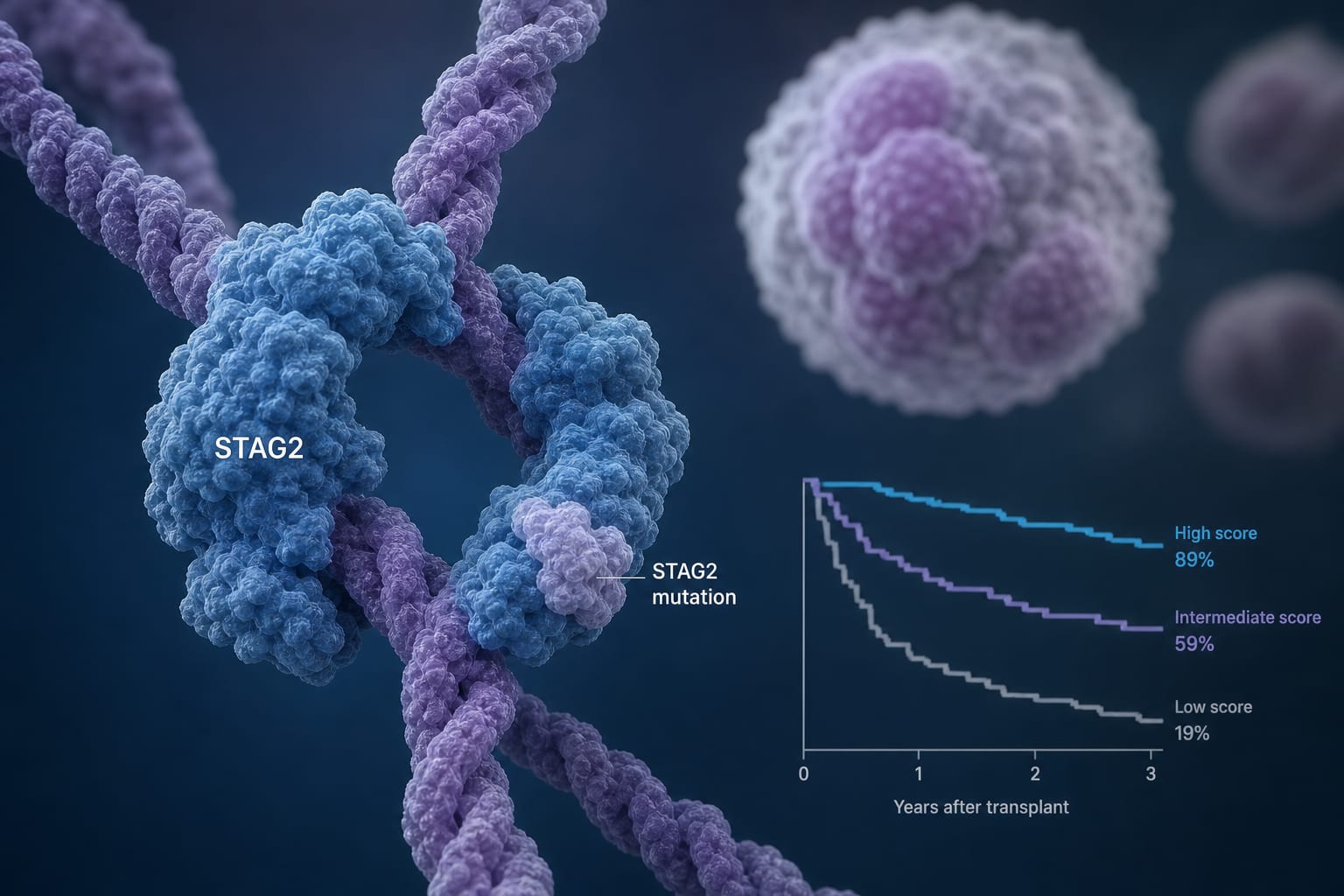
- Among 46 patients, six had STAG2 mutations; none died during a median follow-up of 34.7 months.
- Two-year overall survival was 100% for STAG2-mutated patients and 39.2% for STAG2 wild-type patients (p = 0.028).
- The post-HSCT relapse rate was 37.5% in STAG2 wild-type patients and 0% in STAG2-mutated patients (p = 0.16).
- Age category and DNMT3A mutation status were not associated with overall survival in this cohort; the three-factor score did not stratify survival (p = 0.42).
- The authors state that the small STAG2-mutated subgroup and limited venetoclax-free exposure prevent determining whether the association reflects venetoclax sensitivity or intrinsically more indolent disease.
Guideline-Based Recommendations
Diagnosis
- At diagnosis, mutational profiling was performed using a 54-myeloid-gene next-generation sequencing panel.
Management
- The study describes low-intensity induction followed by first allogeneic HSCT; induction regimens included low-dose cytarabine with or without venetoclax and hypomethylating agents with or without venetoclax.
- The article does not provide a treatment recommendation based on STAG2 status.
Monitoring & Follow-up
- Overall survival was measured from transplantation and estimated using the Kaplan–Meier method, with log-rank comparisons.
- The study also reported post-HSCT relapse rate and relapse-free survival by STAG2 status.
Risks
- The STAG2-mutated subgroup comprised six patients, limiting the precision and interpretation of the association.
- Only one STAG2-mutated patient received venetoclax-free therapy, so the cohort could not distinguish venetoclax sensitivity from intrinsically more indolent disease.
- The age and DNMT3A components of the previously reported score did not replicate as survival predictors in this cohort.
Patient & Prescribing Data
Retrospective cohort of 46 adults with newly diagnosed myelodysplastic neoplasm/AML or AML who received low-intensity induction and a first allogeneic transplant; median age was 63.5 years.
Induction was low-dose cytarabine plus venetoclax in 26 patients, low-dose cytarabine alone in 13, hypomethylating agent plus venetoclax in four, and hypomethylating agent alone in three. Five of six STAG2-mutated patients received venetoclax plus low-dose cytarabine.
Clinical Best Practices
- Interpret the reported STAG2 survival association in light of the small number of mutation-positive patients and the retrospective, single-center cohort.
- Do not assume that the age, DNMT3A, or composite-score associations from the index cohort were reproduced; they were not significant in this cohort.
- The authors identify cohorts with substantial venetoclax-free exposure as necessary to distinguish possible venetoclax sensitivity from intrinsically indolent disease.
Related Resources & Content
Based on findings from:
STAG2 mutation predicts superior posttransplant survival in acute myeloid leukemia treated with low-intensity induction
Yu-Sung Chang, Hsin-An Hou. Blood Cancer Journal, 2026.
https://www.nature.com/articles/s41408-026-01661-1
This content is an AI-generated, fully rewritten summary based on a published scholarly article. It does not reproduce the original text and is not a substitute for the original publication. Readers are encouraged to consult the source for full context, data, and methodology.