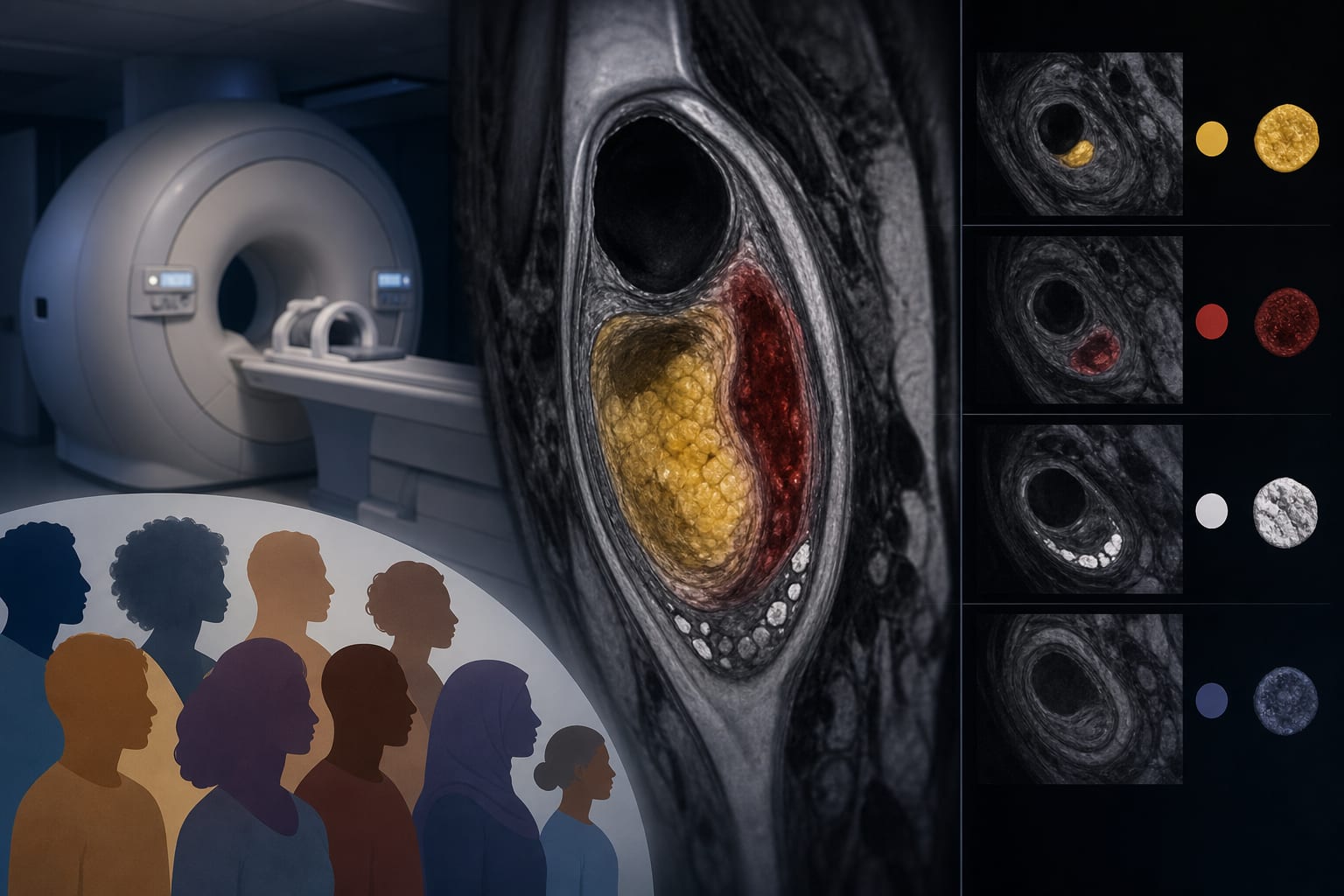
Clinical Scorecard: Assessment of Cardiovascular Risk Factors and Carotid Plaque Composition in a Diverse Population Utilizing 3 Tesla MRI: Insights from the HELIUS Study
At a Glance
Category
Detail
Condition
Carotid Atherosclerosis
Key Mechanisms
Presence of lipid-rich necrotic core (LRNC), intraplaque hemorrhage (IPH), and calcification as indicators of plaque vulnerability and stability.
Target Population
Mid-life participants from a multi-ethnic cohort.
Care Setting
Population-based cohort study
Key Highlights
Study investigates associations between cardiovascular risk factors and carotid plaque composition.
Participants included 356 individuals with cardiovascular risk factors and carotid plaques.
MRI used to assess plaque characteristics, including calcification, LRNC, and IPH.
Study emphasizes the need for research in diverse populations beyond older adults.
Guideline-Based Recommendations
Diagnosis
Utilize 3 Tesla MRI for detailed assessment of carotid plaque characteristics.
Management
Focus on early preventive interventions based on plaque composition findings.
Monitoring & Follow-up
Regular assessment of cardiovascular risk factors in mid-life populations.
Risks
Increased risk of ischemic events associated with vulnerable plaque characteristics.
Patient & Prescribing Data
Mid-life individuals with cardiovascular risk factors.
Understanding plaque composition may guide treatment strategies.
Clinical Best Practices
Incorporate multi-ethnic perspectives in cardiovascular risk assessments.
Use standardized MRI protocols for plaque evaluation.
by Esther M. C. Vriend, Thomas A. Bouwmeester, Daniel Bos, Didier Collard, Eric P. Moll van Charante, Henrike Galenkamp, Renske Merton, Aart J. Nederveen, Pim van Ooij, Oscar H. Franco, Bert-Jan H. van den Born
In a nationwide Finnish cohort, patients with atrial fibrillation and gout had higher ischemic stroke rates, while urate-lowering therapy was associated with lower stroke rates.