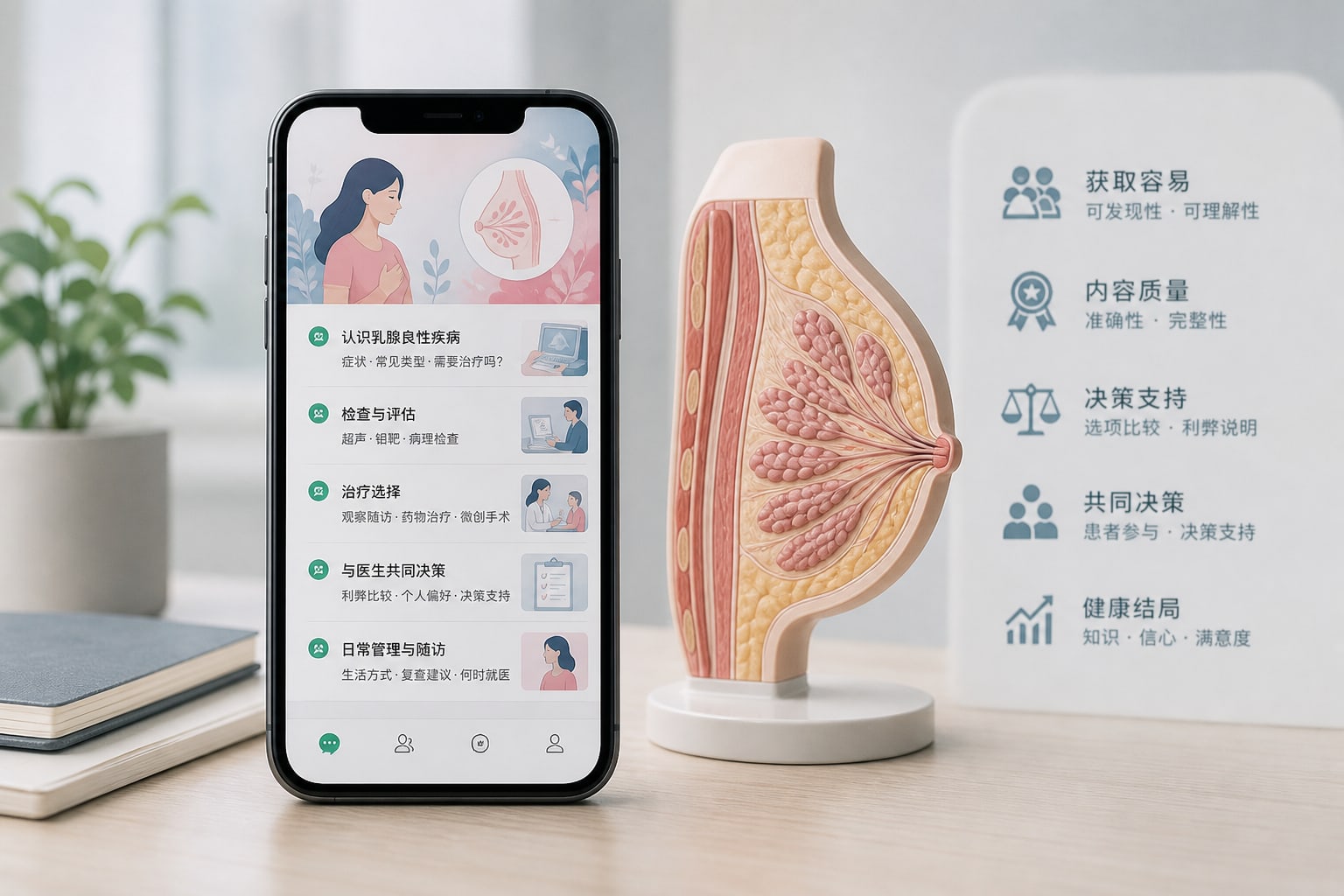
Accessibility and Decision-Supportive Quality of Benign Breast Disease Articles on Chinese Hospital WeChat Public Accounts: Nationwide Cross-Sectional Study - Scorecard - MDSpire
Clinical Scorecard: Accessibility and Decision-Support Quality of Benign Breast Disease Content on Chinese Hospital WeChat Accounts: A Nationwide Cross-Sectional Study
At a Glance
Category
Detail
Condition
Benign breast disease (BBD) and its online patient-education content
Key Mechanisms
BBD management may involve surveillance, biopsy, surgery, or follow-up; choices can depend on lesion-specific risk and patient preferences.
Target Population
People seeking information about BBD through Chinese hospital WeChat public accounts
Care Setting
Digital health information and decision support provided through hospital-operated WeChat accounts in China
Key Highlights
BBD accounts for an estimated 55% to 90% of breast lesions.
Subsequent breast cancer risk varies according to epithelial proliferation and atypia.
BBD management may require individualized choices among surveillance, biopsy, surgery, and follow-up.
The article introduction identifies shared decision-making as recommended for BBD care, particularly for younger female patients.
The supplied article excerpt describes the study rationale but does not provide its methods, results, or conclusions.
Guideline-Based Recommendations
Diagnosis
Management
The introduction reports that American Society of Breast Surgeons and European guidelines recommend shared decision-making for BBD care.
Monitoring & Follow-up
Risks
Breast cancer risk after BBD differs according to epithelial proliferation and atypia.
Patient & Prescribing Data
The article discusses BBD, which is described as occurring predominantly in younger female patients; no study-specific patient sample is provided in the supplied excerpt.
The excerpt describes individualized management options including surveillance, biopsy, surgery, or follow-up. It provides no medication or prescribing data.
Clinical Best Practices
Use shared decision-making when considering BBD management options, as described in the article introduction.
Consider patient-specific risks and informed preferences when choosing among management approaches.
The supplied excerpt does not report study findings about the accessibility or decision-support quality of WeChat content.