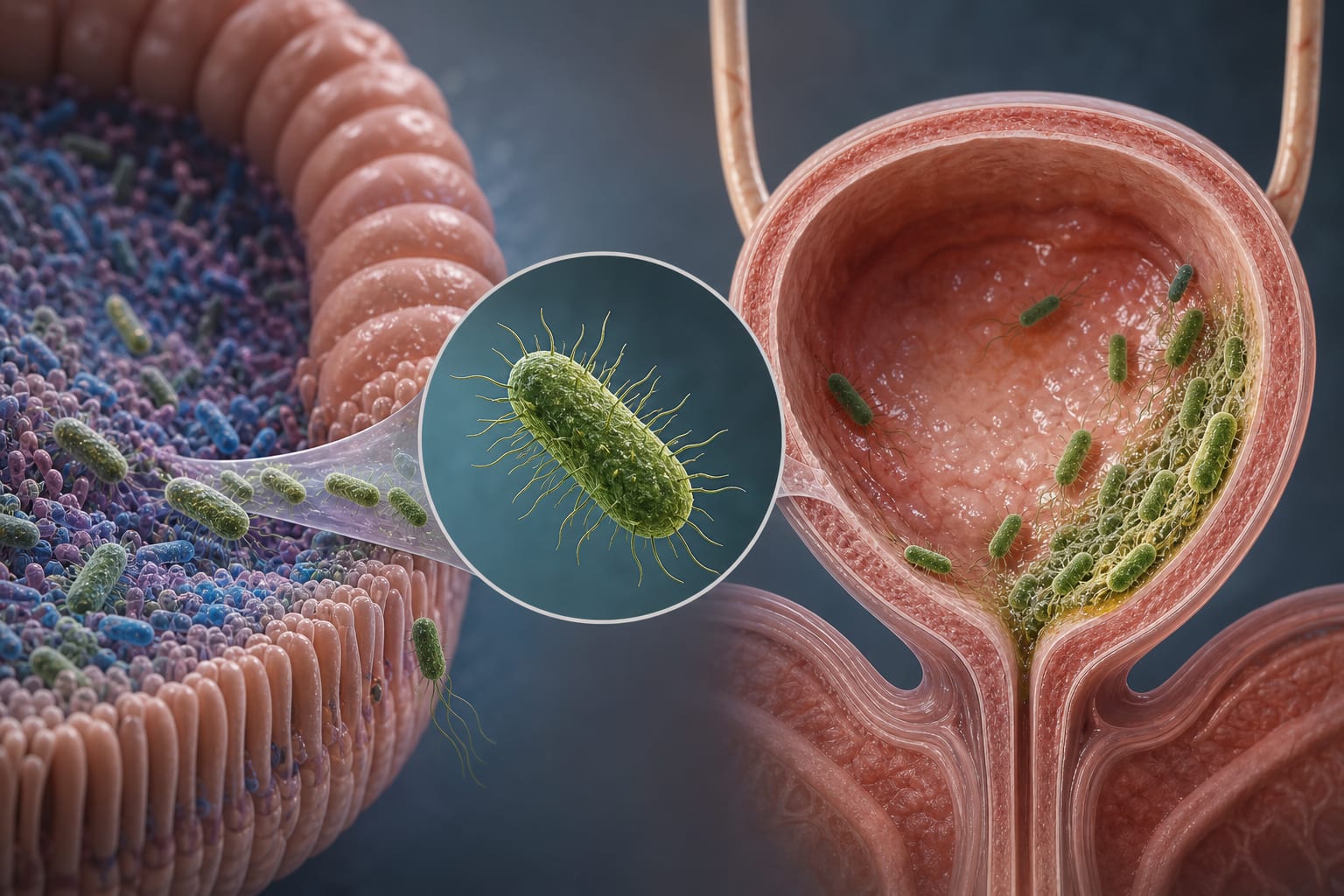
The Dual Role of Escherichia coli: Transitioning from a Commensal Organism to a Pathogen in Urinary Tract Infections
-
By
-
Sabiha Gul
-
July 3, 2026
Clinical Scorecard: The Dual Role of Escherichia coli: Transitioning from a Commensal Organism to a Pathogen in Urinary Tract Infections
At a Glance
| Category | Detail |
|---|---|
| Condition | Urinary Tract Infections (UTIs) |
| Key Mechanisms | Adaptive changes in E. coli facilitate colonization and survival in the urinary tract, including expression of adhesins, toxins, and iron-acquisition systems. |
| Target Population | Individuals at risk of urinary tract infections, particularly those with disrupted microbiota or environmental stress. |
| Care Setting | Clinical microbiology and infectious disease management. |
Key Highlights
- E. coli can act as both a commensal organism in the gut and a pathogen in the urinary tract.
- Uropathogenic E. coli (UPEC) is the leading cause of urinary tract infections.
- Environmental signals such as urine osmolarity and iron limitation trigger the transition of E. coli from commensal to pathogen.
- UPEC utilizes specific adhesins and iron-scavenging systems to colonize the urinary tract.
- The pathogenic potential of E. coli is influenced by its virulence-associated genes.
Guideline-Based Recommendations
Diagnosis
- Identify UPEC through culture and sensitivity testing in patients with suspected UTIs.
Management
- Consider antibiotic therapy based on susceptibility patterns of isolated E. coli strains.
Monitoring & Follow-up
- Monitor for recurrence of UTIs and adjust management strategies accordingly.
Risks
- Increased risk of UTIs in individuals with altered gut microbiota or after antibiotic exposure.
Patient & Prescribing Data
Patients with recurrent urinary tract infections or those at high risk for UTI.
Antibiotic selection should be guided by local resistance patterns and individual patient history.
Clinical Best Practices
- Educate patients on the importance of hydration and proper hygiene to reduce UTI risk.
- Consider probiotics to restore healthy gut microbiota in patients with recurrent UTIs.
Related Resources & Content
Based on findings from:
Double agent: how Escherichia coli switches from commensal to pathogen in the urinary tract infection
Sabiha Gul. Infection, 2026.
https://link.springer.com/article/10.1007/s15010-026-02872-1
This content is an AI-generated, fully rewritten summary based on a published scholarly article. It does not reproduce the original text and is not a substitute for the original publication. Readers are encouraged to consult the source for full context, data, and methodology.