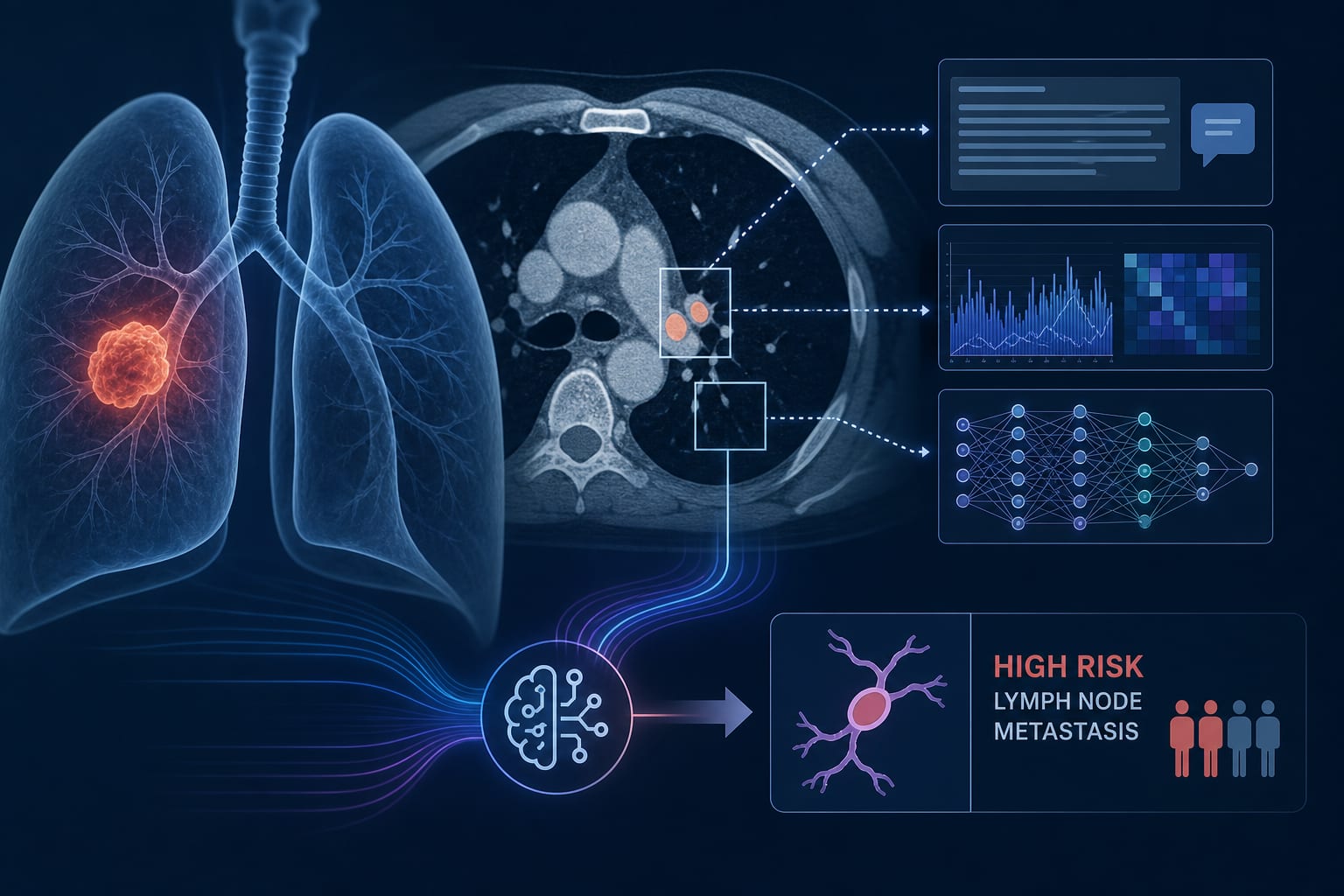
Precision Oncology Is Changing Lung Cancer Treatment
-
By
-
November 17, 2026
-
5 min
Clinical Scorecard: Precision Oncology Is Changing Lung Cancer Treatment
At a Glance
| Category | Detail |
|---|---|
| Condition | Lung cancer, with emphasis on non-small cell lung cancer (NSCLC) |
| Key Mechanisms | Treatment decisions incorporate stage, resectability, tumor biology, molecular biomarkers, disease distribution, and patient-specific factors. |
| Target Population | People undergoing evaluation or treatment for suspected or confirmed lung cancer, including patients with pulmonary nodules and selected patients with resectable, unresectable, or oligometastatic NSCLC. |
| Care Setting | Multidisciplinary thoracic oncology care involving medical oncology, thoracic surgery, radiation oncology, pathology, and imaging. |
Key Highlights
- Evaluate pulmonary nodules using size, morphology, patient-specific risk, location, and change on serial imaging; size alone is insufficient.
- Adequate tissue for histology and appropriate molecular profiling can inform treatment sequencing, including perioperative decisions.
- For selected resectable, locally advanced NSCLC, treatment may include neoadjuvant chemotherapy plus immunotherapy followed by surgery and sometimes postoperative treatment.
- Local treatment of the primary tumor and metastases may be considered with systemic therapy in carefully selected oligometastatic disease.
- Early multidisciplinary coordination supports staging, molecular testing, treatment selection, and clinical trial consideration.
Guideline-Based Recommendations
Diagnosis
- Annual low-dose CT screening is recommended by the U.S. Preventive Services Task Force for adults ages 50 to 80 with a 20-pack-year smoking history who currently smoke or quit within 15 years.
- Assess pulmonary nodules by size, morphology, patient-specific risk, change on serial imaging, composition, location, and prior studies.
- PET/CT can help characterize suspicious lesions and assess disease extent; inflammation may cause false positives, while small or low-metabolic-activity tumors may cause false negatives.
- When tissue is needed, consider CT-guided transthoracic biopsy or robotic-assisted navigational bronchoscopy; the latter can be paired with endobronchial ultrasound-guided sampling of mediastinal and hilar nodes.
- Obtain adequate tissue for histology and appropriate molecular profiling before committing to a treatment sequence.
Management
- Consider EGFR mutations, ALK rearrangements, and PD-L1 expression in the clinical context; the article also describes investigational strategies involving ROS1, HER2, and KRAS G12C alterations.
- For selected patients with resectable, locally advanced NSCLC, neoadjuvant chemotherapy plus immunotherapy may be followed by surgery and sometimes postoperative treatment.
- Use multidisciplinary review for stage 2 and 3 disease, considering molecular status, potential response, functional status, tumor burden, nodal involvement, and extent of disease.
- For unresectable disease, definitive chemoradiation and appropriate consolidation or maintenance therapy remain important.
- In carefully selected oligometastatic disease, surgery or radiation to the primary tumor and metastatic sites may be considered alongside systemic therapy; selection depends on disease distribution, systemic treatment response, and feasibility of comprehensive local therapy.
- For selected small (2 cm or smaller), peripheral, node-negative tumors, segmentectomy may preserve lung parenchyma while achieving appropriate margins and nodal staging; lobectomy remains appropriate for other tumors depending on anatomy, histology, lung function, and nodal status.
Monitoring & Follow-up
- Use serial imaging to assess pulmonary nodule change.
- Systematic lymph node assessment is important during surgery; occult nodal disease may be found on pathology despite negative preoperative PET/CT and endobronchial ultrasound.
- Enhanced recovery protocols address pain control, mobilization, nutrition, and rehabilitation.
Risks
- PET/CT may yield false-positive findings with inflammation and false-negative findings in small or low-metabolic-activity tumors.
- Not all stage 3 tumors are operable, and perioperative immunotherapy is not suitable for every molecular subtype.
- Oligometastatic status alone is not an indication for surgery; evidence on selection and timing continues to evolve.
- Inadequate nodal evaluation risks understaging and may alter postoperative treatment decisions.
Patient & Prescribing Data
The article discusses adults eligible for low-dose CT screening, people with pulmonary nodules, and patients with NSCLC across resectable, unresectable, and oligometastatic settings.
Treatment is individualized according to stage, resectability, molecular findings, functional status, disease extent, and treatment response. The article does not provide drug doses or prescribing schedules.
Clinical Best Practices
- Coordinate thoracic medical oncology, surgery, radiation oncology, pathology, and imaging early, ideally before definitive therapy begins.
- Choose biopsy approach according to lesion accessibility, procedural risk, and the information needed for treatment planning.
- Preserve fundamental oncologic principles during surgery: adequate margins, anatomical resection when indicated, and systematic lymph node assessment.
- Consider clinical trials addressing biomarker-directed therapies, treatment after surgery or chemoradiation, resectability, local control, and treatment sequencing.
Related Resources & Content
Based on findings from:
Precision Oncology Is Changing Lung Cancer Treatment
Baptist Health South Florida, 2026.
https://physicianresources.baptisthealth.net/news/precision-oncology-is-changing-lung-cancer-treatment
This content is an AI-generated, fully rewritten summary based on a published scholarly article. It does not reproduce the original text and is not a substitute for the original publication. Readers are encouraged to consult the source for full context, data, and methodology.