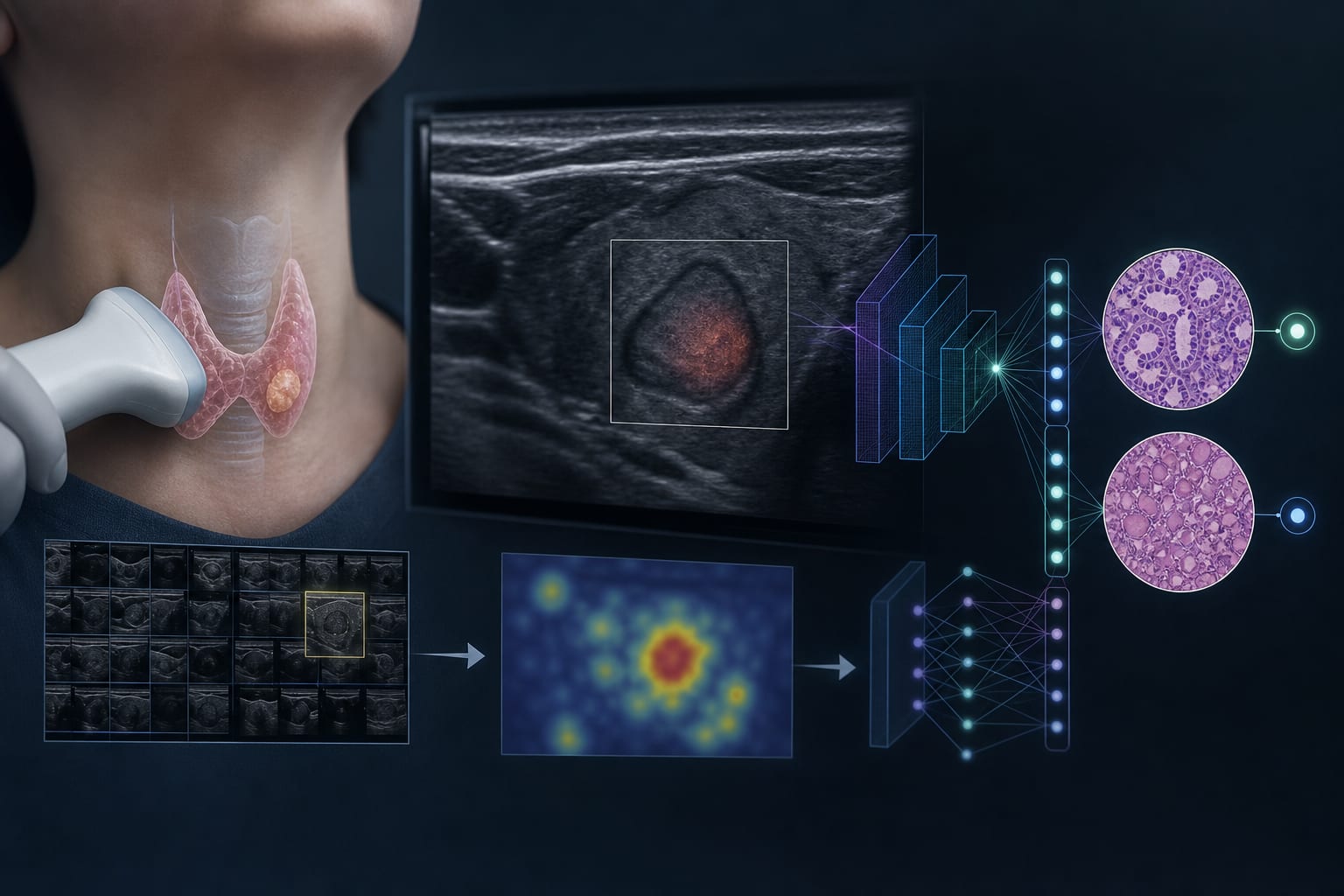
Pathological diagnosis of thyroid nodules directly from ultrasonography by a weakly supervised deep learning framework
-
By
-
Xiao-Wen Hou
-
Mei-Ling He
-
Meng-Yue Ye
-
Jian-Xin Ji
-
Liu-Ying Wang
-
Wei Zhang
-
Yue Zhao
-
Zhen-Zhao Sun
-
Hui-Ru Jiang
-
Ping Li
-
Ji-Hong Wang
-
Fan-Chao Shi
-
Shu-Xin Sun
-
Lei Cao
-
June 1, 2026
-
Clinical Scorecard: Direct Histological Assessment of Thyroid Nodules via Ultrasonography Using a Weakly Supervised Deep Learning Approach
At a Glance
| Category | Detail |
|---|
| Condition | |
| Key Mechanisms | Deep learning framework for histological inference from ultrasound images, utilizing multi-instance learning and dual attention modules. |
| Target Population | |
| Care Setting | |
Key Highlights
- ThyUS2Path framework demonstrated AUCs of 0.754 ± 0.035 and 0.735 ± 0.029 in five-fold cross validation, indicating moderate diagnostic performance.
- Outperformed state-of-the-art MIL-based methods Maxpool and Meanpool, highlighting its effectiveness.
- Achieved AUROCs of 0.70~0.80 and AUPRCs of 0.78~0.83 in external test sets, suggesting good generalizability.
- Utilized 6014 images from 603 patients for training and 1978 images for validation, ensuring a robust dataset.
- Addresses challenges in manual feature extraction and annotation in thyroid nodule assessment, improving diagnostic efficiency.
Guideline-Based Recommendations
Diagnosis
Management
Monitoring & Follow-up
- Regular follow-up imaging for nodules classified as TIRADS stage 3 or higher to assess changes over time.
Risks
Patient & Prescribing Data
Patients with thyroid nodules requiring histological diagnosis.
ThyUS2Path aims to enhance non-invasive diagnosis of thyroid cancer.
Clinical Best Practices
- Utilize deep learning frameworks for improved consistency in ultrasound assessments, incorporating training for radiologists.
- Implement multi-instance learning to manage varying nodule characteristics within patients, ensuring comprehensive training datasets.
Related Resources & Content