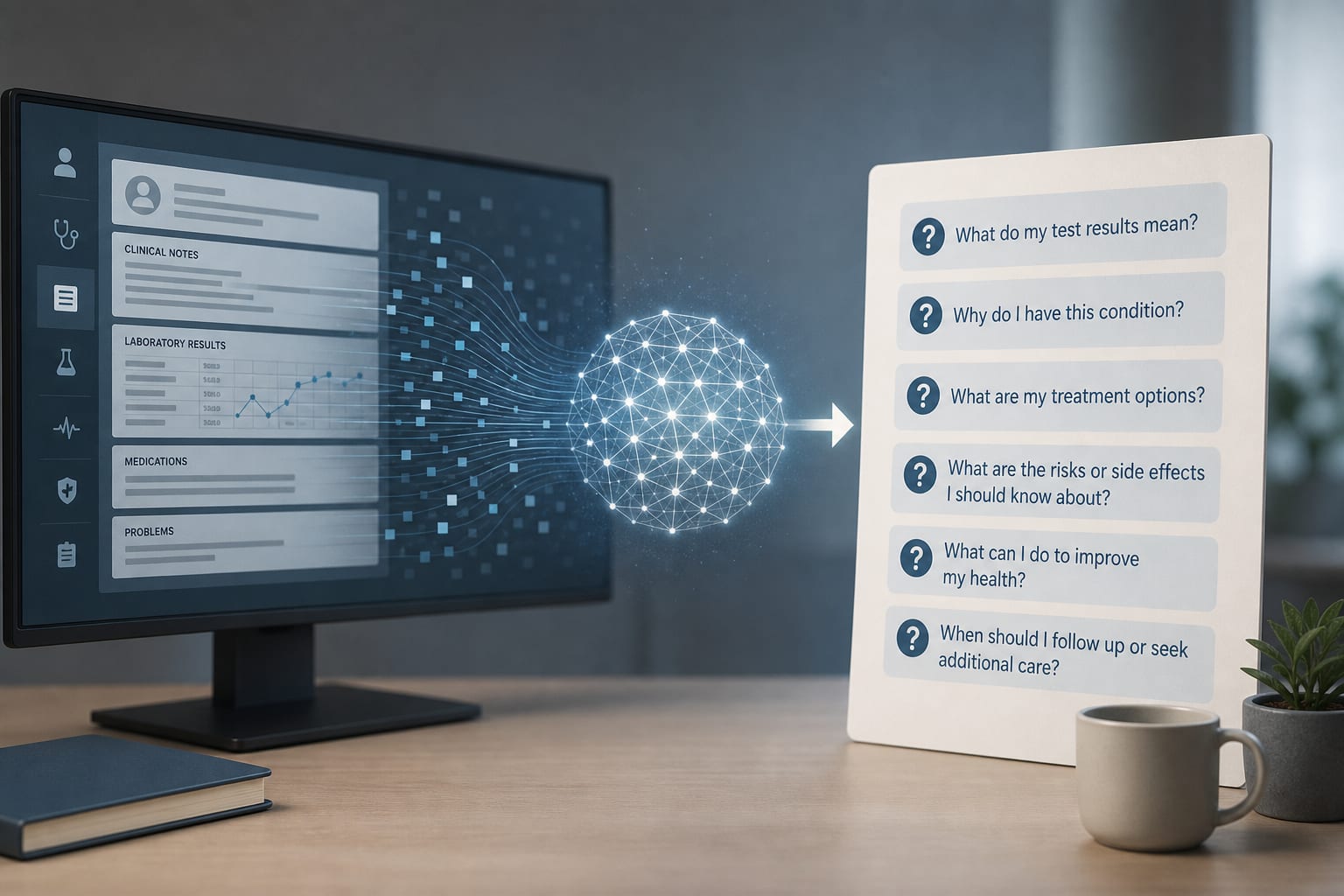
Generating Question Prompt Lists From Electronic Health Record Data Using Large Language Models: Iterative Evaluation Study
By
Zhe He
Balu Bhasuran
Mia Liza A Lustria
Karim Hanna
Michael Killian
Cindy Shavor
Mandy Dailey
Sai Sidharth Manikandan
Xiao Luo
July 9, 2026
Clinical Scorecard: Creating Lists of Inquiry Prompts from EHR Data Utilizing Large Language Models: A Study of Iterative Assessment
At a Glance
Category Detail
Condition Electronic Health Records (EHR) and Patient Communication Key Mechanisms Utilization of large language models (LLMs) to generate tailored question prompt lists (QPLs) from EHR data. Target Population Patients accessing laboratory results through EHR systems, particularly older adults and those with limited health literacy. Care Setting Health systems implementing certified electronic health record systems.
Key Highlights
Patient portals have increased access to laboratory results but often lack context for understanding. Question prompt lists (QPLs) improve patient communication and decision-making. LLMs can generate more accurate and relevant responses to patient inquiries than peer users. AI-assisted messaging can enhance patient satisfaction and reduce clinician workload. Iterative prompt engineering improves the quality of AI-generated responses. Guideline-Based Recommendations
Diagnosis
Management
Monitoring & Follow-up
Risks
Patient & Prescribing Data
Patients using electronic health record systems and patient portals.
LLMs can provide patient-friendly explanations of laboratory results and generate tailored questions.
Clinical Best Practices
Utilize LLMs to create dynamic QPLs based on individual patient data. Ensure patient education materials are accessible and understandable. Incorporate AI-generated responses into clinician workflows to enhance communication. Related Resources & Content