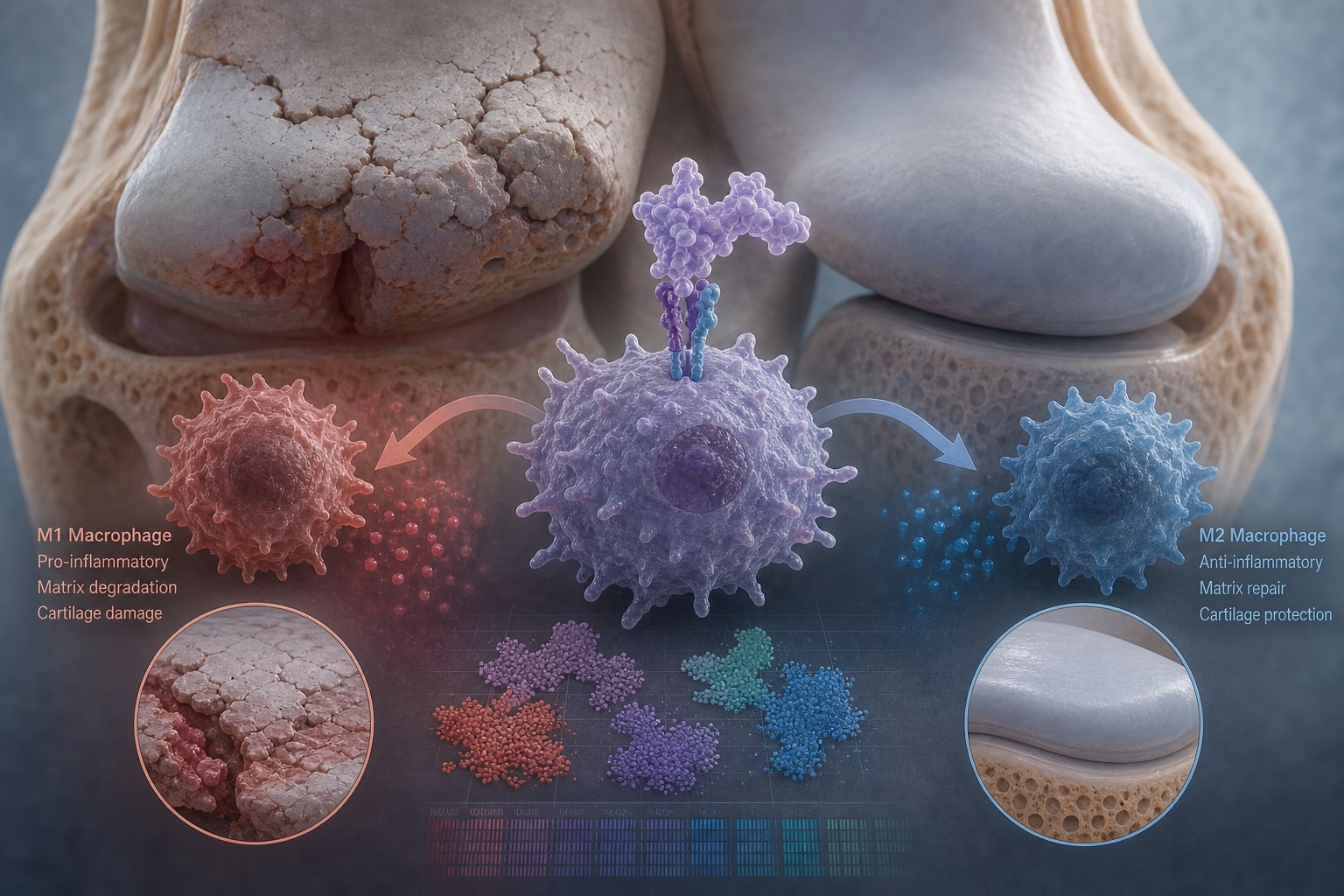
The Role of SEMA4A Signaling in Macrophage Subtypes and Its Relevance to Osteoarthritis
-
By
-
Yue Qiu
-
Shuzhong Huang
-
Bo Yu
-
Baochen Wei
-
Tianyu Ren
-
Xiaofan Yang
-
Zhanying Shi
-
Zhaolan Wei
-
June 5, 2026
Clinical Scorecard: The Role of SEMA4A Signaling in Macrophage Subtypes and Its Relevance to Osteoarthritis
At a Glance
| Category | Detail |
|---|
| Condition | Osteoarthritis (OA) |
| Key Mechanisms | Macrophage polarization imbalance, SEMA4A–PLXNB2 signaling pathway |
| Target Population | Individuals with osteoarthritis |
| Care Setting | Clinical settings involving knee joint assessment and treatment |
Key Highlights
- Osteoarthritis affects approximately 240 million people worldwide.
- M1 macrophages exacerbate cartilage destruction; M2 macrophages promote repair.
- SEMA4A identified as a key gene in macrophage communication during OA progression.
- M1 macrophages act as dominant signal senders in the SEMA4A–PLXNB2 pathway.
- The study provides single-cell-level evidence for inflammatory mechanisms in OA.
Guideline-Based Recommendations
Diagnosis
- Clinical and radiographic confirmation of knee osteoarthritis.
Management
- Potential therapeutic directions include macrophage depletion and M2 polarization.
Monitoring & Follow-up
- Assess changes in macrophage polarization and inflammatory markers.
Risks
- Imbalance in macrophage polarization can lead to persistent inflammation and cartilage degradation.
Patient & Prescribing Data
Patients with knee osteoarthritis undergoing surgical procedures.
Macrophage-targeted therapies may help rebalance M1/M2 ratios.
Clinical Best Practices
- Monitor macrophage polarization in OA patients.
- Consider SEMA4A signaling as a potential therapeutic target.
Related Resources & Content