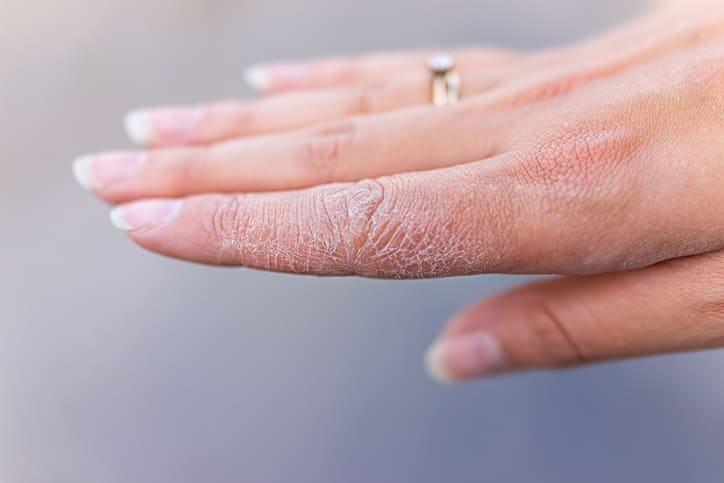
Clinical Scorecard: Palmar lactic acid linked to pathogen defense
At a Glance
Category
Detail
Condition
Clinical topic addressed by the source article: Palmar lactic acid linked to pathogen defense
Key Mechanisms
Mechanisms or clinical associations described in the source article.
Target Population
Patients or participants described in the source article.
Care Setting
Cross-sectional skin assessment and laboratory testing of palmar surface extracts; the study did not establish effects on intact skin or pathogen transmission.
Key Highlights
Higher palmar lactic acid was associated with lower hand-scaling scores (Spearman r = −0.63).
Greater in vitro pathogen-inactivation activity was associated with less scaling for influenza A/H3N2 (r = −0.57), S aureus (r = −0.49), and E coli (r = −0.41).
Lactic acid remained positively associated with activity against all three pathogens in partial correlation analyses accounting for skin pH and temperature; it also remained associated in separate models incorporating hand scaling, sweat rate, and skin pH.
Total ceramide and total amino acid content were not significantly associated with scaling; three ceramide classes showed significant inverse associations.
The cross-sectional design and laboratory assays using extracts cannot establish whether modifying palmar lactic acid improves skin condition or reduces pathogen transmission.
Guideline-Based Recommendations
Diagnosis
Management
Monitoring & Follow-up
Risks
Patient & Prescribing Data
The study included 49 healthy adults aged 20 to 49 years; it did not evaluate a treatment or prescribing intervention.
The findings do not establish that modifying palmar lactic acid improves skin condition or reduces pathogen transmission.
Clinical Best Practices
The source reports that the cross-sectional design prevents causal inference and that the small sample may limit detection of weaker associations and generalizability.
The source notes that laboratory assays using extracted skin components do not establish effects on intact skin or pathogen transmission.
The source identifies potential confounders including moisturizer use, environmental and occupational exposures, hand hygiene, dermatologic conditions, and skin microbiome composition.