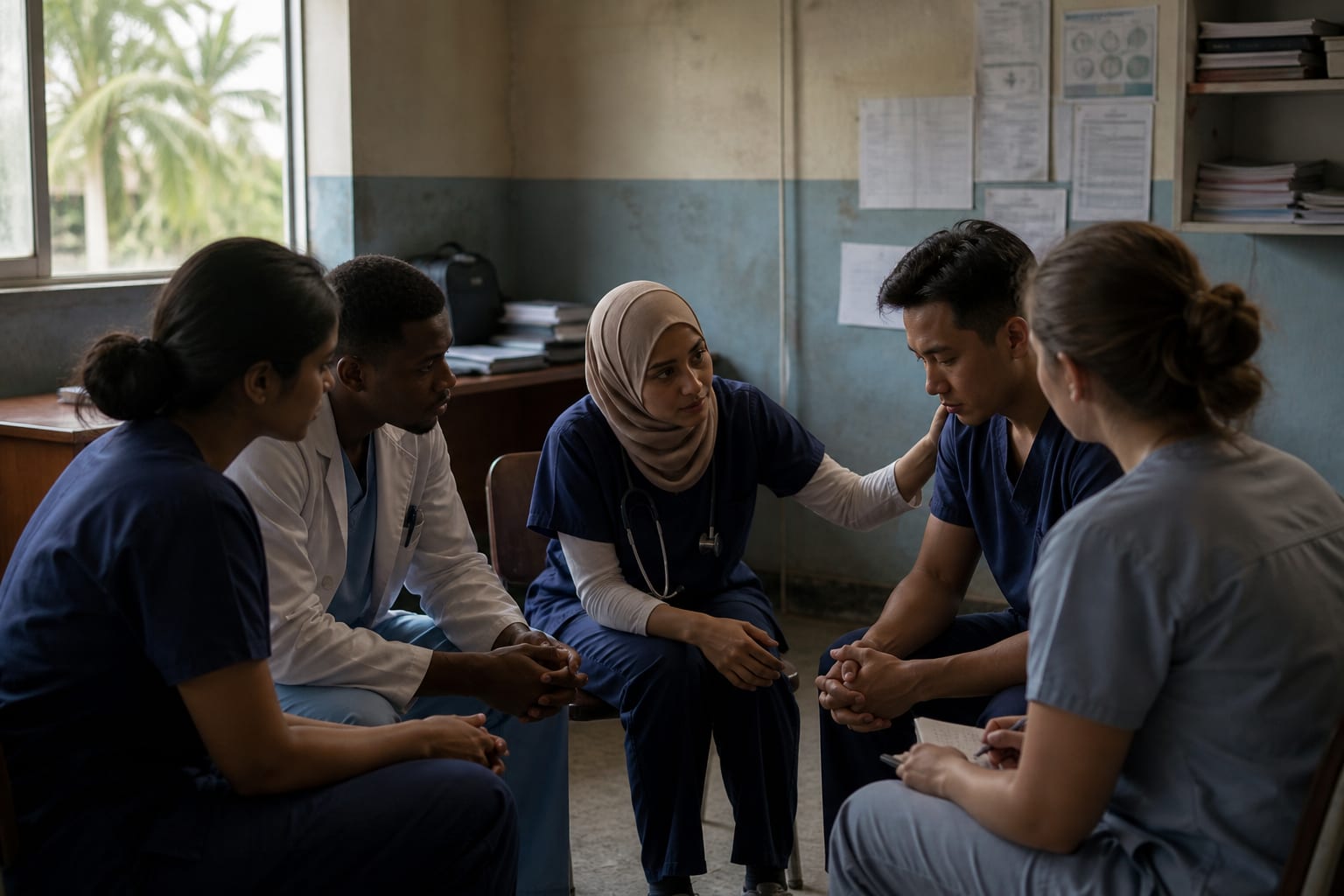
RESIST: Strengthening Resident Resilience in Resource-Limited Settings
-
By
-
Sayed K. Ali
-
Ali K. Chandani
-
Falak Sayed
-
Zohray Talib
-
October 9, 2026
Clinical Scorecard: RESIST: Strengthening Resident Resilience in Resource-Limited Settings
At a Glance
| Category | Detail |
|---|---|
| Condition | Resident stress, burnout, anxiety, and depression in resource-limited training environments |
| Key Mechanisms | RESIST addresses rest and workload, emotional and peer support, resident skills, psychological safety, faculty mentorship and role modeling, and ongoing measurement and improvement. |
| Target Population | Residents and residency programs in low- and middle-income countries |
| Care Setting | Residency training programs in resource-limited institutional and clinical settings |
Key Highlights
- RESIST was developed and implemented at Aga Khan University Hospital in Nairobi after the institution attained ACGME-I accreditation in 2020.
- The program combines six domains: rest and workload hygiene; emotional and collegial support; resident skills development; institutional culture and psychological safety; faculty mentorship and role modeling; and measurement with iterative improvement.
- Workload measures included duty-hour tracking and four part-time locum junior providers; monitored metrics showed reduced resident attrition and lower self-reported burnout.
- Peer support, mentorship, community mental health partnerships, and debriefing were used to support residents after emotionally challenging clinical events.
- The article reports preliminary favorable feedback for some initiatives but notes that formal outcome data remain unavailable for resident skills training.
Guideline-Based Recommendations
Diagnosis
- The article describes resident stress, burnout, anxiety, and depression as well-being concerns; it does not provide diagnostic criteria or a diagnostic protocol.
Management
- Track duty hours, manage workloads, and maintain access to rest, nutrition, exercise, and supervision.
- Use peer-support groups, faculty mentorship, community mental health partnerships, and structured debriefing after critical clinical events.
- Provide practical training in sleep hygiene, fatigue management, early burnout recognition, and awareness of substance use.
- Create protected opportunities for dialogue, including town halls, small-group debriefs, wellness check-ins, and anonymous reporting.
Monitoring & Follow-up
- Measure resident well-being and program outcomes and use findings for iterative improvement.
- The article reports monitored reductions in resident attrition and self-reported burnout after workload measures; it describes a formal longitudinal evaluation of faculty–resident engagement as being developed.
Risks
- The article identifies high patient volumes, workforce shortages, departmental conflict, difficulty balancing professional and personal responsibilities, and maladaptive coping, including substance use, as factors associated with burnout.
- The article states that trainee distress may impair patient care through increased error rates, weaker communication, and lower patient satisfaction.
Patient & Prescribing Data
Not applicable; the article concerns resident well-being and residency-program design, not patient prescribing.
No medication or prescribing recommendations are provided. The described interventions are educational, organizational, peer-support, and workload measures.
Clinical Best Practices
- Adapt resiliency initiatives to local resources; the article describes tiered options such as rotating elective coverage or task-shifting where staffing resources are more constrained.
- Provide confidential referral pathways for substance-use concerns using institutional and community resources.
- Reduce hierarchical barriers through anonymous reporting, resident-selected faculty mentors, and protected settings for candid discussion.
- Consider workload and documentation burden together; the article reports that a less expensive electronic health record additionally reduced documentation burden.
Related Resources & Content
Based on findings from:
RESIST: Addressing Resident Resiliency in Low-Resource Settings
Sayed K. Ali, Ali K. Chandani, Falak Sayed, Zohray Talib. Journal Of General Internal Medicine, 2026.
https://link.springer.com/article/10.1007/s11606-026-10896-4
This content is an AI-generated, fully rewritten summary based on a published scholarly article. It does not reproduce the original text and is not a substitute for the original publication. Readers are encouraged to consult the source for full context, data, and methodology.