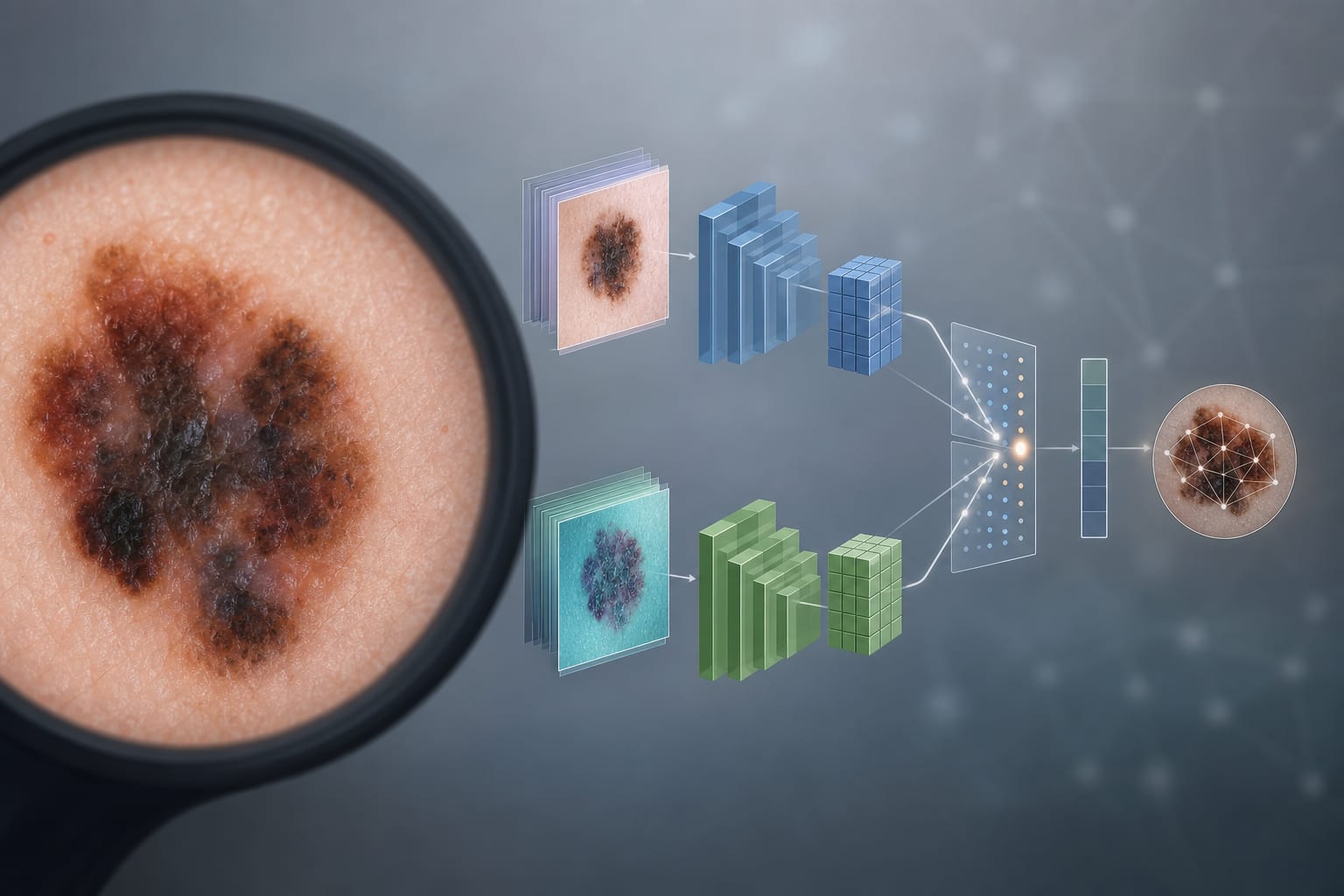
Ensemble-Enhanced Skin Lesion Classification Using Dual Concatenated Transfer Learning with Attention Fusion
By
Probal Bhowmick
Julia Rahman
Anwar Hossain Efat
Tasfi Fairoz Nidhi
Dipanjan Karmaker Amit
June 8, 2026
Clinical Scorecard: Ensemble-Enhanced Skin Lesion Classification Using Dual Concatenated Transfer Learning with Attention Fusion
At a Glance
Category Detail
Condition Key Mechanisms Use of AI, ML, and DL for skin lesion detection and classification, including attention mechanisms. Target Population Care Setting
Key Highlights
Skin lesions are early indicators of dermatological disorders. Melanoma accounts for the majority of skin cancer-related fatalities. AI can enhance self-screening for skin cancer. Class imbalance in datasets affects model performance. Attention mechanisms improve feature extraction in lesion images. Model evaluation should include metrics like Precision, Recall, F1-score, Specificity, and ROC-AUC. Guideline-Based Recommendations
Diagnosis
Early detection of skin lesions is crucial to prevent serious illnesses. Management
Utilize AI and deep learning techniques for improved skin lesion classification. Address class imbalance during model training. Monitoring & Follow-up
Evaluate model performance using accuracy, Precision, Recall, F1-score, Specificity, and ROC-AUC curves. Risks
High cost and time for formal clinical consultations may delay diagnosis. Patient & Prescribing Data
Individuals suffering from skin diseases, including melanoma.
AI and machine learning can facilitate better diagnosis and awareness.
Clinical Best Practices
Implement data augmentation strategies to address class imbalance. Incorporate attention mechanisms to enhance model performance. Use multi-level ensembling to improve robustness and generalization, ensuring balanced performance across all lesion classes. Related Resources & Content