Association of achieved LDL-C levels with global coagulability and clinical outcomes in patients with acute coronary syndrome receiving PCSK9 inhibitors: a prospective cohort study - Scorecard - MDSpire
Conexiant’s news site is now MDSpire News. Learn more
Advertisement
Impact of Target LDL-C Levels on Global Coagulability and Clinical Outcomes in Acute Coronary Syndrome Patients Treated with PCSK9 Inhibitors: Findings from a Prospective Cohort Study
Clinical Scorecard: Impact of Target LDL-C Levels on Global Coagulability and Clinical Outcomes in Acute Coronary Syndrome Patients Treated with PCSK9 Inhibitors: Findings from a Prospective Cohort Study
At a Glance
Category
Detail
Condition
Acute Coronary Syndrome (ACS)
Key Mechanisms
LDL-C levels, platelet reactivity, global coagulability
Target Population
Post-PCI ACS patients on dual antiplatelet therapy
Care Setting
Single-center cohort study
Key Highlights
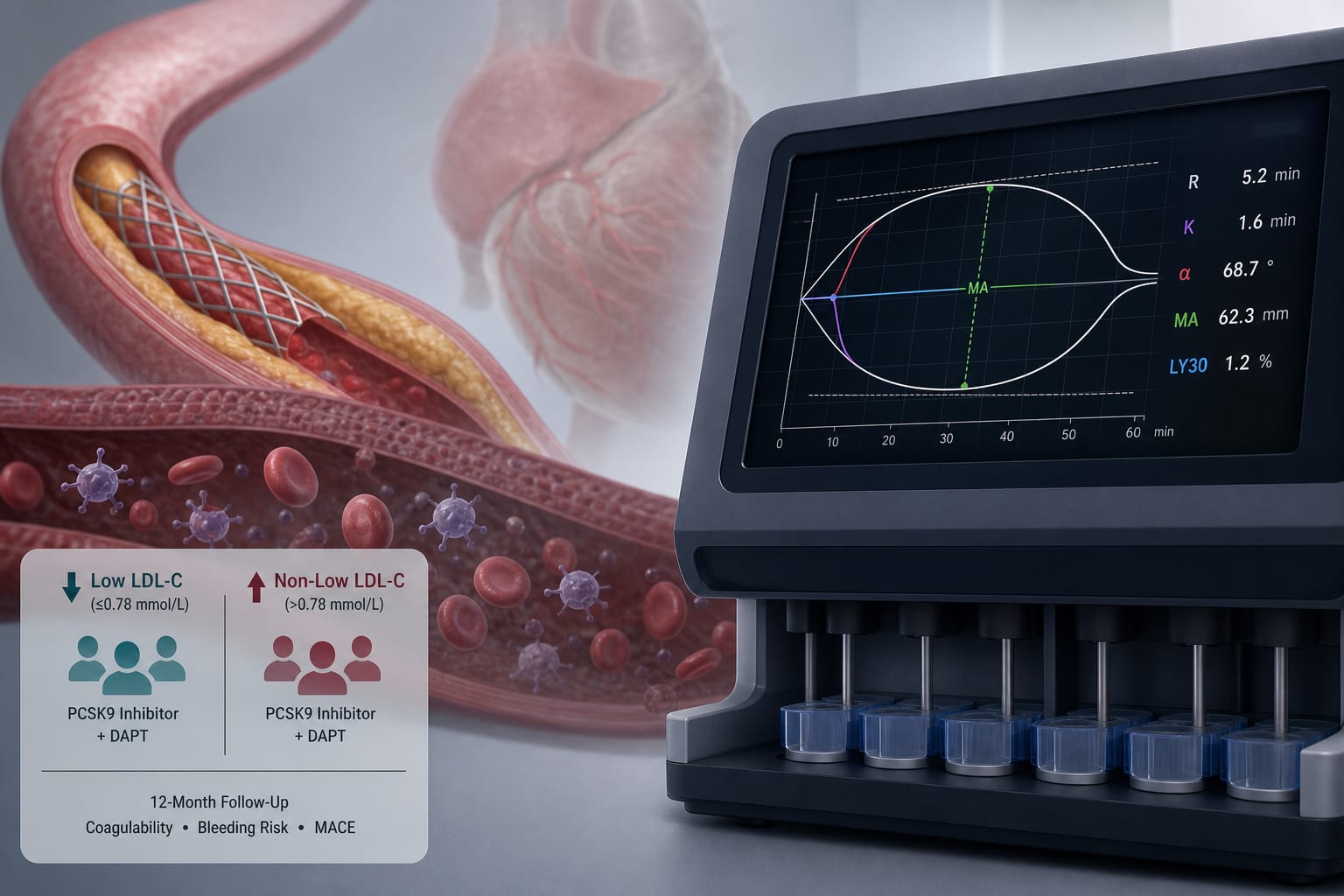
120 post-PCI ACS patients treated with PCSK9 inhibitors and DAPT were enrolled.
Clinically relevant bleeding rates were similar between Low LDL-C (6.7%) and Non-Low LDL-C (5.0%) groups.
No significant differences in global coagulability and specific platelet reactivity were observed.
Major adverse cardiovascular events occurred in 6.7% of the Low LDL-C group and 13.3% of the Non-Low LDL-C group.
Guideline-Based Recommendations
Diagnosis
Management
Intensive LDL-C lowering for very high-risk patients is endorsed, targeting levels below 1.4 mmol/L.
Monitoring & Follow-up
Risks
Safety of achieving low LDL-C levels regarding bleeding risk remains under scrutiny.
Patient & Prescribing Data
Post-PCI ACS patients on dual antiplatelet therapy
Achieving LDL-C levels ≤0.78 mmol/L did not increase bleeding risk or alter coagulability.
Clinical Best Practices
Integrate potent antiplatelet therapy with intensive lipid-lowering strategies post-PCI.
A structured overview of recent FDA recalls, corrections, and alerts involving medications, ventilators, insulin delivery systems, cardiovascular devices, anesthesia products, and other equipment used in clinical practice.