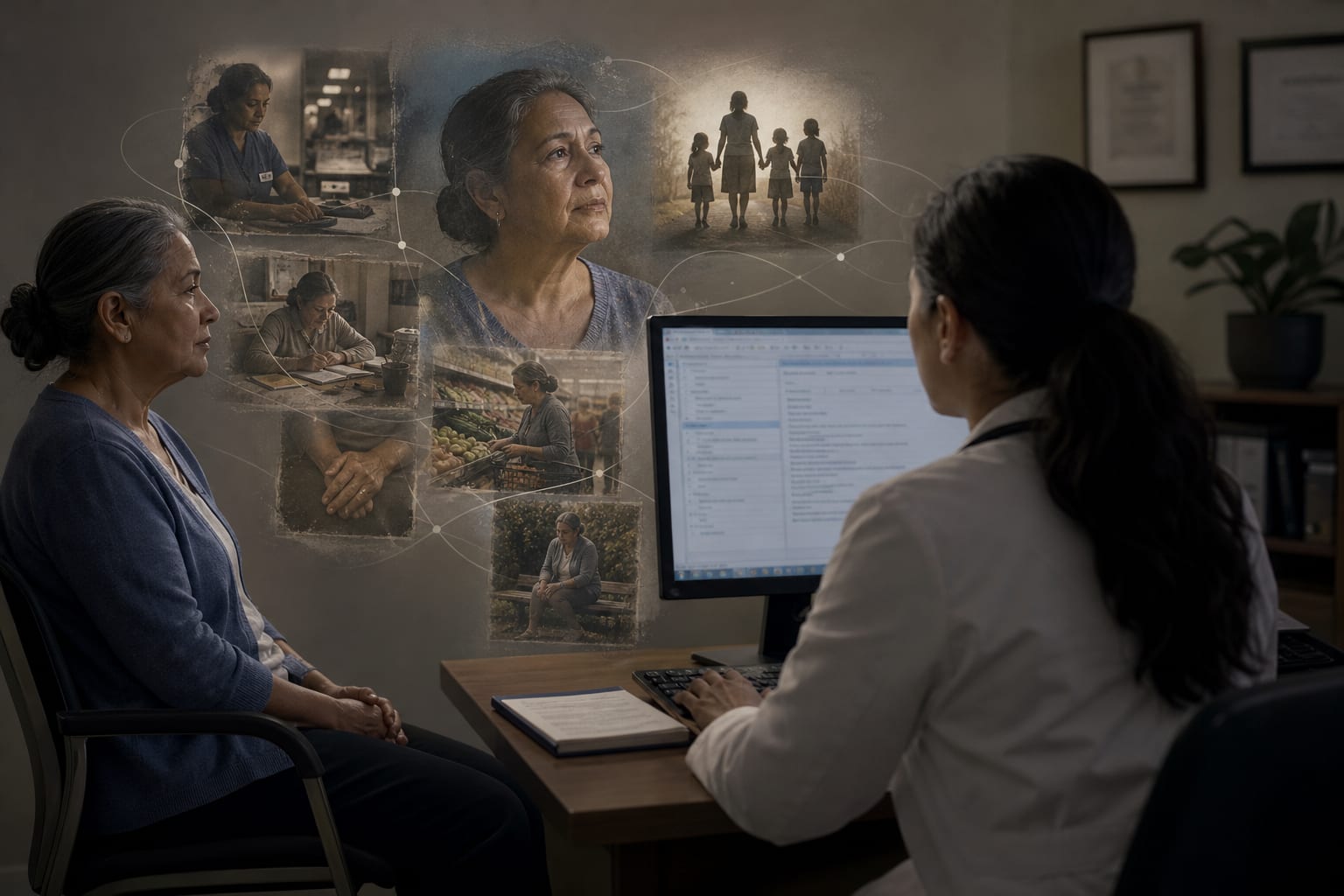
How Medicine Lost Sight of the Value of Clinical Storytelling
-
By
-
Kieran L. Quinn
-
Allan S. Detsky
-
November 18, 2026
Clinical Scorecard: How Medicine Lost Sight of the Value of Clinical Storytelling
At a Glance
| Category | Detail |
|---|---|
| Condition | Clinical storytelling and narrative formulation in patient care |
| Key Mechanisms | Narrative formulation brings symptoms, circumstances, uncertainties, and patient priorities together to inform care. The clinical note records the account and the reasoning underlying the plan; templates and throughput incentives may leave the conversation or reasoning unrepresented. |
| Target Population | Patients and caregivers, clinicians, medical trainees, and institutions involved in clinical encounters and documentation |
| Care Setting | Clinical encounters and medical education, including settings using electronic health records |
Key Highlights
- A patient’s circumstances and concerns may affect which care options are feasible and meaningful, but do not establish the cause or outcome of a symptom.
- A useful clinical narrative makes uncertainty visible and shows how patient priorities influence available choices.
- The article attributes reduced attention to storytelling partly to time constraints and incentives that reward measurable throughput and documentation completion.
- Narrative medicine is included in more than 80% of medical school curricula in Europe and the United States, often as an elective.
Guideline-Based Recommendations
Diagnosis
- Use questioning, focused examination, and health-record review to understand the illness alongside the patient’s circumstances and priorities.
- Do not treat awareness of a patient’s fears or circumstances as evidence that a feared outcome will occur or as an explanation for symptoms.
Management
- Consider how patient priorities and practical circumstances affect the feasibility of proposed care, including time, attendance, and expense.
- Preserve the conversation and reasoning that make the clinical note useful; longer notes alone do not ensure that narrative formulation has occurred.
Monitoring & Follow-up
- Teachers can ask trainees how a patient’s circumstances altered their assessment or plan.
- The article describes throughput and documentation demands as competing with efforts to understand a patient’s circumstances.
Risks
- Templates and abbreviated social histories may omit concerns and circumstances relevant to discussion and care choices.
- Throughput and documentation demands may crowd out the conversation and reasoning needed to formulate a patient narrative.
- Requiring longer notes may take additional time without resolving the underlying constraints.
Patient & Prescribing Data
The article discusses patients and caregivers generally and illustrates the topic with a 63-year-old woman with knee pain, work and caregiving responsibilities, limited resources, and concern about future mobility.
No specific treatment or prescribing regimen is provided. The article recommends considering whether proposed care is feasible in light of the patient’s priorities, time, and resources.
Clinical Best Practices
- Elicit the concern that prompted the visit rather than assuming it is identical to the presenting symptom.
- Ask which activities and outcomes matter most to the patient and what practical barriers may affect the plan.
- Document the reasoning behind the plan, including relevant uncertainty and how patient priorities shaped available choices.
- Support narrative medicine through ongoing education and clinical practice, not education alone.
Related Resources & Content
Based on findings from:
The Vanishing Narrative: How Medicine Stopped Valuing Its Most Important Skill
Kieran L. Quinn, Allan S. Detsky. Journal Of General Internal Medicine, 2026.
https://link.springer.com/article/10.1007/s11606-026-11006-0
This content is an AI-generated, fully rewritten summary based on a published scholarly article. It does not reproduce the original text and is not a substitute for the original publication. Readers are encouraged to consult the source for full context, data, and methodology.