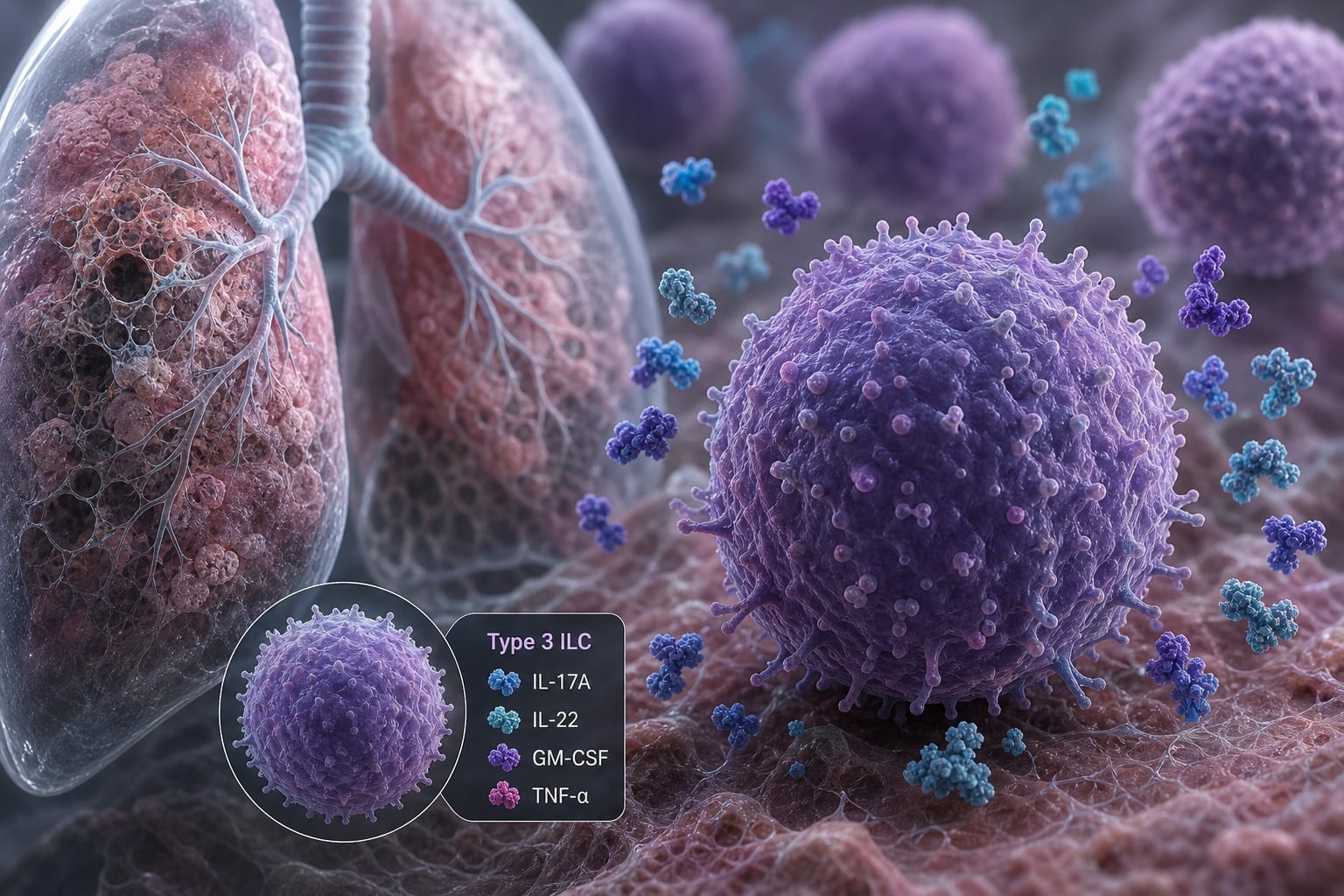
Type 3 innate lymphoid cells dominate the ILC compartment in endstage lung disease
-
By
-
Olga Halle
-
Jan-Niklas Falke
-
Claudia Kessemeier
-
Khatuna Lobjanidze
-
Emily Fuchshuber
-
Sean Brüske
-
Svenja Gaedcke
-
Marina Schumacher
-
Londa Dähne
-
Jonas Knaup
-
Maresa Borghorst
-
Sophia Pallenberg
-
Melanie Albrecht
-
Adan Chari Jirmo
-
Jana Bergmann
-
Michelle Paulsen
-
Danny Jonigk
-
Peter Braubach
-
Anna-Maria Dittrich
-
June 10, 2026
-
Clinical Scorecard: Type 3 Innate Lymphoid Cells Predominate in the ILC Population of Advanced Lung Disease
At a Glance
| Category | Detail |
|---|
| Condition | |
| Key Mechanisms | Type 3 ILCs dominate and contribute to pro-inflammatory cytokine milieu, particularly IL-17A. |
| Target Population | |
| Care Setting | |
Key Highlights
- Type 3 ILCs are predominant in lung and LN tissues of endstage lung disease patients.
- Type 2 ILCs are increased in peripheral blood of clinically stable CF patients.
- ILC-derived cytokines contribute to chronic inflammation and tissue remodeling.
- Differences in ILC composition persist despite treatment with CFTR modulators.
- Study involved analysis of 58 lung donors and 107 lung transplant recipients.
- Sustained changes in ILC composition observed even after 24 months of treatment.
Guideline-Based Recommendations
Diagnosis
- Characterization of ILCs in lung and LN tissues for understanding endstage lung disease using flow cytometry and cytokine profiling.
Management
- Consideration of ILC composition in treatment strategies for chronic lung diseases.
Monitoring & Follow-up
- Longitudinal assessment of ILC populations every 3-6 months in response to treatment.
Risks
- Persistent alterations in ILC composition may reflect underlying pathological processes.
Patient & Prescribing Data
Changes in ILC composition observed even after 24 months of treatment, indicating potential implications for treatment efficacy.
Clinical Best Practices
- Monitor ILC populations in patients with chronic lung diseases at regular intervals.
- Evaluate the impact of ILC-derived cytokines on treatment outcomes.
Related Resources & Content