Extent of the low-density line is associated with time to fracture in children with congenital anterolateral bowing of the tibia: a retrospective survival analysis - Scorecard - MDSpire
Advertisement
Extent of the low-density line is associated with time to fracture in children with congenital anterolateral bowing of the tibia: a retrospective survival analysis
Clinical Scorecard: Association Between Low-Density Line Extent and Fracture Timing in Pediatric Patients with Congenital Anterolateral Bowing of the Tibia: A Retrospective Survival Study
At a Glance
Category
Detail
Condition
Congenital Anterolateral Bowing of the Tibia (ALBT)
Key Mechanisms
Low-density line (LDL) as a radiographic feature associated with fracture risk.
Target Population
Children diagnosed with ALBT and radiographically confirmed LDL.
Care Setting
Pediatric orthopedic care at Hunan Children's Hospital.
Key Highlights
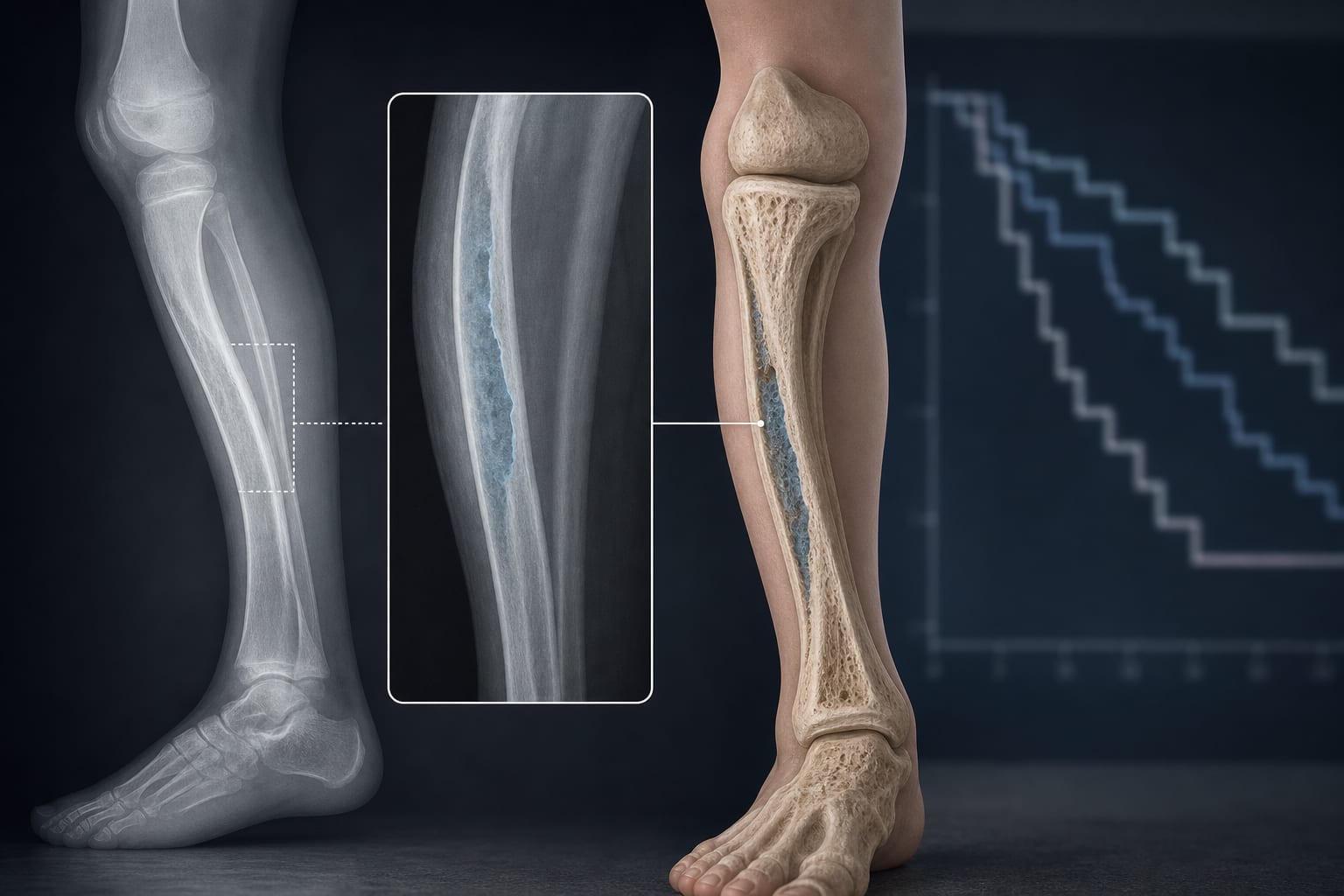
77.5% of children experienced fractures, with 61.3% occurring within 6 months after LDL detection.
Kaplan–Meier analysis indicated significant differences in fracture-free survival among LDL proportion groups.
Median times to fracture were 567 days for <1/3 LDL, 155 days for 1/3–2/3 LDL, and 107 days for >2/3 LDL.
Larger LDL proportions were associated with shorter time to fracture.
Further validation in larger prospective studies is required.
Guideline-Based Recommendations
Diagnosis
Diagnosis of non-Crawford type IV congenital pseudarthrosis of the tibia (CPT) based on radiographic features.
Management
Close monitoring of children with LDL detected on radiographs, especially within the first 6 months.
Monitoring & Follow-up
Consideration of LDL extent for time-based risk stratification and follow-up.
Risks
Increased fracture risk associated with larger LDL proportions.
Patient & Prescribing Data
Children under 18 years with ALBT and LDL.
Treatment strategies may include surgical or conservative approaches, tailored to individual cases.
Clinical Best Practices
Utilize LDL as an imaging marker for assessing fracture risk in pediatric ALBT.
Implement timely interventions based on LDL detection and extent.