Comparison of hybrid surgeries for the treatment of three-level cervical degenerative disease: a systematic review and network meta-analysis - Scorecard - MDSpire
Clinical Scorecard: Evaluation of Hybrid Surgical Approaches for Managing Three-Level Cervical Degenerative Disease: A Systematic Review and Network Meta-Analysis
At a Glance
Category
Detail
Condition
Cervical Degenerative Disease (CDD)
Key Mechanisms
Degenerative pathological changes in the cervical spine leading to compression of the spinal cord, nerve roots, or vertebral artery.
Target Population
Patients with three-level cervical degenerative disease who have not improved with conservative therapy.
Care Setting
Surgical management of multisegmental cervical degenerative disease.
Key Highlights
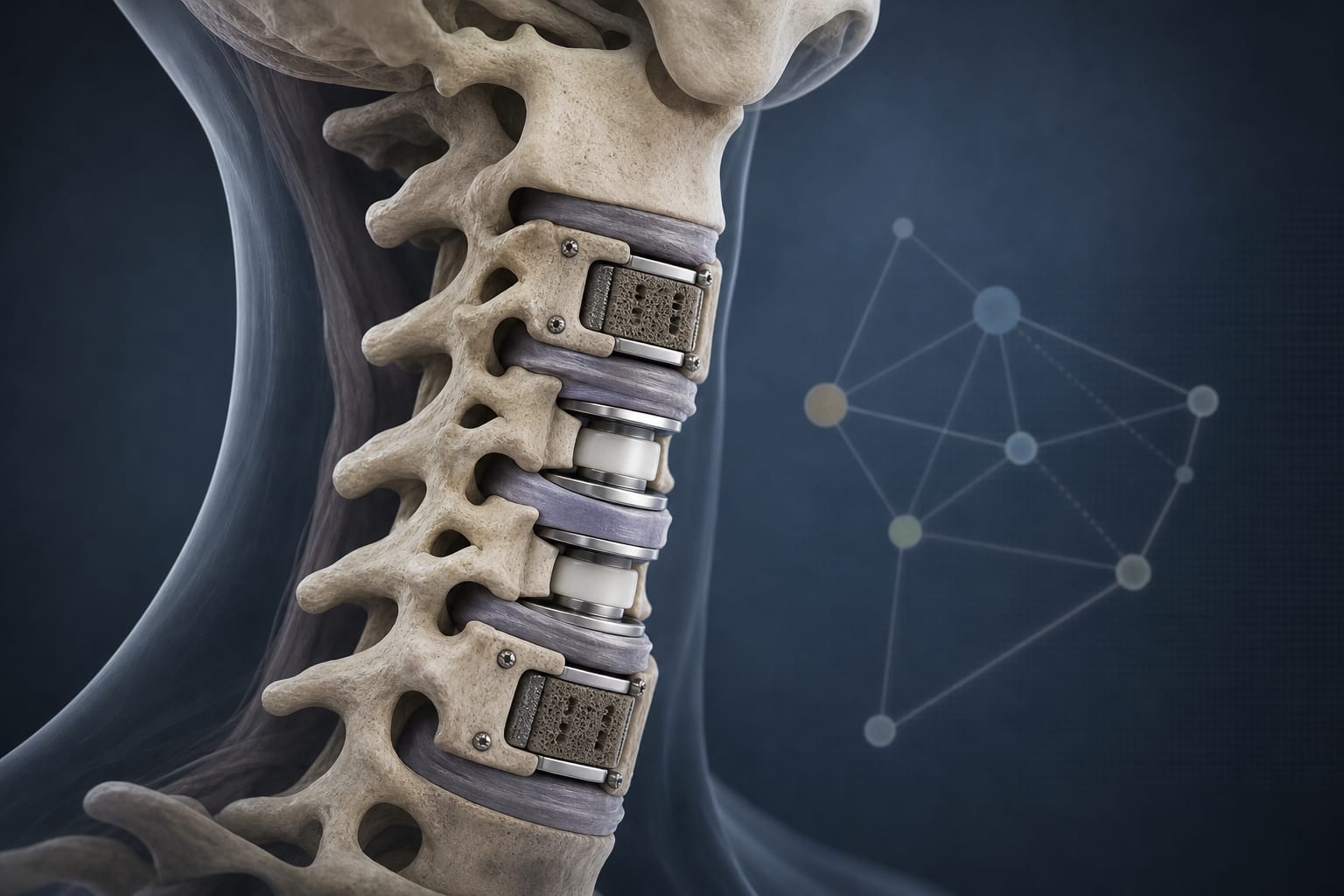
Hybrid surgery (HS1 and HS2) preserves C2-7 range of motion better than ACDF.
HS1 (1-level TDR with 2-level ACDF) shows lower Neck Disability Index compared to ACDF.
No significant difference in range of motion between HS1 and HS2.
Incidence of adjacent segment degeneration (ASD) is similar across HS1, HS2, and ACDF.
Guideline-Based Recommendations
Diagnosis
Confirm three-level CDD through CT or MRI.
Management
Consider hybrid surgery (HS1 or HS2) or ACDF based on the severity of degeneration.
Monitoring & Follow-up
Assess clinical and radiological outcomes post-surgery.
Risks
Monitor for complications such as ASD and revision surgery rates.
Patient & Prescribing Data
Patients with three-level CDD who have failed conservative treatment.
HS1 and HS2 may offer better preservation of cervical motion compared to ACDF.
Clinical Best Practices
Utilize hybrid surgical approaches for targeted treatment of multisegmental CDD.
Evaluate the degree of degeneration to select appropriate surgical method.