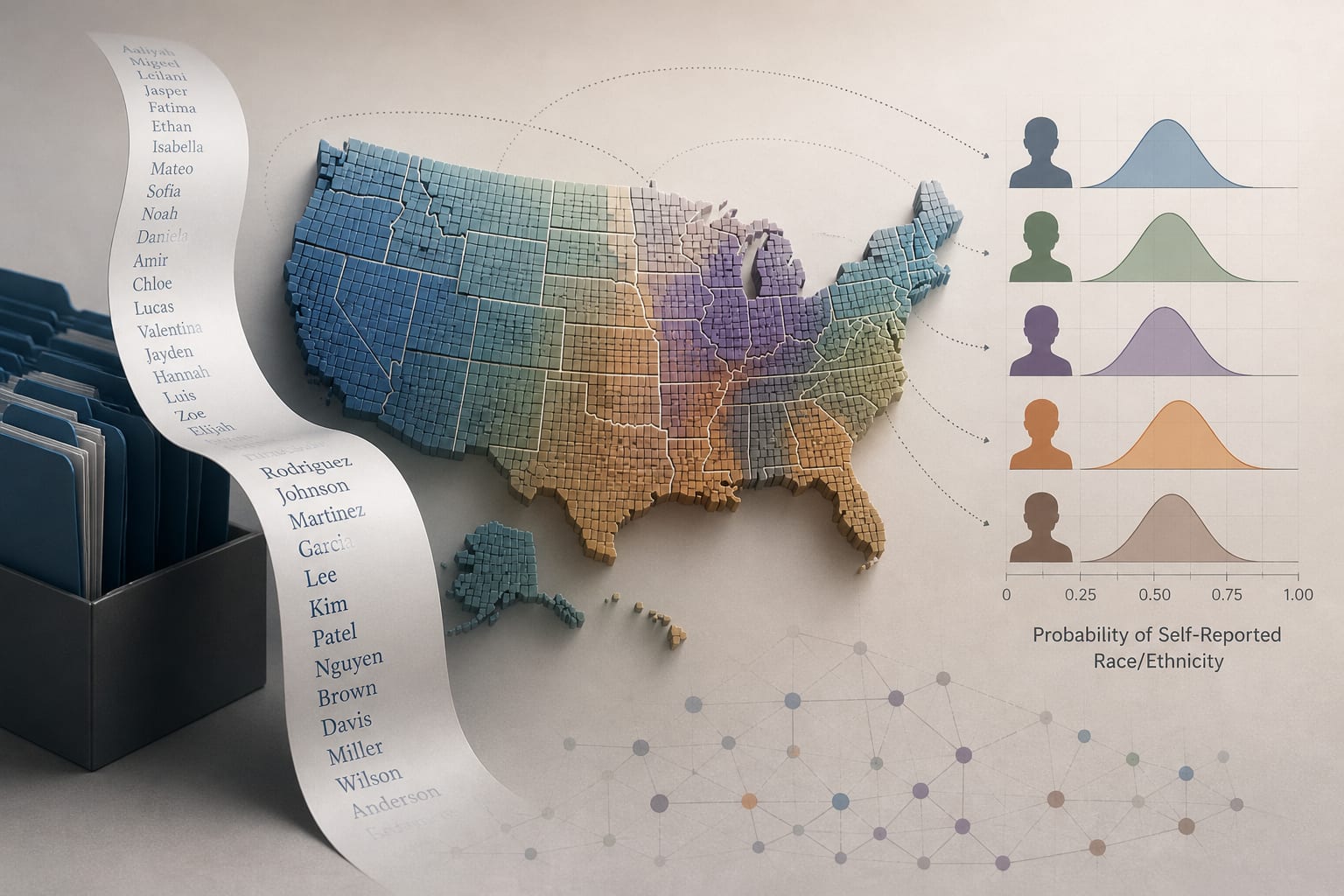
Clinical Scorecard: Improving Race and Ethnicity Imputation With Updated Census First- and Last-Name Data
At a Glance
Category
Detail
Condition
Clinical topic addressed by the source article: Improving Race and Ethnicity Imputation With Updated Census First- and Last-Name Data
Key Mechanisms
Mechanisms or clinical associations described in the source article.
Target Population
BCBSMA members enrolled in commercial or Medicare plans during 2025 who had survey-reported race and ethnicity in one of the four analyzed groups: Asian American and Pacific Islander, Black, Hispanic, or White.
Care Setting
Care setting described in the source article.
Key Highlights
The cross-sectional analysis included 771,215 insured survey respondents; the four analyzed groups represented 96.0% of self-reporters.
mBIFSG 2.0 updated first-name and surname inputs with 2020 Census data; the 2020 Census block-group component was unchanged from mBIFSG 1.0.
Compared with mBIFSG 1.0, C-statistics increased by 0.9 to 1.8 points across the four analyzed groups.
Improvements were generally greater among female than male respondents, although C-statistics remained somewhat higher for male respondents in three groups.
The authors state that mBIFSG probabilities are intended for population-level assessment, not for determining an individual’s race or ethnicity.
Guideline-Based Recommendations
Diagnosis
Management
The study compared mBIFSG 2.0 with mBIFSG 1.0 against survey-reported race and ethnicity; the supplied excerpt notes potential use of more accurate imputation for quality measurement and intervention targeting.
Monitoring & Follow-up
Risks
Patient & Prescribing Data
The analytic cohort comprised 771,215 BCBSMA commercial or Medicare members enrolled in 2025 who had survey-reported race and ethnicity in one of four analyzed groups.
Not applicable; this study evaluated an imputation method rather than a treatment. mBIFSG 2.0 showed higher concordance with self-report than mBIFSG 1.0 across all four analyzed groups.