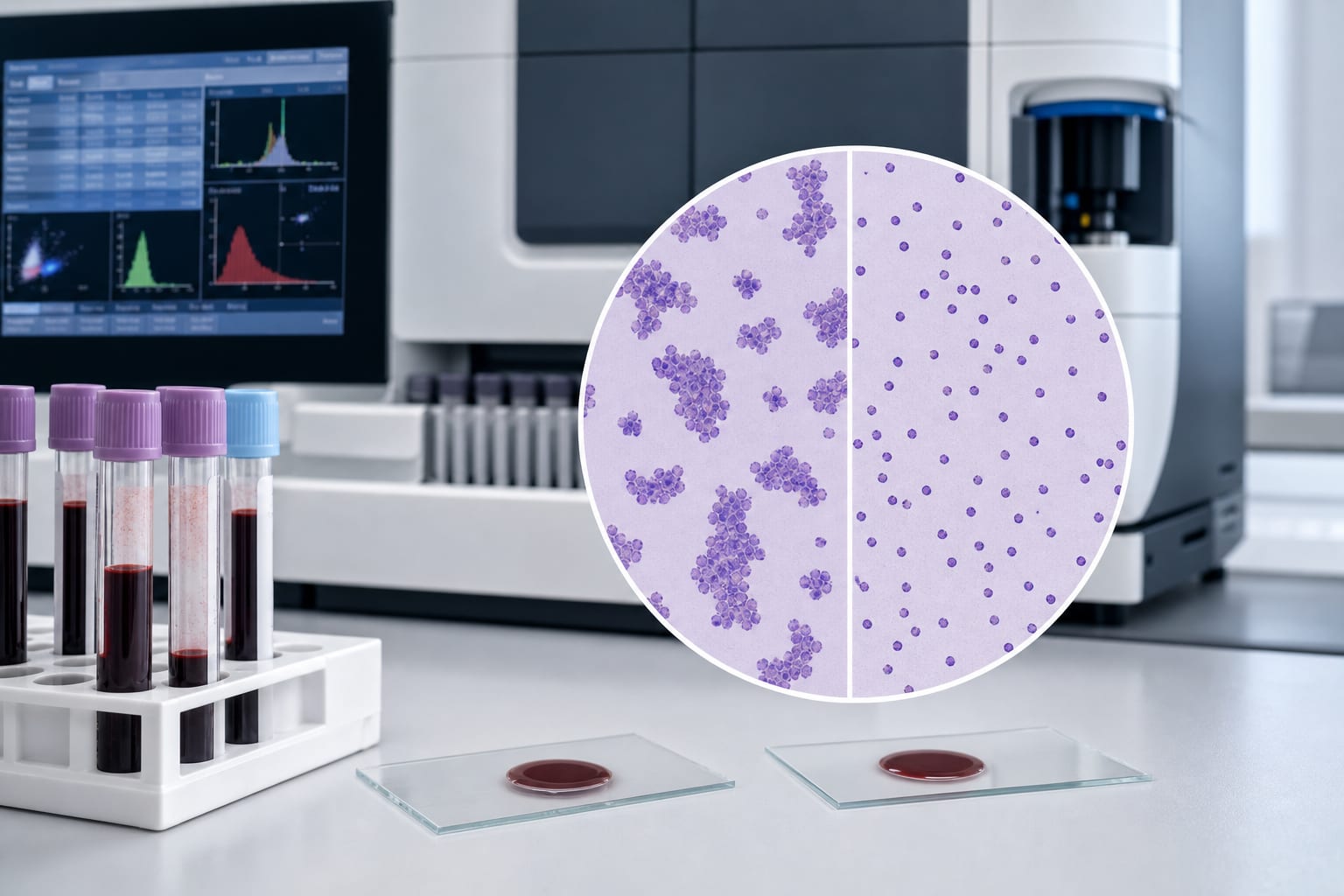
Evaluation of pre-dilution combined with optical/fluorescent platelet counting for correcting pseudothrombocytopenia
-
By
-
Lin Xiong
-
Xingguo Pan
-
Mengyun Peng
-
Tianwen Gan
-
Chengmin Deng
-
He Zha
-
Ya Wang
-
July 10, 2026
-
Clinical Scorecard: Assessment of Pre-Dilution Techniques Combined with Optical and Fluorescent Platelet Counting to Address Pseudothrombocytopenia
At a Glance
| Category | Detail |
|---|
| Condition | Pseudothrombocytopenia (PTCP) |
| Key Mechanisms | Platelet aggregation or agglutination due to anticoagulant use or immune-mediated factors. |
| Target Population | Patients with suspected pseudothrombocytopenia. |
| Care Setting | Clinical laboratory settings. |
Key Highlights
- 1:7 pre-dilution with PLT-O/PLT-F significantly improves accuracy in platelet counting.
- Pre-dilution eliminates bias and enhances anti-interference efficacy.
- Conventional methods showed significant negative bias compared to pre-diluted modes.
- Correlation and agreement between pre-diluted methods and manual counting were strong.
- Study suggests a pilot solution for laboratory management of PTCP.
Guideline-Based Recommendations
Diagnosis
- Confirm pseudothrombocytopenia through microscopic examination of peripheral blood smears.
Management
- Utilize 1:7 pre-dilution with optical/fluorescent platelet counting to correct PTCP.
Monitoring & Follow-up
- Assess recovery rate and mean bias rate to ensure accuracy of platelet counts.
Risks
- Misdiagnosis and unnecessary interventions may occur if PTCP is not identified.
Patient & Prescribing Data
Patients with EDTA-dependent pseudothrombocytopenia.
Pre-dilution techniques can reduce the risk of diagnostic errors and unnecessary repeat testing.
Clinical Best Practices
- Implement optical/fluorescent platelet counting methods in conjunction with pre-dilution.
- Regularly validate the accuracy of platelet counting methods in clinical laboratories.
Related Resources & Content