Clinical Scorecard: Patterns of Prostate-Specific Antigen Screening and Incidence of Metastatic Prostate Cancer Among US Veterans
At a Glance
Category
Detail
Condition
Prostate Cancer Screening
Key Mechanisms
Prostate-specific antigen (PSA) testing and its association with metastatic prostate cancer incidence.
Target Population
US Veterans, particularly those at higher risk for prostate cancer.
Care Setting
Veterans Administration health care system
Key Highlights
PSA screening recommendations have evolved from routine screening to shared decision-making for men aged 55 to 69 years.
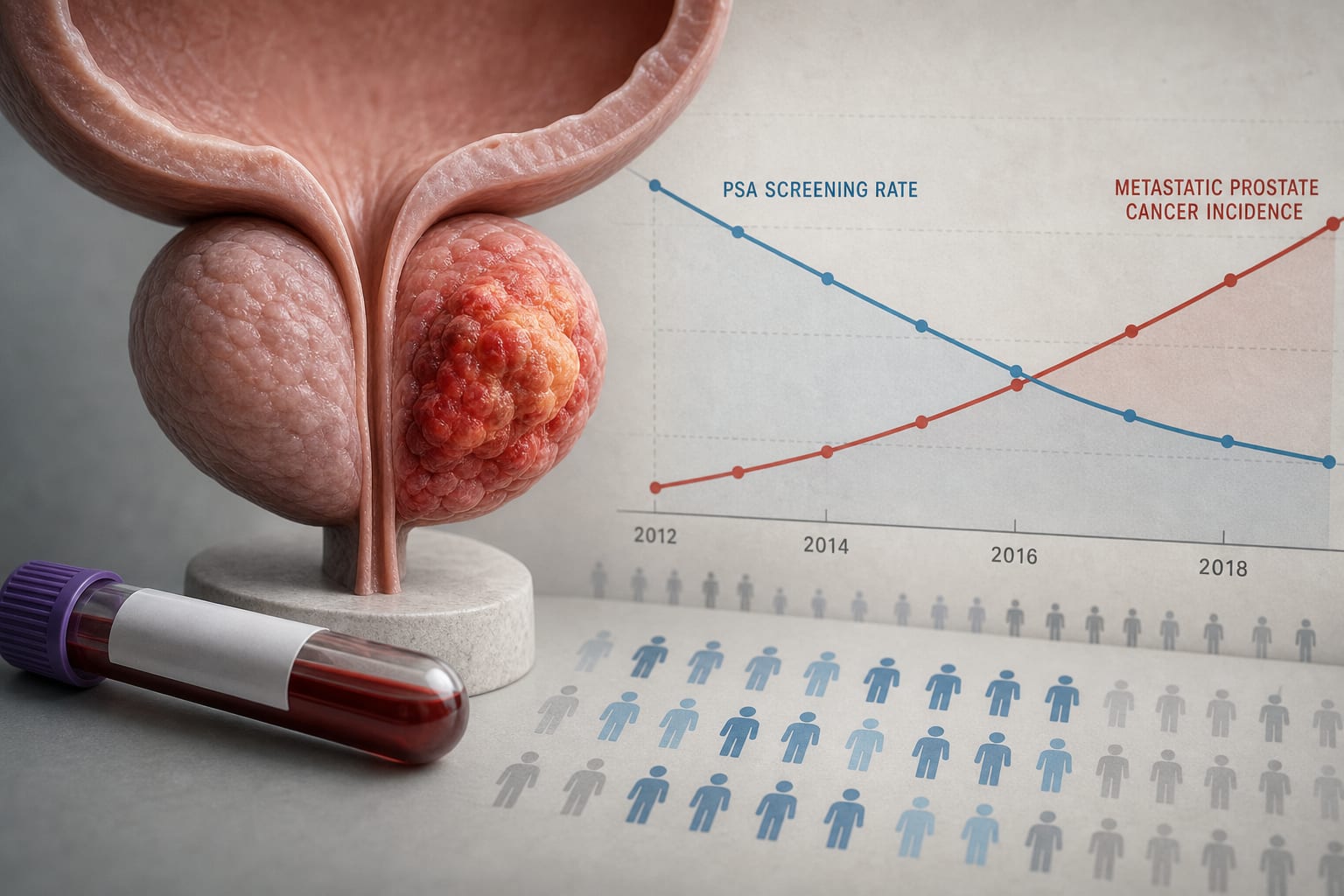
A decline in PSA testing from 2012 to 2018 coincided with an increase in metastatic prostate cancer incidence.
Guidelines recommend baseline PSA testing starting at age 45-50 for average-risk men and 40-45 for high-risk men.
Screening intervals of 2-4 years for average-risk and 1-2 years for high-risk men are advised.
Variability in screening practices exists among patients, clinicians, and facilities.
Guideline-Based Recommendations
Diagnosis
Metastatic prostate cancer is diagnosed based on International Statistical Classification of Diseases and Related Health Problems, Tenth Revision (ICD-10) codes.
Management
Follow current USPSTF guidelines encouraging shared decision-making for men aged 55 to 69 years.
Monitoring & Follow-up
PSA testing intervals should be every 2-4 years for average-risk men and 1-2 years for high-risk men.
Risks
Lower PSA thresholds may increase overdiagnosis without reducing prostate cancer-specific mortality.
Patient & Prescribing Data
Men with at least 2 VA visits and no prior prostate cancer diagnosis.
Understanding PSA screening factors can inform optimized screening recommendations.
Clinical Best Practices
Adhere to NCCN and AUA guidelines for prostate cancer early detection.
Consider individual patient characteristics when determining screening intervals and thresholds.
by Mehrnaz Siavoshi, Stephen Frochen, Mary Fakunle, Ananta Wadhwa, Ashley-Marie Y. Green-Lott, Anissa V. Bailey, Lorna Kwan, Candace Haroldsen, Atim Effiong, Brent S. Rose, Timothy R. Rebbeck, Hari S. Iyer, Isla P. Garraway